

Tokyo Nihonto
Antique Japanaese Katana Sword signed Omi no Kami Fujiwara Tsuguhiro Katana - NBTHK Hozon
Antique Japanaese Katana Sword signed Omi no Kami Fujiwara Tsuguhiro Katana - NBTHK Hozon
Impossibile caricare la disponibilità di ritiro
Save 3% with bank transfer payment, no transaction fees. Contact us here.
USA SHIPPING ⚠️ From 9 oct. 2025
USA SHIPPING ⚠️ From 9 oct. 2025
Order, Japan Post (EMS) has temporarily suspended all commercial deliveries to the United States.
As a result, we are now shipping through alternative private carriers. Unfortunately, these services are considerably more expensive. Therefore, we kindly ask our U.S. customers to contribute a portion of the shipping cost — $200 per order.
Please note that delivery times will also be longer, as we must obtain a custom shipping quote from the carrier for each sword. We currently estimate a 3–4 month delivery window.
We sincerely appreciate your patience, understanding, and continued support during this time.
- Signature (Mei): 近江守藤原継広 Omi no Kami Fujiwara Tsuguhiro
- Swordsmith: Tsuguhiro (Apprentice of 3rd Gen Yasutsugu)
- School / Tradition: Echizen Shimosaka School (Mino-den roots)
- Period / Province: Early Edo Period (Kanbun era, 1661-1673) / Echizen & Edo
- Certificate: NBTHK Hozon (保存刀剣)
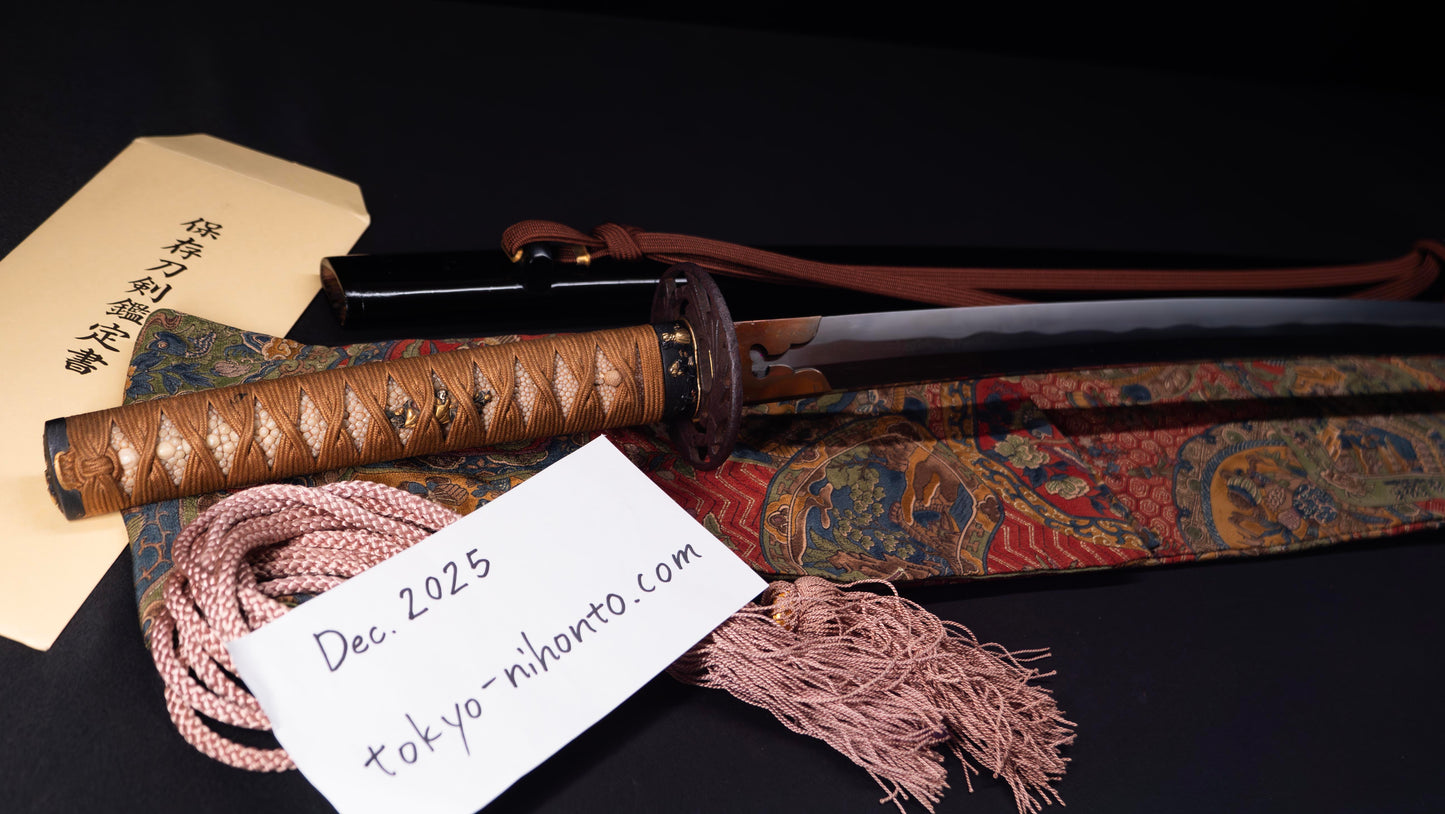
- Mounting: High-quality "Inaho" (Harvest) themed Koshirae
- Blade Length (Nagasa): 65.0 cm
- Curvature (Sori): 1.2 cm
- Mekugi-ana: 2
- Shape: Shinogi-zukuri with a shallow Kanbun-style curvature
- Jihada: Tight Itame with Mino-influenced Shirake-utsuri
- Hamon: Vibrant Gunome-midare with bright Nioikuchi
This refined Katana is a certified NBTHK Hozon work by the esteemed smith Omi no Kami Fujiwara Tsuguhiro. Measuring 65.0 cm with a 1.2 cm sori, the blade exhibits the characteristic "Kanbun Shinto" silhouette—a shape favored by the samurai of the early Edo period for its balanced handling and functional efficiency. The tang is remarkably preserved with two mekugi-ana and a clear, dual-sided signature: the front bearing his prestigious title and name, while the reverse indicates his residence in Echizen under the Shimosaka school name.
The blade's aesthetics are rooted in the Mino-den tradition, featuring a dense and well-forged itame grain. The hamon is a masterful gunome-midare, showing the bright, cloud-like nioikuchi that was a hallmark of the Shimosaka smiths who served the highest levels of the Tokugawa Shogunate.
Koshirae Details
The sword is adorned with a thematic koshirae celebrating Inaho (the rice harvest), a symbol of wealth and divine protection in Japanese culture. The tsuba is a masterful iron sukashi (openwork) piece depicting sheaves of ripening rice. This motif is elegantly continued in the menuki and fuchi-kashira, which feature high-relief carvings of farmers and scenes of abundance. The saya is finished in a deep, lustrous black lacquer, providing a sober yet high-status aesthetic that complements the golden silk tsuka-ito.
Swordsmith Background
Omi no Kami Tsuguhiro was a prominent figure within the Echizen Shimosaka school during the mid-17th century. As a direct apprentice to the third-generation Yasutsugu, Tsuguhiro inherited the elite technical secrets of the Okakaekaji (the official smiths to the Shogun). While primarily based in Echizen, historical records show that his skill was so highly regarded that he was also active in the capital city of Edo. His work is celebrated for bridging the gap between the rugged practicality of Sengoku-era blades and the refined artistry of the peaceful Edo period.
School History
The Echizen Shimosaka School rose to national fame under the patronage of the Tokugawa clan. Founded by the first-generation Yasutsugu—who was granted the use of the "Aoi" (Holly Oak) crest and the character "Yasu" by Tokugawa Ieyasu—the school became synonymous with the "Shinto" (New Sword) era. Blades from this lineage were world-renowned for their razor-sharpness and functional resilience, drawing heavily from the Mino-den style. This katana stands as a testament to that legacy, representing the peak of craftsmanship in the Hokuriku region under the service of the Matsudaira and Tokugawa families.


Contenuto comprimibile
Pagamento
Puoi pagare con carta di credito o bonifico bancario. Se desideri utilizzare il bonifico bancario, contattaci utilizzando il modulo sottostante con il nome della spada che intendi acquistare.
Dogane e tasse
・I dazi doganali, le tasse e le spese non sono inclusi nel prezzo dell'articolo o nelle spese di spedizione. Queste spese sono a carico dell'acquirente.
・Si prega di verificare con l'ufficio doganale del proprio paese per determinare quali saranno questi costi aggiuntivi prima dell'offerta/acquisto.
・Queste spese vengono normalmente riscosse dalla società di spedizione (spedizione) o al momento del ritiro dell'articolo: non confonderle con spese di spedizione aggiuntive.
Spedizione e Reso
- Le spade vengono spedite da Tokyo, in Giappone . Gestiamo tutte le procedure per esportare la spada.
- Non puoi restituire la spada al Giappone perché le procedure sono troppo rigide.
- Lavoriamo con una compagnia di spedizioni che ha esperienza con Nihonto, quindi non devi preoccuparti.
- Si prega di controllare le regole del proprio paese prima di importare la spada. Non ci assumiamo alcuna responsabilità, incluso (non limitato a) il rimborso, a causa dei motivi di cui sopra.
Procedura di esportazione (la gestiamo noi)
・Tutte le nostre spade sono registrate presso l'Agenzia per gli affari culturali come opere d'arte e The Board of Education (Comitato per la protezione dei beni culturali); pertanto ogni spada ha la scheda di registrazione, rilasciata dal Board of Education.
・ Dopo aver ricevuto il pagamento completo degli articoli, restituiamo la scheda di registrazione e otteniamo il permesso dal Ministero degli Affari Culturali per esportare legalmente le spade dal Giappone. Ci vorranno circa 20 giorni lavorativi per eseguire questa procedura.
・ Dopo aver ricevuto l'autorizzazione, ti informeremo via e-mail e invieremo immediatamente gli articoli.