


Tokyo Nihonto
Antique Japanese Katana Sword by Takada Munekage - Late Muromachi - Double HOZON
Antique Japanese Katana Sword by Takada Munekage - Late Muromachi - Double HOZON
Impossibile caricare la disponibilità di ritiro
Save 3% with bank transfer payment, no transaction fees. Contact us here.
USA SHIPPING ⚠️ From 9 oct. 2025
USA SHIPPING ⚠️ From 9 oct. 2025
Order, Japan Post (EMS) has temporarily suspended all commercial deliveries to the United States.
As a result, we are now shipping through alternative private carriers. Unfortunately, these services are considerably more expensive. Therefore, we kindly ask our U.S. customers to contribute a portion of the shipping cost — $200 per order.
Please note that delivery times will also be longer, as we must obtain a custom shipping quote from the carrier for each sword. We currently estimate a 3–4 month delivery window.
We sincerely appreciate your patience, understanding, and continued support during this time.
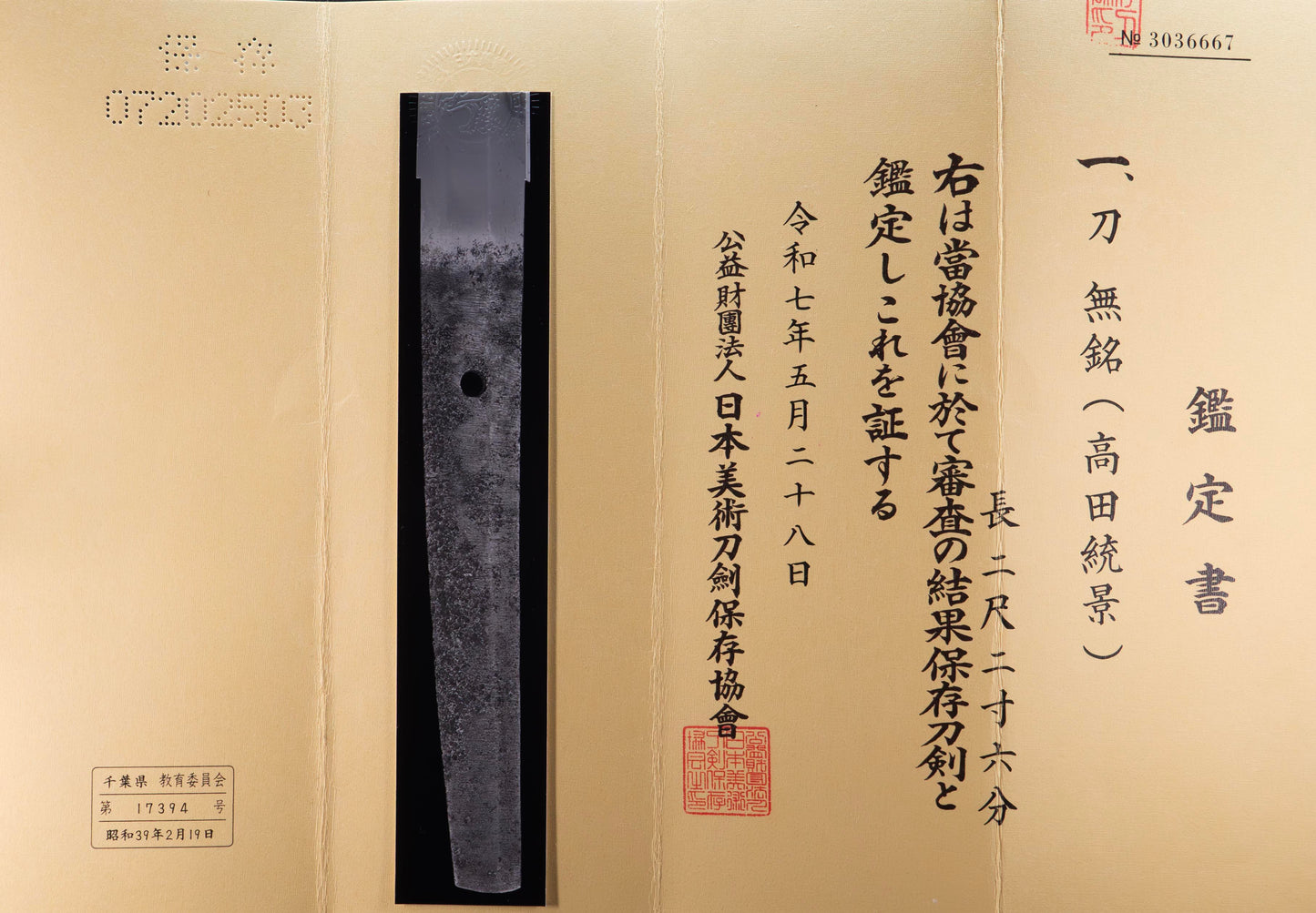
- Signature (Mei): Mumei — attributed to Takada Munekage (豊後高田統景)
- Period / Province: Tenshō era (1573–1592, Late Muromachi period) — Bungo Province (modern Ōita)
- School: Taira Takada (高田) School — Kyūshū tradition
- Certification: NBTHK Hozon Token (日本美術刀剣保存協会 保存刀剣)
- Blade Length (Nagasa): 68.6 cm
- Curvature (Sori): 1.8 cm
- Mekugi-ana: 1
- Shape: Shinogi-zukuri with balanced proportions for battlefield use
- Hamon: Suguha with soft notare undulation, bright nioi-guchi
- Jihada: Refined ko-itame hada, tight grain with subtle surface activity
- Kissaki: Chū-kissaki (medium point)
- Polish: Traditional Japanese polish revealing controlled hamon and jihada
- Mounting (Koshirae): Edo-period koshirae — black lacquer saya, iron sukashi tsuba with landscape motif and gold nunome, carved iron fuchi-kashira, black lacquered ito over samegawa
This NBTHK Hozon-class katana is attributed to Takada Munekage (豊後高田統景), one of the hallmark smiths of the Taira Takada school in Bungo Province. Forged in the Tenshō era (1573–1592), a time of intense warfare during the late Muromachi period, this sword represents the height of Kyūshū sword craftsmanship.
The Takada school originated in the Nanbokuchō period under its founder, Takada Tomoyuki, who trained in the esteemed Bizen tradition. Returning to Bungo, he established a lineage that blended Bizen elegance with the durability demanded by Kyūshū warfare. By the Sengoku era, Takada smiths—known collectively as Taira Takada—were producing large quantities of swords for samurai across the island.
Munekage is recorded as having served retainers of the powerful Ōtomo clan, whose domain dominated Kyūshū’s political and military landscape. With access to rich iron sand deposits from Mount Sobo Katamuki, Takada smiths forged blades widely respected for reliability, resilience, and cutting performance.
The blade displays a dignified suguha hamon with gentle notare undulation—an unmistakable trademark of the Takada style. The bright nioi-guchi testifies to refined heat-treating skill, while the ko-itame jihada reveals a tightly forged grain reminiscent of Bizen influences. The balanced shinogi-zukuri geometry and graceful tori-zori curvature reflect the functional elegance of Sengoku-period battlefield swords.
Its Edo-period koshirae is exceptionally characterful. The iron tsuba is decorated with a scenic landscape—pagoda, mountains, and flowing water—accented with gold nunome. The matching fuchi-kashira are deeply carved with botanical motifs, and the black lacquered ito over samegawa tsuka creates a powerful aesthetic presence. The saya is finished in a rich black lacquer and paired with a traditional green sageo.
A fully authenticated Hozon Token, this sword is recognized by the NBTHK as a culturally significant work. With its historic provenance, elegant Edo-period mountings, and exemplary late-Muromachi craftsmanship, this katana stands as an outstanding example of the Taira Takada school—a blade forged for real samurai, preserved with dignity, and rich with the spirit of Japan’s warrior history.
Tsuba
This antique Aizu Shoami tsuba features a refined tower-and-landscape motif with subtle gold nunome highlights. Certified by the NBTHK in 1974 as Kichō Kodōgu it is officially recognized as a valuable fitting of historical importance. The iron plate shows soft Edo-period patination, while the flowing scenery—mountains, water, and architectural elements—reflects the artistic sophistication for which the Aizu school is renowned. A tasteful and collectible tsuba, ideal for display or as part of an original koshirae.


Contenuto comprimibile
Pagamento
Puoi pagare con carta di credito o bonifico bancario. Se desideri utilizzare il bonifico bancario, contattaci utilizzando il modulo sottostante con il nome della spada che intendi acquistare.
Dogane e tasse
・I dazi doganali, le tasse e le spese non sono inclusi nel prezzo dell'articolo o nelle spese di spedizione. Queste spese sono a carico dell'acquirente.
・Si prega di verificare con l'ufficio doganale del proprio paese per determinare quali saranno questi costi aggiuntivi prima dell'offerta/acquisto.
・Queste spese vengono normalmente riscosse dalla società di spedizione (spedizione) o al momento del ritiro dell'articolo: non confonderle con spese di spedizione aggiuntive.
Spedizione e Reso
- Le spade vengono spedite da Tokyo, in Giappone . Gestiamo tutte le procedure per esportare la spada.
- Non puoi restituire la spada al Giappone perché le procedure sono troppo rigide.
- Lavoriamo con una compagnia di spedizioni che ha esperienza con Nihonto, quindi non devi preoccuparti.
- Si prega di controllare le regole del proprio paese prima di importare la spada. Non ci assumiamo alcuna responsabilità, incluso (non limitato a) il rimborso, a causa dei motivi di cui sopra.
Procedura di esportazione (la gestiamo noi)
・Tutte le nostre spade sono registrate presso l'Agenzia per gli affari culturali come opere d'arte e The Board of Education (Comitato per la protezione dei beni culturali); pertanto ogni spada ha la scheda di registrazione, rilasciata dal Board of Education.
・ Dopo aver ricevuto il pagamento completo degli articoli, restituiamo la scheda di registrazione e otteniamo il permesso dal Ministero degli Affari Culturali per esportare legalmente le spade dal Giappone. Ci vorranno circa 20 giorni lavorativi per eseguire questa procedura.
・ Dopo aver ricevuto l'autorizzazione, ti informeremo via e-mail e invieremo immediatamente gli articoli.