


Tokyo Nihonto
Antique Japanese Katana Sword signed Osafune Sukesada, Late Muromachi - NBTHK Hozon
Antique Japanese Katana Sword signed Osafune Sukesada, Late Muromachi - NBTHK Hozon
Impossibile caricare la disponibilità di ritiro
Save 3% with bank transfer payment, no transaction fees. Contact us here.
USA SHIPPING ⚠️ From 9 oct. 2025
USA SHIPPING ⚠️ From 9 oct. 2025
Order, Japan Post (EMS) has temporarily suspended all commercial deliveries to the United States.
As a result, we are now shipping through alternative private carriers. Unfortunately, these services are considerably more expensive. Therefore, we kindly ask our U.S. customers to contribute a portion of the shipping cost — $200 per order.
Please note that delivery times will also be longer, as we must obtain a custom shipping quote from the carrier for each sword. We currently estimate a 3–4 month delivery window.
We sincerely appreciate your patience, understanding, and continued support during this time.
- Signature (Mei): 備州長船祐定 Bishū Osafune Sukesada
- Swordsmith: Sukesada (Osafune School)
- School / Tradition: Bizen Osafune School (Bizen-den tradition)
- Period / Province: Late Muromachi Period (Late 1400s - Early 1500s) / Bizen Province
- Certificate: NBTHK Hozon (保存刀剣) - Blade worthy of preservation
- Mounting: Period koshirae with family mon (crest) inlay
- Blade Length (Nagasa): 65.15 cm (2 shaku 1 sun 5 bu)
- Curvature (Sori): 2.4 cm (8 bu) - pronounced Muromachi-period curve
- Mekugi-ana: 2
- Shape: Shinogi-zukuri with deep Sengoku-era battlefield curvature
- Jihada: Classic Bizen Mokume-itame with potential Utsuri
- Hamon: Notare with Gunome elements - classic mid-Muromachi Bizen style with prominent Nie
This historic Katana is a certified NBTHK Hozon work by the legendary Bishū Osafune Sukesada, one of the most prolific and respected smithing lineages in Japanese sword history. Measuring 65.15 cm with a substantial 2.4 cm sori, this blade exemplifies the quintessential late Muromachi battlefield sword—forged during the tumultuous Sengoku period when practical cutting performance was paramount. The pronounced curvature was specifically designed for mounted cavalry combat and the dynamic fighting styles that defined this era of constant warfare.
The blade bears the unmistakable characteristics of Bizen Osafune workmanship, featuring the school's signature approach to steel forging and heat treatment. The hamon displays an elegant notare (undulating wave) pattern with distinctive gunome (clove-shaped) peaks—a refined tempering style that represents the artistic maturity of mid-Muromachi Sukesada work. The bright, active nie (crystalline martensitic structures) dancing along the habuchi (boundary line) demonstrate the master-level control of traditional Bizen water-quenching techniques. This hamon style balances battlefield functionality with aesthetic sophistication, showing that even during wartime production, skilled Sukesada smiths maintained their artistic standards. The tang retains period-appropriate yasurime (file marks) and clearly carved mei, authenticated by Japan's premier sword preservation organization.
The boshi (tempering pattern in the kissaki/point) shows proper turnback with controlled activity, while the overall hamon exhibits the gentle rhythmic undulation characteristic of accomplished mid-period Sukesada work. The visible nie particles create a bright, lively appearance along the entire cutting edge—a hallmark of properly executed traditional Japanese differential hardening.
This sword represents an authentic piece of samurai history—a weapon that was forged during one of Japan's most violent and transformative periods, when master swordsmiths like Sukesada supplied countless blades to the warring clans that shaped Japan's destiny.
Koshirae Details
The sword retains its period koshirae (mountings), showing honest age and historical use. The tsuba is a remarkable shakudō masterwork featuring intricate karakusa (arabesque scrollwork) decoration with gilt highlights on a nanako-ji (stippled) ground. The sophisticated openwork design and precious metal embellishment indicate this was commissioned for a samurai of considerable status—not a common soldier's weapon.
Most significantly, the saya (scabbard) features an inlaid family mon (crest) in what appears to be mother-of-pearl or similar material. This triangular design indicates specific clan or family ownership, transforming this from an anonymous antique into a sword with traceable samurai lineage. The black urushi lacquer finish, while showing age-appropriate wear and patina, retains the dignified aesthetic befitting its original owner's station.
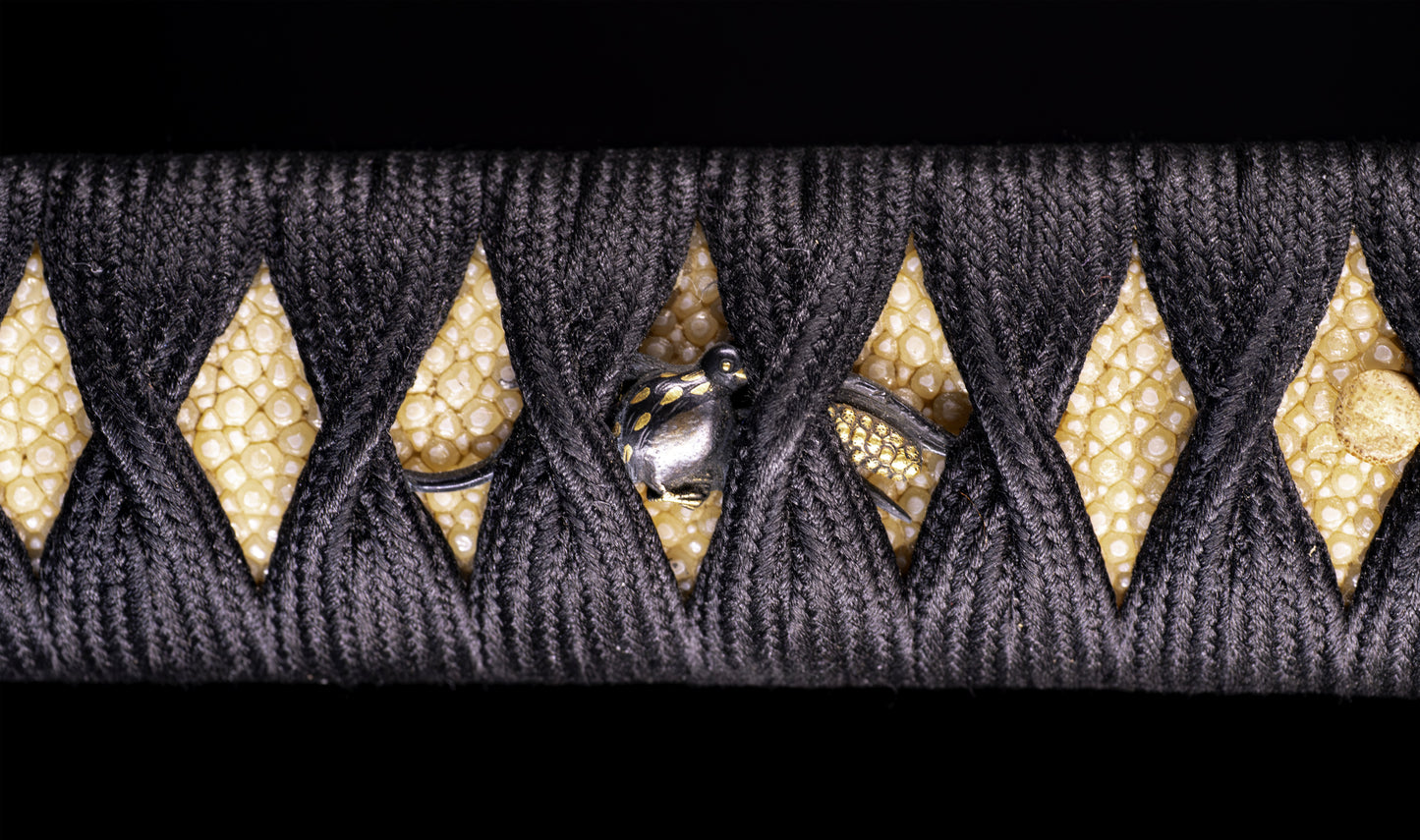
The tsuka (handle) maintains its traditional black leather wrapping in the classic hishimaki diamond pattern, with original menuki ornaments still in place. The overall presentation speaks to centuries of careful stewardship by collectors who recognized this sword's historical and artistic significance.
Swordsmith Background
Osafune Sukesada (長船祐定) represents one of the most enduring smithing lineages in Japanese sword history, with multiple generations bearing this name from the mid-Muromachi period through the late 1500s. Working in Bizen Province (modern-day Okayama Prefecture)—the heartland of Japanese sword production—the Sukesada line produced thousands of blades during the Sengoku period's unprecedented demand for quality weapons.
The Sukesada smiths were known for maintaining the classical Bizen tradition even as warfare demanded increased production. Their blades balanced battlefield practicality with the refined aesthetic sensibilities that had made Bizen the premier sword-producing region for centuries. While some Sukesada works show hurried construction due to wartime demand, many—like this Hozon-certified example—demonstrate the masterful technique that earned the name international recognition.
Sukesada blades were carried by samurai across Japan during the pivotal battles of unification, making them tangible links to the dramatic events that forged modern Japan under Oda Nobunaga, Toyotomi Hideyoshi, and ultimately Tokugawa Ieyasu.
School History: Bizen Osafune Tradition
The Osafune School in Bizen Province stood as the undisputed center of Japanese sword production for over 500 years. From the Kamakura period through the Muromachi era, the village of Osafune was home to hundreds of smiths who supplied the samurai class with the finest blades in Japan. Names like Nagamitsu, Kanemitsu, Kiyomitsu, and Sukesada became synonymous with cutting excellence and refined artistry.
The Bizen-den (Bizen tradition) forging style emphasized a distinctive approach to steel folding, producing the characteristic mokume-itame grain pattern and often featuring utsuri—a mysterious reflection effect in the ji that remains one of Japanese metallurgy's most captivating achievements. The school's tempering method created dynamic hamon patterns that ranged from elegant notare undulations to more active gunome-midare, always featuring the bright, crystalline nie that became synonymous with Bizen excellence. This combination of refined aesthetics with superior edge geometry made Bizen blades the gold standard for Japanese swords.
By the Sengoku period, when this blade was forged, Osafune smiths were working at maximum capacity to meet wartime demand. Despite producing thousands of swords annually, master smiths like Sukesada maintained quality standards that continue to earn NBTHK recognition five centuries later. The Osafune tradition represents the pinnacle of the Japanese swordsmith's art—a perfect synthesis of metallurgical science, aesthetic philosophy, and practical weapon design.
This katana stands as an authentic testament to that legendary tradition, certified by modern experts and bearing the unmistakable characteristics that made Bizen blades the most sought-after weapons in feudal Japan.
Condition & Restoration Opportunity
Current Condition: Despite surface oxidation, this blade already reveals its quality—the hamon is clearly visible with its elegant notare pattern and bright nie activity, even through the degraded polish. The koshirae exhibits period-appropriate wear with some lacquer deterioration on the saya. This visibility of the tempering pattern despite the condition speaks to the strength and quality of the original heat treatment.


Contenuto comprimibile
Pagamento
Puoi pagare con carta di credito o bonifico bancario. Se desideri utilizzare il bonifico bancario, contattaci utilizzando il modulo sottostante con il nome della spada che intendi acquistare.
Dogane e tasse
・I dazi doganali, le tasse e le spese non sono inclusi nel prezzo dell'articolo o nelle spese di spedizione. Queste spese sono a carico dell'acquirente.
・Si prega di verificare con l'ufficio doganale del proprio paese per determinare quali saranno questi costi aggiuntivi prima dell'offerta/acquisto.
・Queste spese vengono normalmente riscosse dalla società di spedizione (spedizione) o al momento del ritiro dell'articolo: non confonderle con spese di spedizione aggiuntive.
Spedizione e Reso
- Le spade vengono spedite da Tokyo, in Giappone . Gestiamo tutte le procedure per esportare la spada.
- Non puoi restituire la spada al Giappone perché le procedure sono troppo rigide.
- Lavoriamo con una compagnia di spedizioni che ha esperienza con Nihonto, quindi non devi preoccuparti.
- Si prega di controllare le regole del proprio paese prima di importare la spada. Non ci assumiamo alcuna responsabilità, incluso (non limitato a) il rimborso, a causa dei motivi di cui sopra.
Procedura di esportazione (la gestiamo noi)
・Tutte le nostre spade sono registrate presso l'Agenzia per gli affari culturali come opere d'arte e The Board of Education (Comitato per la protezione dei beni culturali); pertanto ogni spada ha la scheda di registrazione, rilasciata dal Board of Education.
・ Dopo aver ricevuto il pagamento completo degli articoli, restituiamo la scheda di registrazione e otteniamo il permesso dal Ministero degli Affari Culturali per esportare legalmente le spade dal Giappone. Ci vorranno circa 20 giorni lavorativi per eseguire questa procedura.
・ Dopo aver ricevuto l'autorizzazione, ti informeremo via e-mail e invieremo immediatamente gli articoli.