

Tokyo Nihonto
Antique Japanese Katana Sword by Tanba-no-kami Terukado with Gold Lacquer Saya, Iron Mokkō Tsuba and Notare Hamon - NBTHK Hozon
Antique Japanese Katana Sword by Tanba-no-kami Terukado with Gold Lacquer Saya, Iron Mokkō Tsuba and Notare Hamon - NBTHK Hozon
Couldn't load pickup availability
- Signature (Mei): Mumei (unsigned) — attributed by the NBTHK to 丹波守照門 Tanba-no-kami Terukado
- Swordsmith: Tanba-no-kami Fujiwara Terukado — leading Seki smith of the early Edo period
- School / Tradition: Zenjō lineage, Seki — Mino-den tradition
- Period / Province: Edo period, Shintō — Mino Province (Seki, modern Gifu Prefecture)
- Certificate: NBTHK Hozon Tōken (保存刀剣) No. 3036709 — issued 28 May Reiwa 7 (2025)
- Japanese Registration (Tōroku-shō): Hyōgo Prefecture No. 6063 — originally issued 12 December Shōwa 26 (1951)
- Mounting: Complete katana koshirae — gold-speckled lacquer saya with same panel, cloisonné enamel fuchi-kashira, iron mokkō tsuba
- Blade Length (Nagasa): 70.9 cm (2 shaku 3 sun 4 bu)
- Curvature (Sori): approx. 1.2 cm (4 bu) — shallow Kanbun-shintō curvature
- Mekugi-ana: 2
- Shape (Sugata): Shinogi-zukuri, iori-mune, chū-kissaki
- Hamon: Notare with gunome mixed in, nioi-deki with a soft, luminous nioiguchi
- Boshi: Notare-komi with a rounded turnback
An NBTHK Hozon-certified katana attributed to Tanba-no-kami Terukado, one of the outstanding Seki smiths of the early Edo period. The blade measures a full 70.9 cm in nagasa with a shallow sori of roughly 1.2 cm. When the NBTHK names an individual smith on an unsigned blade rather than stopping at a school, it means the workmanship carried enough of that smith's specific character for the panel to identify the hand. In this case the name is unusually precise: Terukado was used by one man across a single generation.
The sugata dates the blade on sight. A 70.9 cm nagasa with barely 1.2 cm of curvature and a compact chū-kissaki is the Kanbun-shintō shape almost exactly — the near-straight, businesslike profile that dominated Japanese swordmaking in the 1660s and 1670s, when the drawing arts had displaced cavalry work and a blade was judged on how fast it came out of the saya and how cleanly it tracked. Terukado received his Tanba-no-kami title in 1659, placing him precisely in that generation.
The hamon is a flowing notare with gunome worked into it, executed in nioi-deki with a soft, luminous nioiguchi that glows rather than glitters. The undulations are broad and unhurried, rising and falling in long intervals along the monouchi and tightening as they approach the yokote. It is a controlled, quietly confident temper — the work of a smith with nothing to prove, supplying men who could tell the difference. The boshi follows the hamon into the kissaki as notare-komi and turns back roundly.
The blade is in good polish, healthy in the ji and readable end to end. The nakago carries two mekugi-ana and an even dark patina consistent with its age and long documented life in Japan.
Koshirae Details
The mounting is the most immediately arresting thing about this sword, and it is a genuinely sophisticated assembly.
The saya is lacquered in a dense gold speckle — a warm ochre field flecked throughout, catching light along the entire curve — with a contrasting panel of black-lacquered same (rayskin) at the koiguchi end, its pebbled texture set against the smooth gold. A heavy black and gold sageo picks up the same two-tone scheme. Very few antique koshirae are built around gold this openly, and fewer still carry it off.
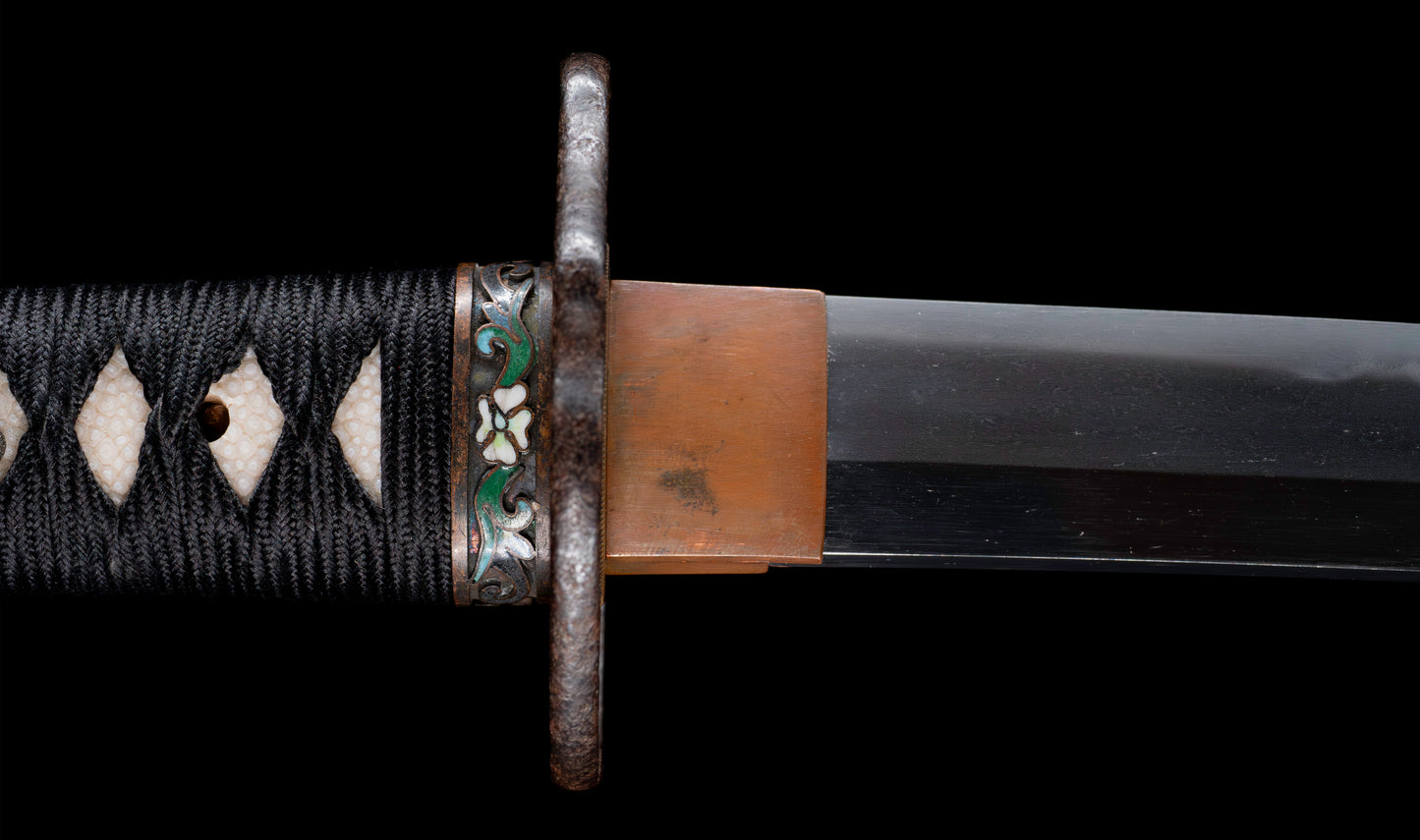
The fuchi and kashira are the pieces to look at closely: a matched pair in cloisonné enamel (shippō), worked in white and pale green blossoms with green and blue foliate scrollwork and coral-red accents on a dark ground, framed in fine metal wire. Enamel fittings of this quality are far scarcer than carved metal ones — the technique is unforgiving, and surviving examples in this condition, with the colours still clean and the wirework intact, are not common on the market.
The tsuba deliberately answers all that colour with silence: an iron plate in mokkō-gata with a single hitsu-ana, its surface a rich pitted texture under a deep brown-black patina, the rim slightly raised. Austere iron against enamel and gold is a classic Japanese pairing, and it is the reason the mounting reads as considered rather than merely rich.
The tsuka is wrapped in black silk ito in hineri-maki over full panels of white same with large, well-defined nodes, and carries gilt menuki modelled as a seated robed figure in the manner of a sage, cap on his head, rendered with real character in the face and drapery. The habaki is a plain single-piece copper alloy collar, undecorated — the correct restraint at the one point where the eye should go straight to the steel.
The Swordsmith: Tanba-no-kami Terukado 丹波守照門
His name was Zenjō Sōemon (善定惣右衛門), also known as Sōkurō. He was not a distant claimant to the Zenjō name — he was born into the house itself, the senior family of Seki, and signed his early work Kanekado (兼門).
When Ujifusa, then head of the Zenjō family, left Seki for Nagoya, Sōemon succeeded him. That succession made him head of the Zenjō house and kaji-gashira — head of the swordsmiths of Seki, the largest swordmaking town in Japan. He held the court title Tanba-daijō, and in 1659 he was raised to Tanba-no-kami, changing his signature to Terukado at that moment. Blades signed Terukado are therefore all from the second half of his career, after he had reached the top of his profession.
He worked for a demanding clientele and travelled to reach it: commissions from high-ranking samurai took him beyond his native Mino to Edo and to Kuwana in Ise. His tangs carry the Zenjō name openly — 於関善定作之 ("made at Seki, Zenjō"), 善定後裔丹波守藤原照門 ("descendant of Zenjō"), 於濃州関以粹鉄治之 ("forged at Seki in Nōshū from refined steel"). A rare surviving daishō by his hand exists, matched and mounted for formal castle attendance, and his work is held in museum collections and papered to Tokubetsu Hozon.
One detail matters more than any other for a collector. Terukado was a single-generation name. He alone used it; after his death the house reverted to the Kanekado signature, which the family has carried down to the present day. An attribution to Terukado does not point at a lineage or a workshop spanning centuries — it points at one identifiable man, working within a window of roughly twenty years, at the head of the Seki smiths. That is an unusually precise thing for the NBTHK to say about an unsigned blade.
Seki and the Zenjō Lineage
Seki, in Mino province, was the largest swordmaking town in Japan, and the Zenjō line ran it.
Mino-den was the youngest of the Gokaden, the five great traditions, and by the Sengoku era it was the most productive. The town's smiths organised themselves into a self-governing guild, the kaji-za, within which the seven strongest workshops formed the Seki Shichiryū — the Seven Schools of Seki. The Zenjō school was its principal house: successive heads of the Zenjō line were the sōryō-ke, the senior family, and served as head of the Seki smiths.
The school was founded by Zenjō Kaneyoshi, born in 1395, son of Kaneyoshi of the Yamato Tegai school. He carried Yamato technique into Mino and produced work of unusual refinement for the province — ko-kissaki, a slightly narrow mihaba, an elegant curve close enough to Awataguchi that the two have been confused, with masame mixed into the jigane and a tight nioi-based hoso-suguha. His blades are regarded as having the most beautiful shape in all of Mino-den.
That is the ancestry Terukado claimed on his tangs, and it is the tradition this katana descends from: a Seki blade from the senior lineage of the largest sword town in Japan, certified by the NBTHK, registered in Hyōgo since 1951, and complete in a mounting of gold lacquer and enamel that has stayed with it.


Collapsible content
Payment
You can pay by Bank card or Bank transfer. If you wish to use bank transfer please contact us using the form bellow with the name of the sword you are willing to buy.
Customs and Taxes
・Import duties, taxes and charges are not included in the item price or shipping charges. These charges are the buyer’s responsibility.
・Please check with your country’s customs office to determine what these additional costs will be prior to bidding/buying.
・These charges are normally collected by the delivering freight (shipping) company or when you pick the item up - do not confuse them for additional shipping charges.
Shipping and Return
- Swords are shipped from Tokyo, Japan. We manage all the procedures to export the sword.
- You can't return sword to Japan because procedures are too strict.
- We work with a shipping company that have experience with Nihonto so you don't have to worry.
- Please check the rules of your country before importing the sword. We do not take any responsibility, including (not limited to) refund, due to the above reasons.
- We can NOT cancel an order once, we already applied for the export authorization. As this document is made to customer name.
We have shipped authentic Japanese swords to the USA, UK, Canada, Mexico, Germany, France, Hong Kong, and Australia. If you don’t live in these countries and like to order, please contact us first before purchasing. We normally ship by EMS (Express Mail Service) provided by Japan Post.
If you live in the UK, please contact us BEFORE order.
Export Procedure (We manage it)
・All our swords are registered in the Agency for Cultural Affairs as artwork and The Board of Education(Cultural properties protection Committee); therefore each sword has the registration card, issued by the Board of Education.
・After receiving the full payment of the items,we return the registration card and get the permission from Ministry of Cultural Affairs to export the swords legally from Japan. It will take about 1 to 3 months for that step.
・After the receiving the permission, we will inform you by email and send the items immediately.
Contact form
What Our Collectors Say
Independent reviews from verified buyers on Trustpilot
Wonderful folks to buy from
“Large selection to choose from. The katana were signed with Hozon and the blades in a shirasaya. My two katana and Kozuka came packed in a solid wooden crate. Great friendly communication.”
Got a beautiful sword delivered to NYC
“Condition is just as pictured. Took a little while to get all the way to the states, but I was very happy with this seller and plan to purchase more from them.”
Order with confidence
“In the end I received what I ordered, well-packaged and in the condition specified.”
Un katana antique magnifique
“J'ai posé beaucoup de questions au support qui a su répondre et m'aider dans mon choix. La commande est arrivée avec le certificat dans un emballage robuste et en parfait état, il est vraiment magnifique !”