


Tokyo Nihonto
Antique Japanese Katana Sword signed Kojima Katsumasa with Iron Landscape Tsuba
Antique Japanese Katana Sword signed Kojima Katsumasa with Iron Landscape Tsuba
Couldn't load pickup availability
- Signature (Mei): 濃州関住小島勝正作 Nōshū Seki-jū Kojima Katsumasa-saku (omote) / Ura: nashi (unsigned reverse)
- Swordsmith: Kojima Katsumasa (Seki, Gifu Prefecture)
- School / Tradition: Nōshū Seki tradition (Mino-den lineage)
- Period / Province: Gendaitō — dated Heisei 22 (April 13, 2010) / Nōshū (Mino Province, modern Gifu Prefecture)
- Mounting: Period-style koshirae — black urushi-lacquered saya, iron sansui-zu maru-gata tsuba with inlay, gilt ryū menuki, dragon-engraved fuchi-kashira
- Blade Length (Nagasa): 66.7 cm
- Curvature (Sori): 1.5 cm
- Mekugi-ana: 1
- Overall Length (with saya): 104.2 cm
- Blade Weight: 737 g
- Motohaba (base width): 3.1 cm
- Sakihaba (tip width): 2.1 cm
- Motokasane (base thickness): 0.7 cm
- Sakikasane (tip thickness): 0.5 cm
- Shape: Shinogi-zukuri, iori-mune, chu-kissaki
This Gendaitō katana by Kojima Katsumasa of Seki, Gifu Prefecture is a fine example of the living Mino tradition — a blade forged in Heisei 22 (2010) by a smith working in one of Japan's most historically significant sword-producing regions. Measuring 66.7 cm in nagasa with a refined 1.5 cm sori, the proportions are classical and well-resolved: a functional, balanced cutting sword with the clean geometry that defines accomplished modern work rooted in the Nōshū tradition.
The blade presents in shinogi-zukuri with iori-mune (ridged back) and a chu-kissaki of controlled, elegant form. Examined along the edge, the hamon runs as a fine, relatively tight pattern along the full length — consistent in its rhythm, well-anchored to the edge, and revealing the active nie characteristic of careful differential hardening. The kissaki carries a clean boshi with a contained turnback, the point finishing with precision. The jihada is tight and well-worked, reflecting the controlled forging technique one expects from a Seki smith trained in traditional methods. The overall condition of the steel is excellent — a recently polished surface presenting the blade at its best.
What sets this katana apart is its nakago (tang): the mei is carved in kinzōgan — gold inlay script — running the full length of the tang face. This technique, in which the smith's signature is inlaid in precious metal rather than simply chiseled into the steel, elevates the nakago from a functional surface to a work of art in itself. A single mekugi-ana is neatly placed. The nakago patina is natural and honest, contrasting beautifully with the gleaming blade above the habaki.
A sword forged by a living master in the tradition of Seki — a city whose swordsmiths supplied Japan's samurai for six centuries — with koshirae of remarkable artistic ambition. This is a piece for the collector who understands that gendaitō at their finest are not lesser than their antique predecessors, but a continuation of an unbroken line.
Koshirae Details
The koshirae assembled for this blade is exceptional — not a generic mounting but a carefully composed ensemble whose artistic program centers on a single theme: the drama of the natural world rendered in iron, gold, and lacquer.
The tsuba is a maru-gata (round) iron plate of substantial weight and presence, worked on both faces in kebori and inlay with a continuous sansui-zu (mountain-water landscape) composition. The obverse presents mountains rendered in low relief above a winding river; small birds in flight — their wings picked out in gold or silver nunome inlay — cross the lower field. The reverse face deepens the narrative: a mikazuki (crescent moon) in silver inlay hangs in the upper field above a pine tree with gold-highlighted foliage; below, a rustic thatched structure sits beside still water and rounded rocks, scattered gold hirazōgan punctuating the ground. The overall effect is a night landscape — moon, pine, shelter, river — rendered with the economy and suggestion of Japanese ink painting transposed into iron. This is tsuba-making as haiku.
The tsuka (handle) is wrapped in rich brown silk braid over white samegawa (ray skin) in the traditional hishimaki diamond pattern. The menuki are the visual centerpiece of the handle: bold, three-dimensional ryū (dragon) figures cast in gilt metal, each rendered with visible scale detail, horns, and coiling form. Four menuki are present — two to each side — creating a handle that feels alive under the hand. The fuchi (collar at the base of the tsuka) shows matching engraved dragon and scrollwork decoration in a darkened metal, tying the ensemble together.
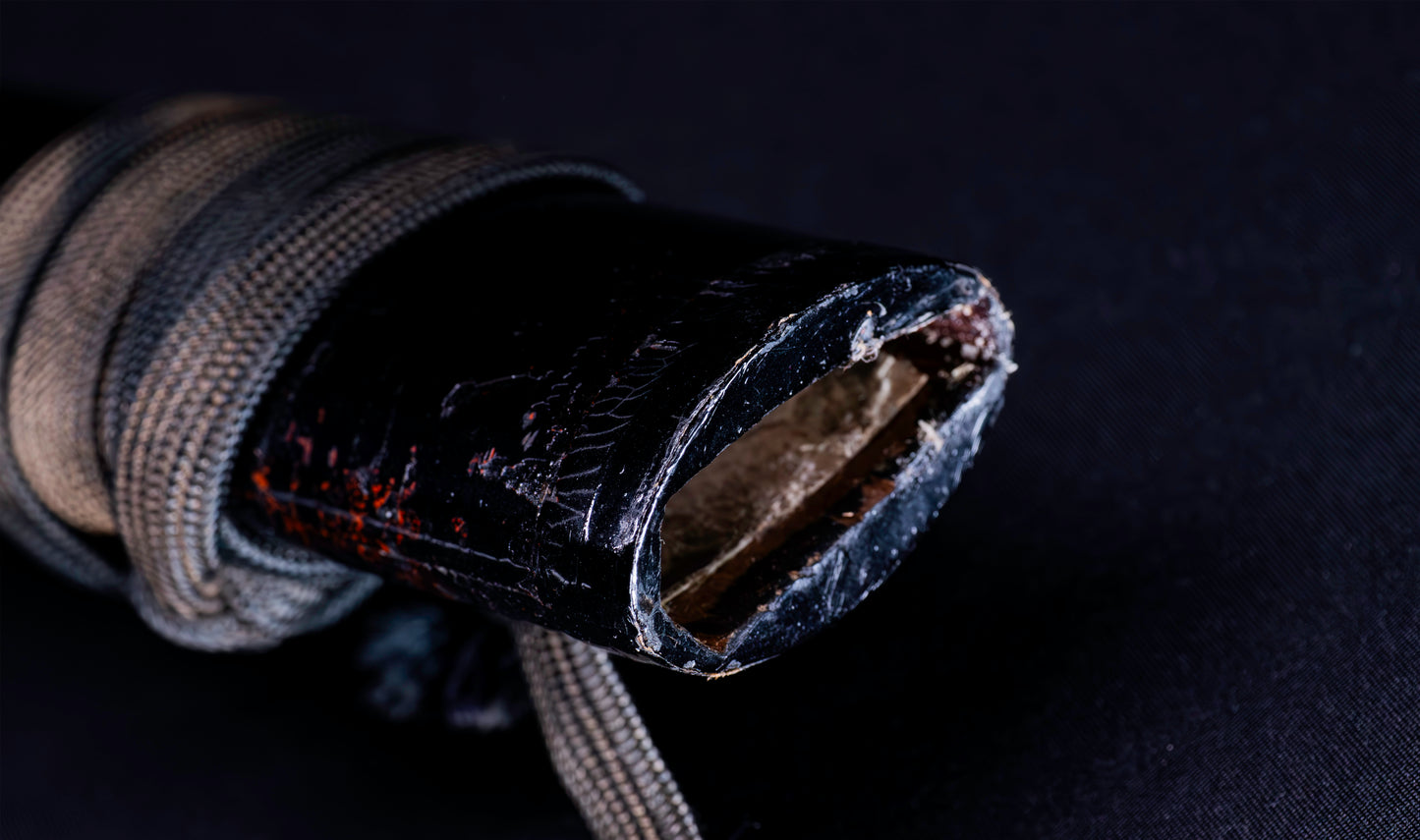
The saya (scabbard) is finished in glossy kuro urushi (black lacquer), showing the dignified, restrained aesthetic appropriate to the sword's overall character. A dark olive-grey sageo (suspension cord) in woven silk is present. The habaki is a two-piece futakouchi construction with engraved dragon and scrollwork decoration — the same motif that runs through the fuchi and menuki — providing elegant continuity from blade to mounting. The overall koshirae composition, from the landscape tsuba to the dragon hardware, reflects genuine artistic intention: a sword dressed for someone who understood what they were commissioning.
Swordsmith Background
Kojima Katsumasa (小島勝正) is a registered swordsmith working in Seki City, Gifu Prefecture — the heart of the ancient Nōshū sword-making tradition. The dated mei on this blade places its completion on April 13, 2010 (Heisei 22), a period in which a small but committed community of gendaitō smiths continued to forge using traditional tamahagane and time-honored methods, maintaining the craft in direct continuity with the historical Mino tradition.
Seki smiths carry the legacy of the Nōshū-den (Mino tradition), one of the Gokaden — the five great sword-making lineages of Japan. Working in this tradition means forging blades characterized by a tight, refined jihada and a precise, well-disciplined hamon: qualities evident in Katsumasa's work here. The kinzōgan mei — gold-inlaid signature — speaks to a smith commissioned for a piece of ceremony and permanence, not anonymous production.
School History: The Nōshū Seki Tradition
Seki City in Gifu Prefecture has been producing edged weapons continuously for over 700 years. In the Muromachi period, Nōshū (Mino Province) smiths became the preferred suppliers to the armies of the Sengoku era — blades like the Seki-mono katana were exported across Japan for their reliability, sharp geometry, and the distinctive tight grain of Mino forging. The names Kanemoto, Kanefusa, and Kaneuji became synonymous with practical cutting excellence.
The Mino-den (Mino tradition) is one of the Gokaden — the five classical schools alongside Yamashiro, Yamato, Bizen, and Sōshū. Mino blades are characterized by a typically tight itame or mokume jihada, with hamon running to patterns including gunome, notare-gunome, and the distinctive sanbonsugi (three-cedar) pattern that became a hallmark of the school. The Mino tradition emphasized practical geometry: well-proportioned blades with reliable edge-taking qualities that made them the weapon of choice for working warriors.
Today, Seki City remains Japan's largest center of cutlery and blade production — and a handful of registered smiths continue to forge nihonto by traditional methods, holding the living thread of the Nōshū tradition. A blade by Kojima Katsumasa, dated and signed in gold on the nakago, is exactly this: the tradition still breathing, still cutting, still signed.


Collapsible content
Payment
You can pay by Bank card or Bank transfer. If you wish to use bank transfer please contact us using the form bellow with the name of the sword you are willing to buy.
Customs and Taxes
・Import duties, taxes and charges are not included in the item price or shipping charges. These charges are the buyer’s responsibility.
・Please check with your country’s customs office to determine what these additional costs will be prior to bidding/buying.
・These charges are normally collected by the delivering freight (shipping) company or when you pick the item up - do not confuse them for additional shipping charges.
Shipping and Return
- Swords are shipped from Tokyo, Japan. We manage all the procedures to export the sword.
- You can't return sword to Japan because procedures are too strict.
- We work with a shipping company that have experience with Nihonto so you don't have to worry.
- Please check the rules of your country before importing the sword. We do not take any responsibility, including (not limited to) refund, due to the above reasons.
- We can NOT cancel an order once, we already applied for the export authorization. As this document is made to customer name.
We have shipped authentic Japanese swords to the USA, UK, Canada, Mexico, Germany, France, Hong Kong, and Australia. If you don’t live in these countries and like to order, please contact us first before purchasing. We normally ship by EMS (Express Mail Service) provided by Japan Post.
If you live in the UK, please contact us BEFORE order.
Export Procedure (We manage it)
・All our swords are registered in the Agency for Cultural Affairs as artwork and The Board of Education(Cultural properties protection Committee); therefore each sword has the registration card, issued by the Board of Education.
・After receiving the full payment of the items,we return the registration card and get the permission from Ministry of Cultural Affairs to export the swords legally from Japan. It will take about 1 to 3 months for that step.
・After the receiving the permission, we will inform you by email and send the items immediately.
Contact form
What Our Collectors Say
Independent reviews from verified buyers on Trustpilot
Wonderful folks to buy from
“Large selection to choose from. The katana were signed with Hozon and the blades in a shirasaya. My two katana and Kozuka came packed in a solid wooden crate. Great friendly communication.”
Got a beautiful sword delivered to NYC
“Condition is just as pictured. Took a little while to get all the way to the states, but I was very happy with this seller and plan to purchase more from them.”
Order with confidence
“In the end I received what I ordered, well-packaged and in the condition specified.”
Un katana antique magnifique
“J'ai posé beaucoup de questions au support qui a su répondre et m'aider dans mon choix. La commande est arrivée avec le certificat dans un emballage robuste et en parfait état, il est vraiment magnifique !”