


Tokyo Nihonto
Antique Japanese Katana Sword signed Tsunahiro with Gold Dragon Menuki, Russet Lacquer Saya - NBTHK Hozon
Antique Japanese Katana Sword signed Tsunahiro with Gold Dragon Menuki, Russet Lacquer Saya - NBTHK Hozon
Couldn't load pickup availability
- Signature (Mei): 綱廣 Tsunahiro (omote, two characters; ura unsigned) — carved in the classical kyūjitai form, transcribed 綱広 on the NBTHK paper
- Swordsmith: Tsunahiro of Yamashiro — certified by the NBTHK as 綱広(山城・延宝頃)
- School / Tradition: Yamashiro (Kyoto) — Shintō-period Kyoto workmanship
- Period / Province: Edo period, circa Enpō era (1673–1681) — Shintō classification / Yamashiro Province (modern Kyoto)
- Certificate: NBTHK Hozon Tōken (保存刀剣) No. 3036707 — issued 28 May Reiwa 7 (2025)
- Japanese Registration (Tōroku-shō): Tochigi Prefecture No. 44145, issued 22 August Shōwa 61 (1986)
- Mounting: Complete katana koshirae — russet-brown lacquered saya, black silk tsuka-ito, gold dragon menuki, copper-alloy sukashi tsuba
- Blade Length (Nagasa): 62.1 cm (2 shaku 0 sun 5 bu)
- Curvature (Sori): 1.1 cm — shallow, typical of mature Shintō geometry
- Mekugi-ana: 1 — ubu nakago, unshortened, signature intact
- Shape (Sugata): Shinogi-zukuri, iori-mune, chū-kissaki
- Hamon: Gunome-midare — large, rounded, openly spaced heads with a broad nioiguchi and nie in the valleys
- Boshi: Midare-komi with a rounded turnback
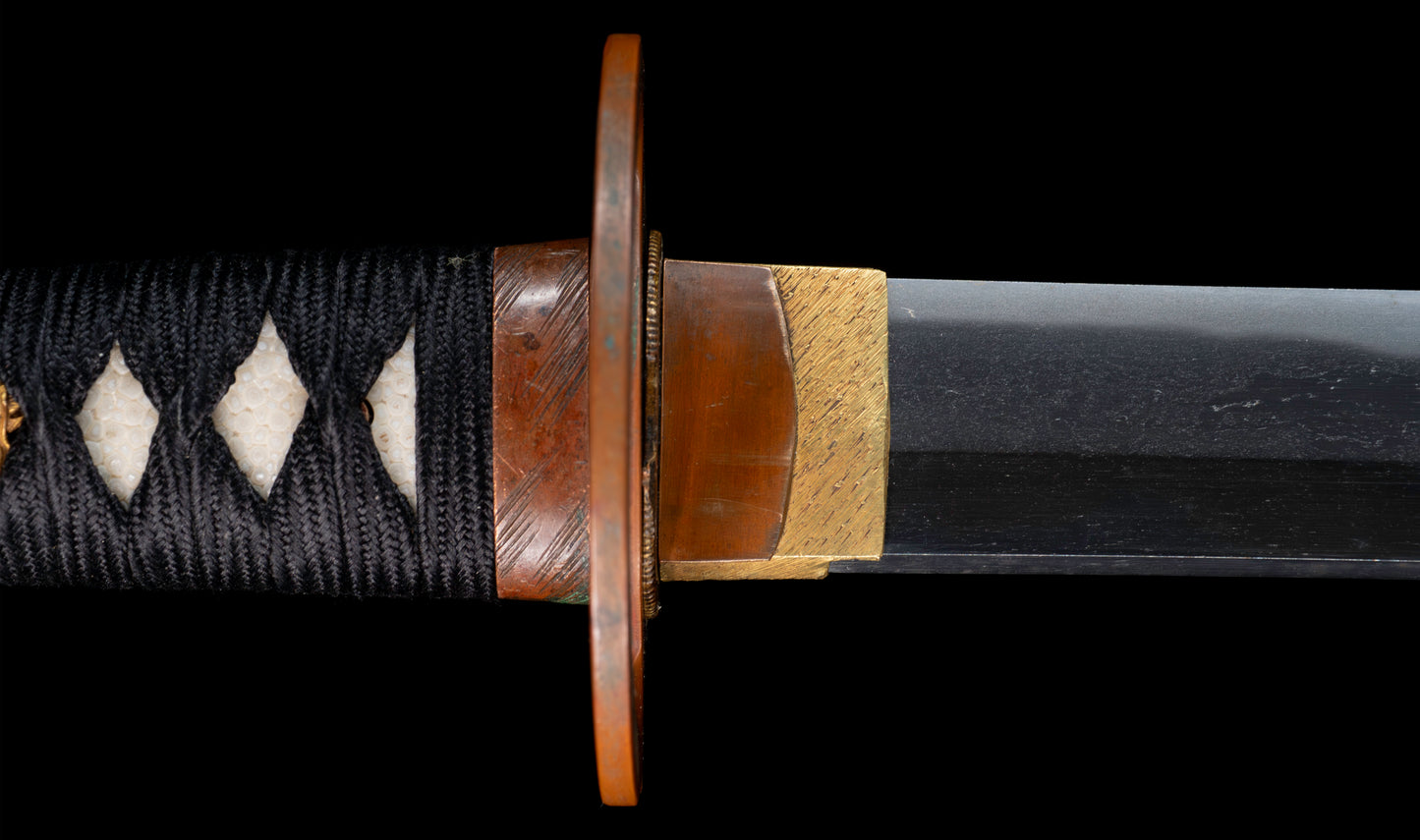
- Habaki: Gold-foiled (kin-kise) with neko-gaki file texturing
A NBTHK Hozon-certified katana signed 綱廣 (Tsunahiro), placed by the NBTHK in Yamashiro province — Kyoto — around the Enpō era, 1673 to 1681. It measures 62.1 cm nagasa with 1.1 cm of sori, and the nakago is ubu: original length, one mekugi-ana, the signature untouched. For an Edo-period blade to reach Hozon the shinsa panel must judge the mei genuine. This one did.
The hamon is the reason to look twice. It runs as a bold gunome-midare of large, rounded heads set at generous intervals — an open, unhurried rhythm rather than the tight repetition of a workshop blade. The nioiguchi is broad and softly luminous, with nie collecting in the valleys between the heads, and the pattern widens confidently through the monouchi. This is tempering built to read at arm's length and across a room, which is precisely what a Kyoto smith of standing in the 1670s was being paid to deliver.
The geometry belongs unmistakably to its era. A shallow 1.1 cm sori across 62.1 cm is pure Shintō: the deep battlefield curve of the Muromachi centuries had long given way to a straighter, more controlled profile suited to the drawing arts and to the flat, precise cutting favoured under the Tokugawa peace. The chū-kissaki is compact and well proportioned, and the boshi enters it as midare-komi, turning back roundly and continuously with the hamon.
The polish is sound and the blade presents cleanly along its full length. Minor surface marks are visible in the ji and along the hamon under close studio light — three and a half centuries of careful ownership, not neglect.
Koshirae Details
The sword comes complete in a koshirae of unusual and confident colouring. The saya is finished in glossy russet-brown lacquer — a warm chestnut tone rather than the default black, catching the light along its full length — and fitted with a thick black braided sageo. Against black fittings and black ito, the brown reads as a deliberate choice by an owner with an eye.
The tsuba is a copper-alloy plate with a rich brown-gold patina and the scattered green verdigris of age. Its design is architectural rather than pictorial: a raised central oval carrying the nakago-ana, framed by a border of small punched circles, flanked in turn by two large crescent sukashi openings that leave the plate reading as three bold masses. The lobed outline and rounded rim complete a piece that works through mass and negative space rather than ornament — an approach that takes far more confidence than covering a plate in decoration.
The tsuka is wrapped in black silk ito in hineri-maki over full panels of white same with large, crisply defined nodes. Beneath the crossings sit the finest fittings on the sword: gilt dragon menuki, their heads modelled in high relief with individually rendered scales, horns, bared teeth and clawed forelimbs, the gold still bright in the recesses. The fuchi carries a fine diagonal neko-gaki texture echoed exactly on the gold-foiled habaki — a matched treatment across two separate fittings, the sort of coherence that indicates a koshirae assembled as a whole rather than accumulated piecemeal. The kashira is plain polished copper alloy, deliberately undecorated, letting the dragons carry the hand.
The Swordsmith: Tsunahiro 綱廣 of Yamashiro
The nakago is signed in two characters on the omote: 綱廣, cut in the classical kyūjitai orthography that swordsmiths used throughout the Edo period. The NBTHK renders it 綱広 in modern script — the same character, the same relationship as 國 to 国 — and has judged the signature genuine.
The certificate places Tsunahiro in Yamashiro province — Kyoto — around the Enpō era, 1673 to 1681. That is a considered attribution: the shinsa panel read the steel and the tempering and identified the hand as a Kyoto one. For a collector, it is also the most prestigious address in Japanese swordmaking. Kyoto was the imperial capital and the oldest forging centre in the country, and by the seventeenth century it was where the rest of Japan came for recognition — the Kyoto houses administered the granting of honorary court titles to smiths in every province.
A Kyoto smith of the Enpō years was working at the height of the Shintō period, in a city with a forging tradition already seven centuries deep and a clientele of court nobles, temple patrons and senior samurai who could tell refined work from ordinary. This blade shows what that environment produced: a broad, generously spaced gunome-midare carried on a controlled quench, on a sugata of quiet correctness. Signed, unshortened, and certified — the three things that decide whether an Edo-period katana is a documented work or an anonymous one.
Kyoto Swordmaking in the Shintō Era
Kyoto in the 1670s was not the Kyoto of the Kamakura masters, and understanding the difference is what separates a buyer who knows what he is holding from one who does not.
The city that produced Awataguchi Yoshimitsu and the Rai school had been the imperial capital and forged for the court. By the Shintō period it had been remade. In 1593 the Mino smith Kanemichi moved from Seki to Kyoto with his four sons — Iga-no-kami Kinmichi, Rai Kinmichi, Tanba-no-kami Yoshimichi and Etchū-no-kami Masatoshi — and founded the Mishina school, which together with the Horikawa school of Kunihiro and the workshop of Umetada Myōju dominated Kyoto swordmaking for the rest of the Edo period. The four brothers became known as the Kyō-go-kaji, the Five Smiths of Kyoto.
Their influence went well beyond the forge. Iga-no-kami Kinmichi was granted the right to sign Nihon Kaji Sōshō — head of the swordsmiths of Japan — and his house came to administer the awarding of honorary court titles to smiths across the entire country. Kyoto in this period was where a provincial maker went to become Ise-no-kami or Tanba-no-kami. The Mishina line also carried the imperial chrysanthemum crest on its tangs and perfected the distinctive sudareba, the bamboo-blind hamon.
Kyoto work of the era is recognisable by a finely forged ko-itame jigane and a refinement of finish inherited from the old capital's courtly tradition — elegance rather than brute power, in contrast with the muscular Sōshū and Edo styles. This katana sits in that world: signed, ubu, Hozon-certified, dated to the Enpō years, and mounted in a coherent koshirae that has stayed with it.


Collapsible content
Payment
You can pay by Bank card or Bank transfer. If you wish to use bank transfer please contact us using the form bellow with the name of the sword you are willing to buy.
Customs and Taxes
・Import duties, taxes and charges are not included in the item price or shipping charges. These charges are the buyer’s responsibility.
・Please check with your country’s customs office to determine what these additional costs will be prior to bidding/buying.
・These charges are normally collected by the delivering freight (shipping) company or when you pick the item up - do not confuse them for additional shipping charges.
Shipping and Return
- Swords are shipped from Tokyo, Japan. We manage all the procedures to export the sword.
- You can't return sword to Japan because procedures are too strict.
- We work with a shipping company that have experience with Nihonto so you don't have to worry.
- Please check the rules of your country before importing the sword. We do not take any responsibility, including (not limited to) refund, due to the above reasons.
- We can NOT cancel an order once, we already applied for the export authorization. As this document is made to customer name.
We have shipped authentic Japanese swords to the USA, UK, Canada, Mexico, Germany, France, Hong Kong, and Australia. If you don’t live in these countries and like to order, please contact us first before purchasing. We normally ship by EMS (Express Mail Service) provided by Japan Post.
If you live in the UK, please contact us BEFORE order.
Export Procedure (We manage it)
・All our swords are registered in the Agency for Cultural Affairs as artwork and The Board of Education(Cultural properties protection Committee); therefore each sword has the registration card, issued by the Board of Education.
・After receiving the full payment of the items,we return the registration card and get the permission from Ministry of Cultural Affairs to export the swords legally from Japan. It will take about 1 to 3 months for that step.
・After the receiving the permission, we will inform you by email and send the items immediately.
Contact form
What Our Collectors Say
Independent reviews from verified buyers on Trustpilot
Wonderful folks to buy from
“Large selection to choose from. The katana were signed with Hozon and the blades in a shirasaya. My two katana and Kozuka came packed in a solid wooden crate. Great friendly communication.”
Got a beautiful sword delivered to NYC
“Condition is just as pictured. Took a little while to get all the way to the states, but I was very happy with this seller and plan to purchase more from them.”
Order with confidence
“In the end I received what I ordered, well-packaged and in the condition specified.”
Un katana antique magnifique
“J'ai posé beaucoup de questions au support qui a su répondre et m'aider dans mon choix. La commande est arrivée avec le certificat dans un emballage robuste et en parfait état, il est vraiment magnifique !”