


Tokyo Nihonto
Antique Japanese Katana Sword with Gunome Hamon and Black Roiro Koshirae by Ichimune Nagamitsu
Antique Japanese Katana Sword with Gunome Hamon and Black Roiro Koshirae by Ichimune Nagamitsu
Insured worldwide shipping from Tokyo
Couldn't load pickup availability
- Signature (Mei): 一宗長光 Ichimune Nagamitsu (omote; ura unsigned)
- Swordsmith: Ichimune Nagamitsu — 一宗 as the art name, 長光 as the working name
- Classification: Gendaitō — traditionally forged, water-quenched modern blade
- Period: Shōwa era (1926–1989)
- Japanese Registration (Tōroku-shō): Kyoto Prefecture No. 61883 — the mandatory possession licence for swords held in Japan
- Mounting: Complete katana koshirae — black roiro-nuri saya, rose silk tsuka-ito, iron tsuba with gold pine decoration
- Blade Length (Nagasa): 60.8 cm (just over 2 shaku)
- Curvature (Sori): 1.5 cm (approx. 5 bu)
- Mekugi-ana: 1 — ubu nakago, never shortened
- Shape (Sugata): Shinogi-zukuri, iori-mune, chū-kissaki
- Jihada: Itame with a pronounced flowing nagare, drifting to masame toward the shinogi; ji-nie present
- Hamon: Regular gunome-midare in nioi-deki, ko-nie along the habuchi
- Boshi: Midare-komi with a rounded turnback
A gendaitō by Ichimune Nagamitsu, signed 一宗長光 on the omote, measuring 60.8 cm nagasa with 1.5 cm of sori. The nakago is ubu — original length, single mekugi-ana, never shortened — so the sword stands in exactly the proportions its maker gave it.
The hamon is the achievement here. A regular gunome-midare runs the full length of the blade, rounded heads spaced with near-metronomic evenness, starting immediately at the ha-machi with no yakidashi and holding its rhythm all the way to the yokote. The nioiguchi is tight and bright, with ko-nie gathered along the habuchi. Laying clay to this tolerance and carrying it through a water quench without the pattern breaking is the hardest thing a smith does; hesitation in the yaki-ire shows immediately, and there is none.
The jihada is a well-forged itame with strong flowing nagare, running to masame as it reaches the shinogi-ji. Under raking light the folded structure reads across the ji as long streaming lines, with ji-nie giving the steel depth. The boshi enters the chū-kissaki as midare-komi and turns back in a rounded maru — continuous with the hamon, correctly formed, and the first thing we look at on any twentieth-century blade.
The polish is sound and the hataraki are readable end to end. A few minor surface spots show in the ji under close studio light — the marks of a sword that has been owned and handled rather than shut away.
Koshirae Details
The blade is housed in a complete katana koshirae of deliberately quiet taste. The saya is plain black roiro-nuri — deep, glossy, undecorated urushi — with a horn kurikata and a woven taupe sageo. No inlay, no texture, no ornament: a mounting built to let the blade carry the room.
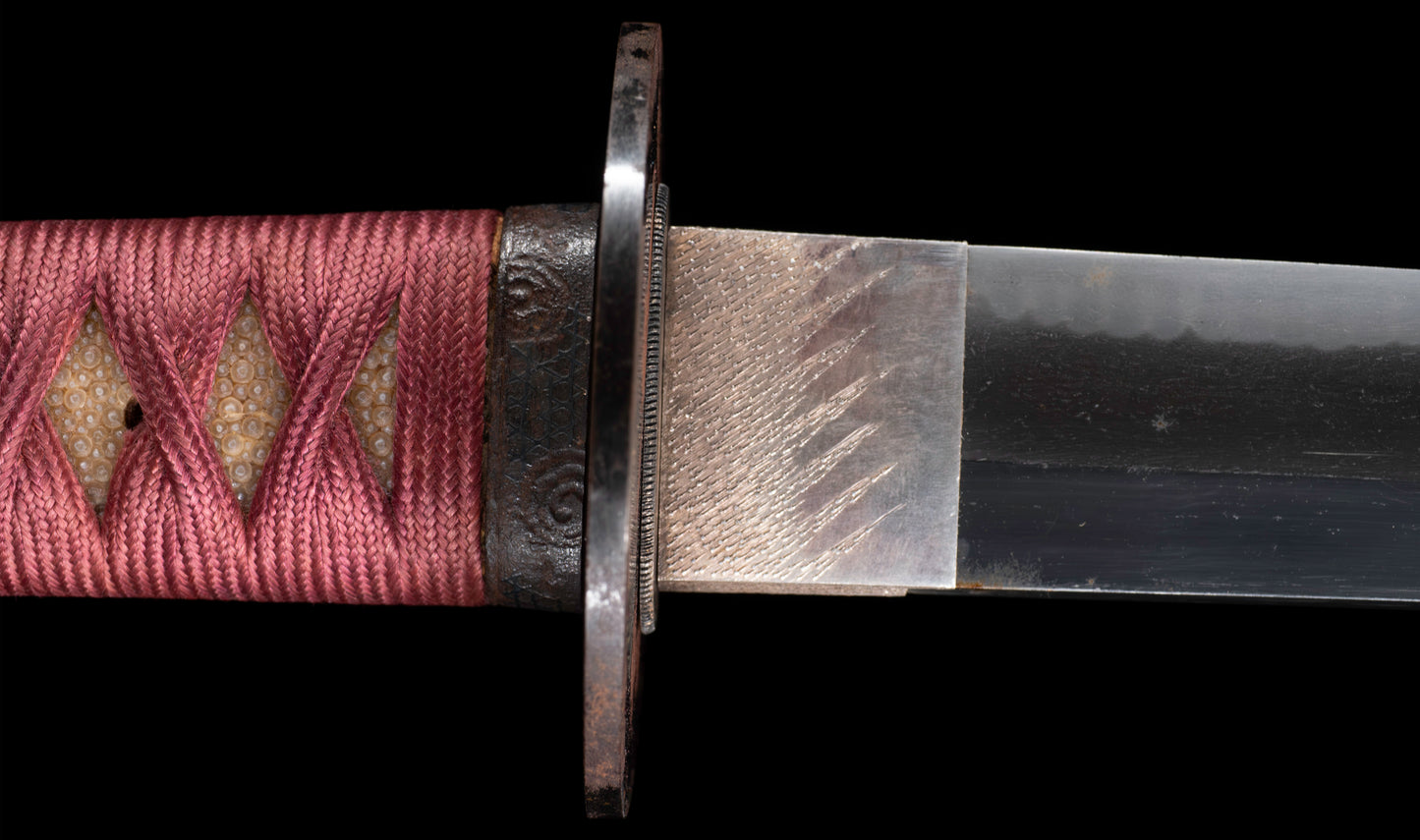
The tsuba is a round iron plate with a mottled dark patina and a single hitsu-ana, carrying gold pine-needle sprays (matsuba) in applied relief on both faces. Each cluster is a fan of fine radiating lines with a curling stem; on the omote they descend along one edge above a curving band of punched circles reading as a stream, and two further sprays sit opposite on the ura, so the design stays continuous as the sword is worn. Pine against water is the hamamatsu motif — shore pine, an emblem of endurance. The decoration pushed hard to one edge of an open field is a confident compositional choice, not an economical one.
The tsuka is wrapped in rose silk ito in hineri-maki over full panels of white same with large, well-defined nodes. The faded mauve-pink against cream rayskin and dark fittings is an unusual pairing and a genuinely handsome one. Gilt menuki sit beneath the crossings of the ito, half-concealed as intended. The fuchi carries a finely engraved geometric ground beneath a beaded rim; the kashira shows carved scrollwork under a dark patina. Both wear honestly.
The Swordsmith: Ichimune Nagamitsu 一宗長光
The mei is cut on the omote in four characters, in a confident, fine-chiselled hand: 一宗 (Ichimune) as the art name, 長光 (Nagamitsu) as the working name. The ura is left blank — no date, no province — which is common practice among Shōwa smiths signing under a personal gō.
Nagamitsu was a name carried by several distinct smiths during the Shōwa era, each working under his own art name. The best known is Ichihara Nagamitsu of Okayama, who signed 一龍子長光 (Ichiryūshi) and held Army-approved status. Ichimune is a separate hand, and the distinction matters when reading a Shōwa 長光 mei correctly.
The name itself is a deliberate homage. 長光 belonged to the Kamakura-period Osafune master, son of Mitsutada, whose Daihannya Nagamitsu is a National Treasure — a name a modern smith takes up as a statement of intent, not of lineage. What this blade demonstrates on its own account is disciplined forging, a controlled quench, and no shortcuts taken where they would have been easiest.
Authentication
We have examined this blade directly. It is a genuine gendaitō — hand-forged, folded, and water-quenched in the traditional manner — and the workmanship is consistent throughout: visible hada, a nioi-based hamon carrying real hataraki, a correctly turned boshi, and no arsenal or inspection stamp on the nakago. That is our assessment, and we stand behind it.
The sword carries its tōroku-shō (銃砲刀剣類登録証), Kyoto Prefecture No. 61883. This is the registration document that makes a sword legal to hold in Japan and that is surrendered on export — it records the type, nagasa, sori, mekugi-ana and mei, and it is issued only to traditionally made art swords, which is why shōwatō do not receive one.
The blade has no NBTHK paper at present, as is the case with most nihontō in circulation. For a buyer who wants the signature formally entered into the record, this is a straightforward candidate for Hozon shinsa in Tokyo, and we are glad to advise on the submission.
Gendaitō: The Japanese Sword in the Shōwa Era
The Shōwa period produced both the finest blades made in Japan since the Edo era and the worst objects ever to carry the shape of a katana — which is why the distinction between the two is the first thing a serious buyer learns.
After the Haitōrei edict of 1876 banned the wearing of swords, the craft came close to extinction before being deliberately revived in the twentieth century. Under the licensing system administered by the Agency for Cultural Affairs, a licensed smith may forge only a limited number of blades each year, using tamahagane smelted in a tatara, folded and forged by hand, and hardened by clay-coated water quenching. Blades made this way are gendaitō: modern in date, nihontō in every respect that matters.
Against them stand the shōwatō — machine-assisted, usually oil-quenched blades of industrial steel produced for military issue. They cannot be registered in Japan and they do not pass shinsa. The markers separating the two are consistent and readable: genuine hada, a nioi-deki hamon with visible hataraki, a properly turned boshi, no arsenal stamp, and a valid Japanese registration.
This katana answers every one of them. It is a hand-forged, water-quenched blade of assured workmanship — ubu, signed, complete in its original koshirae — for a collector buying the craft in front of him.


Collapsible content
Payment
You can pay by Bank card or Bank transfer. If you wish to use bank transfer please contact us using the form bellow with the name of the sword you are willing to buy.
Customs and Taxes
・Import duties, taxes and charges are not included in the item price or shipping charges. These charges are the buyer’s responsibility.
・Please check with your country’s customs office to determine what these additional costs will be prior to bidding/buying.
・These charges are normally collected by the delivering freight (shipping) company or when you pick the item up - do not confuse them for additional shipping charges.
Shipping and Return
- Swords are shipped from Tokyo, Japan. We manage all the procedures to export the sword.
- You can't return sword to Japan because procedures are too strict.
- We work with a shipping company that have experience with Nihonto so you don't have to worry.
- Please check the rules of your country before importing the sword. We do not take any responsibility, including (not limited to) refund, due to the above reasons.
- We can NOT cancel an order once, we already applied for the export authorization. As this document is made to customer name.
We have shipped authentic Japanese swords to the USA, UK, Canada, Mexico, Germany, France, Hong Kong, and Australia. If you don’t live in these countries and like to order, please contact us first before purchasing. We normally ship by EMS (Express Mail Service) provided by Japan Post.
If you live in the UK, please contact us BEFORE order.
Export Procedure (We manage it)
・All our swords are registered in the Agency for Cultural Affairs as artwork and The Board of Education(Cultural properties protection Committee); therefore each sword has the registration card, issued by the Board of Education.
・After receiving the full payment of the items,we return the registration card and get the permission from Ministry of Cultural Affairs to export the swords legally from Japan. It will take about 1 to 3 months for that step.
・After the receiving the permission, we will inform you by email and send the items immediately.
Contact form
What Our Collectors Say
Independent reviews from verified buyers on Trustpilot
Wonderful folks to buy from
“Large selection to choose from. The katana were signed with Hozon and the blades in a shirasaya. My two katana and Kozuka came packed in a solid wooden crate. Great friendly communication.”
Got a beautiful sword delivered to NYC
“Condition is just as pictured. Took a little while to get all the way to the states, but I was very happy with this seller and plan to purchase more from them.”
Order with confidence
“In the end I received what I ordered, well-packaged and in the condition specified.”
Un katana antique magnifique
“J'ai posé beaucoup de questions au support qui a su répondre et m'aider dans mon choix. La commande est arrivée avec le certificat dans un emballage robuste et en parfait état, il est vraiment magnifique !”