


Tokyo Nihonto
Antique Japanese Katana Sword with Ubu Nakago, Hoso-Suguha Hamon and Genji Wheel Iron Tsuba
Antique Japanese Katana Sword with Ubu Nakago, Hoso-Suguha Hamon and Genji Wheel Iron Tsuba
Couldn't load pickup availability
- Signature (Mei): Mumei, unsigned
- Nakago: Ubu, unshortened, with its original taper and kuri-jiri
- Swordsmith: Unknown. The blade carries no shinsa paper
- School / Tradition: Not attributed
- Period: Azuchi-Momoyama, the closing decades of the sixteenth century
- Registration: Japanese torokusho Tokyo no. 78910, issued 14 August 1961
- Certificate: None. The blade has never been submitted to shinsa
- Mounting: Complete black katana koshirae with roiro lacquer saya, iron openwork tsuba and dragon fuchi-kashira
- Blade Length (Nagasa): 68.5 cm (2 shaku 2 sun 6 bu)
- Curvature (Sori): 2.1 cm (7 bu), deep and set low on the blade
- Mekugi-ana: 2
- Shape (Sugata): Shinogi-zukuri, iori-mune, compact chu-kissaki, pronounced koshi-zori with clear funbari
- Jihada: Itame mixed with mokume, muted by the present polish
- Hamon: Hoso-suguha, narrow, strict and unbroken, nioi-deki
- Boshi: Sugu with a tight ko-maru turnback, healthy width remaining
- Habaki: Single-piece silver or silver-foiled, filed with shigure rain marks
- Polish: Older polish, now tired
Of the swords we have listed recently, this is the one we would keep to study, and the reason is its shape.
The nakago is ubu. It has never been shortened. The taper from the machi to the nakago-jiri is natural and unbroken, the kuri-jiri is the original one, and the patina is a heavy, even black-brown that has taken centuries to build. That alone puts this blade in a minority: the great majority of sixteenth-century Japanese swords in circulation were cut down at some point, and an untouched tang is the single most informative thing a sword can offer.
What that intact geometry then shows is a deep koshi-zori, with the centre of the curve sitting distinctly in the lower third of the blade, and clear funbari, the widening toward the base that a sword only keeps if it has not been shortened. The sword is dated to the Azuchi-Momoyama period, and the proportions belong to it precisely: a blade of 68.5 cm with 2.1 cm of curvature set low is a sword made while the old forms were still alive and the new ones were arriving.
The temper is a strict, narrow hoso-suguha that runs parallel to the edge without interruption, reading as nioi-deki. It is an austere temper, the sort favoured by traditions that trusted their steel rather than their showmanship. The boshi turns back in a tight ko-maru with good width still in the point. The blade has been polished many times across its life, which is what has narrowed the hamon, but no core steel is showing and the machi remain healthy.
The blade is unsigned and unpapered, and the polish is tired. The jihada is almost entirely muted and the finer activity that would let anyone name a school cannot be seen, so no attribution is offered. What the sword does have is a combination that rewards a foundation polish and an NBTHK submission: an untouched tang, sixteenth-century proportions and an austere suguha. A buyer who funds that work is doing it on a blade whose geometry is already saying something worth hearing.
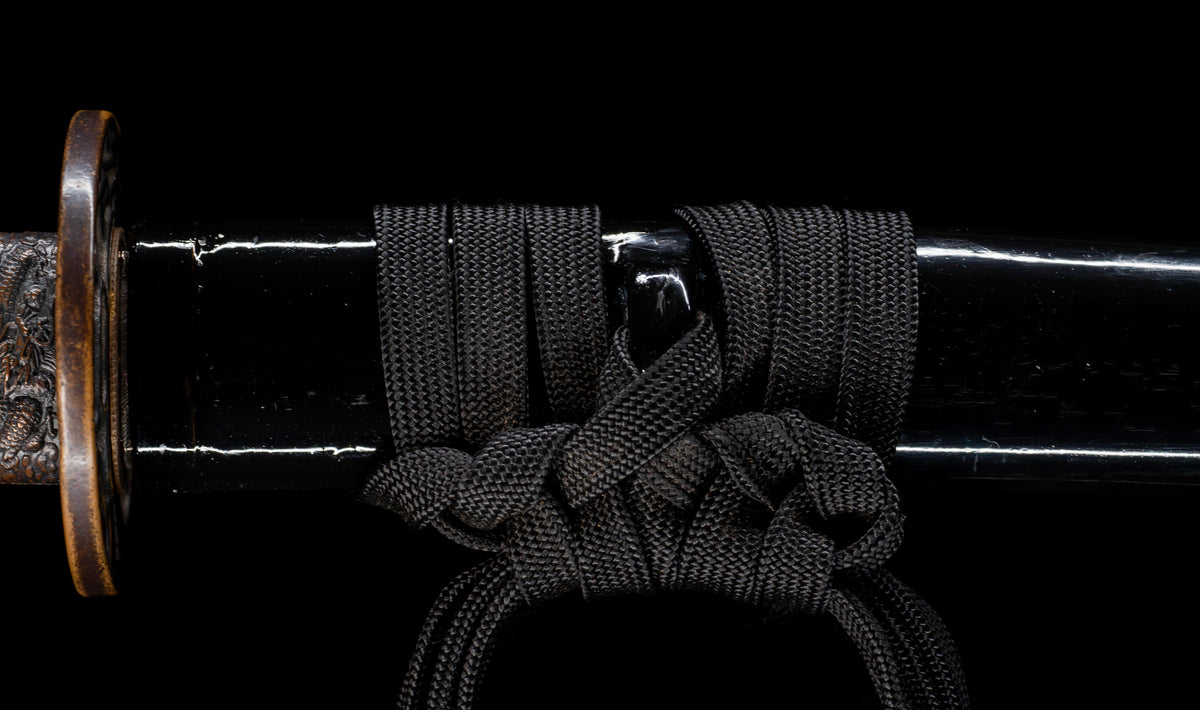
The mounting is black throughout, and deliberately so. The saya is finished in roiro, the mirror-black lacquer, in very good condition with only superficial handling marks and a little dulling at the tip. The tsuka is wrapped in black ito over white samegawa in hineri-maki, and the sageo is black.
The tsuba is the piece to look at: iron, maru-gata, with a dark mature patina, cut in ji-sukashi with an asymmetrical design that sets a spoked Genji wheel against curling waves, the wave detail picked out in kebori. It has both hitsu-ana open and a kaku-mimi koniku rim. The robustness of the iron and the character of the openwork point to Owari or Akasaka work of the Edo period. It is unsigned.
The fuchi and kashira are a perfectly matched pair in dark alloy, coiling dragons among clouds in takabori over a nanako ground. The menuki are a floral cluster, layered multi-petalled blossoms flanked by veined leaves, and we will not put a name to the flower because the wrap hides too much of it. The habaki is single-piece and silvered, filed with diagonal shigure marks on its lower half.
A note on originality: the metal fittings are genuine Edo-period work, but the tsuka-maki, the samegawa and the roiro lacquer are all crisp and unworn. This sword was professionally remounted in the modern era using antique fittings. The work is of high quality.
The blade is unsigned, so what deserves explaining is the thing it does carry: an untouched tang, on a sword made in the most violent thirty years of Japanese history.
The Azuchi-Momoyama period is short and it is loud. It runs from Oda Nobunaga's seizure of Kyoto to the eve of the Tokugawa settlement, and into it are packed Nagashino, the burning of the great monasteries, Hideyoshi's unification, the invasions of Korea and the road to Sekigahara. Swords were being consumed at a rate the country has never matched before or since, and every province that could forge was forging.
It is also the moment the Japanese sword changes hands. The tachi, slung edge-down from cords and drawn from the saddle, gives way to the katana, thrust edge-up through the sash and drawn in a single motion while standing. Blades from these decades sit exactly on that hinge: still carrying the deep koshi-zori of the older form, already cut to the length and balance of the newer one. That is what this sword is, and it is why its untouched tang is worth more than a decorated one would be.
When a sword is shortened, the signature usually goes with the steel that is removed, and so does the evidence. The curve shifts, the funbari disappears, and the proportions stop being testimony. An untouched tang keeps all of it: the curve sits where the smith put it, the taper is his, and the balance in the hand is the one he intended. For an unsigned blade, that geometry is the primary evidence a shinsa panel works from, which is why we have described this sword's proportions in more detail than its decoration.
Swords of this period survive in two conditions: cut down, or lucky.
The century that followed Azuchi-Momoyama was hard on long blades. Fashion shortened them, the Kanbun style made deep curves look archaic, and a sword that could not be worn comfortably in a city at peace was altered until it could. Enormous numbers of sixteenth-century blades went under the file for that reason alone. A sword that came through with its tang untouched did so because at every generation somebody decided to leave it as it was.
The mounting it wears today is black throughout, and the fittings inside it are genuine Edo work: an iron tsuba cut with a Genji wheel against waves, fuchi and kashira carrying coiling dragons over a nanako ground. The lacquer, the rayskin and the silk are modern and professionally done, which is a fair description of most antique swords that are actually handled rather than stored.
What is offered here is a genuine antique Japanese sword of the Azuchi-Momoyama period with an untouched tang, a deep and elegant curve, an austere suguha temper and a complete black mounting on antique Edo fittings, registered in Japan under a torokusho issued in 1961. It carries no attribution. Its shape is the most interesting thing in this listing.


Collapsible content
Payment
You can pay by Bank card or Bank transfer. If you wish to use bank transfer please contact us using the form bellow with the name of the sword you are willing to buy.
Customs and Taxes
・Import duties, taxes and charges are not included in the item price or shipping charges. These charges are the buyer’s responsibility.
・Please check with your country’s customs office to determine what these additional costs will be prior to bidding/buying.
・These charges are normally collected by the delivering freight (shipping) company or when you pick the item up - do not confuse them for additional shipping charges.
Shipping and Return
- Swords are shipped from Tokyo, Japan. We manage all the procedures to export the sword.
- You can't return sword to Japan because procedures are too strict.
- We work with a shipping company that have experience with Nihonto so you don't have to worry.
- Please check the rules of your country before importing the sword. We do not take any responsibility, including (not limited to) refund, due to the above reasons.
- We can NOT cancel an order once, we already applied for the export authorization. As this document is made to customer name.
We have shipped authentic Japanese swords to the USA, UK, Canada, Mexico, Germany, France, Hong Kong, and Australia. If you don’t live in these countries and like to order, please contact us first before purchasing. We normally ship by EMS (Express Mail Service) provided by Japan Post.
If you live in the UK, please contact us BEFORE order.
Export Procedure (We manage it)
・All our swords are registered in the Agency for Cultural Affairs as artwork and The Board of Education(Cultural properties protection Committee); therefore each sword has the registration card, issued by the Board of Education.
・After receiving the full payment of the items,we return the registration card and get the permission from Ministry of Cultural Affairs to export the swords legally from Japan. It will take about 1 to 3 months for that step.
・After the receiving the permission, we will inform you by email and send the items immediately.
Contact form
What Our Collectors Say
Independent reviews from verified buyers on Trustpilot
Wonderful folks to buy from
“Large selection to choose from. The katana were signed with Hozon and the blades in a shirasaya. My two katana and Kozuka came packed in a solid wooden crate. Great friendly communication.”
Got a beautiful sword delivered to NYC
“Condition is just as pictured. Took a little while to get all the way to the states, but I was very happy with this seller and plan to purchase more from them.”
Order with confidence
“In the end I received what I ordered, well-packaged and in the condition specified.”
Un katana antique magnifique
“J'ai posé beaucoup de questions au support qui a su répondre et m'aider dans mon choix. La commande est arrivée avec le certificat dans un emballage robuste et en parfait état, il est vraiment magnifique !”