

Tokyo Nihonto
Japanese Shinsakutō Katana Sword by Hizen Kazuyoshi with Suguha Hamon, Plum Sukashi Tsuba and Daikoku Menuki, Dated 1988
Japanese Shinsakutō Katana Sword by Hizen Kazuyoshi with Suguha Hamon, Plum Sukashi Tsuba and Daikoku Menuki, Dated 1988
Insured worldwide shipping from Tokyo
Couldn't load pickup availability
- Signature (Mei): 肥前国一吉作 Hizen no Kuni Kazuyoshi saku ("made by Kazuyoshi of Hizen Province"), dated 戊辰年二月日 ("a day in the second month of the tsuchinoe-tatsu year", February 1988)
- Swordsmith: Nakao Kazuyoshi 中尾一吉 (born 1939), Saga Prefecture
- School / Tradition: Hizen tradition; son and pupil of Nakao Tadatsugu 忠次
- Period: Late Shōwa, February 1988. A modern shinsakutō: the date is on the tang and the sword was registered one month later
- Certificate: None. No shinsa paper; the attribution rests on the signed and dated tang
- Japanese Registration (Tōroku-shō): Saga no. 27041, issued 16 March 1988
- Mounting: Complete katana koshirae: reddish-brown speckled lacquer saya, iron plum-tree sukashi tsuba with gold inlay, iron fuchi with gold pine needles, kashira carved as an Okame face, Daikoku menuki, brown silk tsuka-ito
- Blade Length (Nagasa): 71.8 cm
- Curvature (Sori): 1.9 cm
- Mekugi-ana: 1
- Shape (Sugata): Shinogi-zukuri, iori-mune, chū-kissaki, bo-hi on both sides running down into the tang; tang unaltered (ubu) with a rounded kuri-jiri
- Jihada: Very tight ko-itame, fine and even
- Hamon: Suguha with gentle undulations, in nioi
- Bōshi: Straight, with a small rounded turnback (ko-maru)
- Habaki: Single-piece copper, with diagonal file marks
A signed and dated katana of 71.8 cm by Nakao Kazuyoshi 中尾一吉, a licensed swordsmith of Saga Prefecture, the old Hizen Province. The tang reads 肥前国一吉作 and is dated 戊辰年二月日, the second month of the tsuchinoe-tatsu year: February 1988. The sword was registered in Saga on 16 March 1988, a few weeks after it left the forge. This is a shinsakutō, a sword made by hand in the traditional way in modern Japan, and it is sold as such, not as an antique.
The shape is a full-sized shinogi-zukuri katana with an iori-mune and a chū-kissaki. At 71.8 cm with 1.9 cm of curvature, it is a long, well-balanced blade, a little over the 2 shaku 3 sun that is the standard length for a katana. A bo-hi is cut on both sides and runs down into the tang, which lightens the blade without reducing its width.
The hamon is a suguha, a straight temper line with gentle undulations, formed in nioi, ending in a straight bōshi with a small rounded turnback. A straight hamon is the signature of the Hizen tradition, and it is also the hardest to make well: there is no pattern to hide an uneven line.
The steel is a very tight ko-itame, fine and even. The blade is in a bright polish and in healthy condition. The tang is unaltered, with a single mekugi-ana and a light grey surface: at less than forty years old, it has not yet taken the dark patina of an Edo-period tang.
Koshirae Details
The tsuba is a round iron plate with a lobed rim, cut in openwork (sukashi) as an old plum tree: a thick, gnarled trunk, thin branches and blossoms carved in relief. Small gold dots are inlaid across the iron, and on one face a single plum flower is inlaid in gold. The plum flowers at the end of winter, before any other tree, which made it a favourite emblem of endurance.
The fuchi is iron with a stippled surface, carved in relief with a small stone lantern and scattered with gold inlaid pine needles. The kashira is unusual: it is carved as the round, smiling face of Okame, the goddess of good fortune and good humour, with flecks of gold.
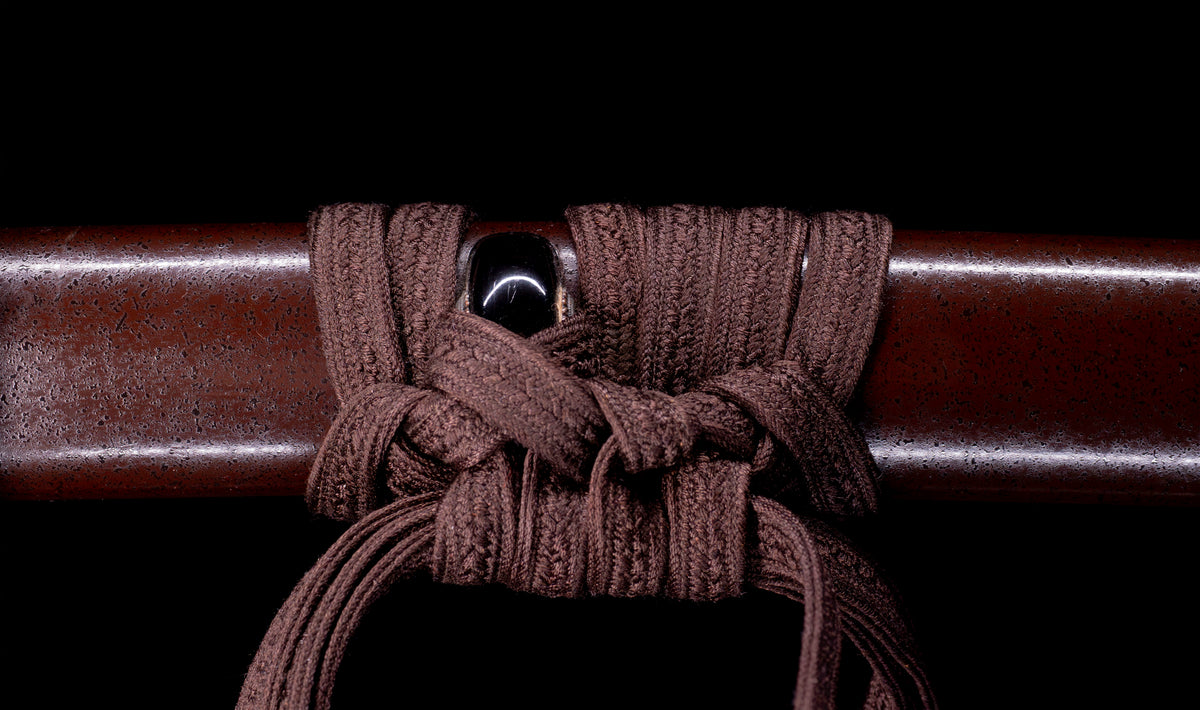
The tsuka is wrapped in brown silk in hineri-maki over white same, with a large nodule visible on one side. The menuki depict Daikoku, god of wealth and one of the Seven Lucky Gods, in his flat cap: on one side he holds a large gilt mallet or rice bale, on the other he appears in silver. Okame and Daikoku together make this a mounting built entirely around good fortune.
The saya is lacquered in a reddish-brown with a fine black speckle, with a black horn koiguchi, an iron kojiri with low-relief scrolls, and a brown sageo. The habaki is a single-piece copper collar with diagonal file marks, and the seppa are gilt and copper.
The Swordsmith: Nakao Kazuyoshi 中尾一吉
Nakao Kazuyoshi was born in 1939 into a family of swordsmiths in Saga Prefecture. He trained under his father, Nakao Tadatsugu 忠次, himself a pupil of Horii Toshihide 堀井俊秀, one of the leading smiths of the first half of the twentieth century. He signs 肥前国住一吉作 or, as here, 肥前国一吉作, and is listed in the directory of the All Japan Swordsmith Association (Zen Nihon Tōshō-kai) under Saga Prefecture.
Kazuyoshi is known for his utsushi, studies of great historical styles: the Kamakura-period Ichimonji school, Minamoto Kiyomaro, and above all Hizen Tadayoshi, the founder of his own province's tradition. Japanese dealers describe him as a versatile smith who also worked in the manner of Sukehiro and Naotane. He has won several prizes at the annual contemporary sword exhibitions, including Yūshū-shō (excellence) and Doryoku-shō awards.
He made relatively few blades. This one is not signed as a copy of any earlier master: it is his own work, in the straight-hamon style of Hizen.
Hizen Swords, Then and Now
Under the Edo period, Hizen Province was ruled by the Nabeshima clan, and its official swordsmiths, the Tadayoshi line, founded the most consistent school of the shintō era. Over more than two and a half centuries, the Tadayoshi family and its branches trained over a hundred smiths. Their trademark was a fine, almost seamless steel called konuka-hada ("rice-bran grain") and a calm, perfectly controlled suguha. Hizen swords were valued as much for their reliability as for their beauty.
After 1945, sword making was banned in Japan, and it only resumed in 1953 under a licensing system that still applies. Every traditional sword is now made by a licensed smith, in tamahagane steel produced in the traditional furnace, and each smith may make only a limited number of long blades a year. Every finished blade is registered with the prefectural Board of Education before it can be sold, which is why this sword carries a registration card issued only weeks after its date.
What is offered here is a katana of 71.8 cm, signed by Nakao Kazuyoshi of Hizen and dated February 1988, registered in Saga, with a straight Hizen-style hamon and a complete koshirae built around good-fortune motifs: an iron plum-tree tsuba, an Okame kashira and Daikoku menuki.


Collapsible content
Payment
You can pay by Bank card or Bank transfer. If you wish to use bank transfer please contact us using the form bellow with the name of the sword you are willing to buy.
Customs and Taxes
・Import duties, taxes and charges are not included in the item price or shipping charges. These charges are the buyer’s responsibility.
・Please check with your country’s customs office to determine what these additional costs will be prior to bidding/buying.
・These charges are normally collected by the delivering freight (shipping) company or when you pick the item up - do not confuse them for additional shipping charges.
Shipping and Return
- Swords are shipped from Tokyo, Japan. We manage all the procedures to export the sword.
- You can't return sword to Japan because procedures are too strict.
- We work with a shipping company that have experience with Nihonto so you don't have to worry.
- Please check the rules of your country before importing the sword. We do not take any responsibility, including (not limited to) refund, due to the above reasons.
- We can NOT cancel an order once, we already applied for the export authorization. As this document is made to customer name.
We have shipped authentic Japanese swords to the USA, UK, Canada, Mexico, Germany, France, Hong Kong, and Australia. If you don’t live in these countries and like to order, please contact us first before purchasing. We normally ship by EMS (Express Mail Service) provided by Japan Post.
If you live in the UK, please contact us BEFORE order.
Export Procedure (We manage it)
・All our swords are registered in the Agency for Cultural Affairs as artwork and The Board of Education(Cultural properties protection Committee); therefore each sword has the registration card, issued by the Board of Education.
・After receiving the full payment of the items,we return the registration card and get the permission from Ministry of Cultural Affairs to export the swords legally from Japan. It will take about 1 to 3 months for that step.
・After the receiving the permission, we will inform you by email and send the items immediately.
Contact form
What Our Collectors Say
Independent reviews from verified buyers on Trustpilot
Wonderful folks to buy from
“Large selection to choose from. The katana were signed with Hozon and the blades in a shirasaya. My two katana and Kozuka came packed in a solid wooden crate. Great friendly communication.”
Got a beautiful sword delivered to NYC
“Condition is just as pictured. Took a little while to get all the way to the states, but I was very happy with this seller and plan to purchase more from them.”
Order with confidence
“In the end I received what I ordered, well-packaged and in the condition specified.”
Un katana antique magnifique
“J'ai posé beaucoup de questions au support qui a su répondre et m'aider dans mon choix. La commande est arrivée avec le certificat dans un emballage robuste et en parfait état, il est vraiment magnifique !”