


Tokyo Nihonto
Antique Japanese Katana Sword with Gunome Hamon, Namban Iron Tsuba and Gilt Karashishi Menuki attributed to Taira Takada - NBTHK Hozon
Antique Japanese Katana Sword with Gunome Hamon, Namban Iron Tsuba and Gilt Karashishi Menuki attributed to Taira Takada - NBTHK Hozon
Couldn't load pickup availability
- Signature (Mei): Mumei (無銘) — unsigned
- Attribution: 平高田 Taira Takada — NBTHK attribution
- School / Tradition: Takada School of Bungo Province (Bizen-influenced Kyūshū workmanship)
- Period / Province: Kotō, Muromachi period (15th–16th century) / Bungo Province, Kyūshū
- Certificate: NBTHK Hozon Tōken (保存刀剣) No. 3038516, issued 16 February 2026
- Registration (Tōroku-shō): Saitama Prefecture No. 18736, dated 19 December 1962
- Mounting: Full katana koshirae — black lacquer saya, Namban iron tsuba with gold nunome, karashishi menuki
- Blade Length (Nagasa): 65.0 cm (2 shaku 1 sun 4 bu)
- Curvature (Sori): 1.8 cm — generous Muromachi battlefield curve
- Mekugi-ana: 2
- Shape: Shinogi-zukuri, iori-mune, chū-kissaki
- Jihada: Tight ko-itame with itame mixed in, quiet and dark under the polish
- Hamon: Regular gunome-midare in nioi-deki, evenly rhythmic along the full length
- Bōshi: Sugu with ko-maru kaeri
- Habaki: Single-piece gilt habaki with diagonal file finish
This Katana is mumei (unsigned) and carries NBTHK Hozon Tōken papers issued in February 2026 attributing it to 平高田 — Taira Takada, the Kotō-period Takada school of Bungo Province in Kyūshū. Measuring 65.0 cm with a generous 1.8 cm sori, it is a Muromachi fighting sword in the fullest sense: the curvature, the length and the balance all belong to the Sengoku century, when Takada smiths were arming samurai across Kyūshū.
The blade is shinogi-zukuri with iori-mune and a chū-kissaki, the profile drawing down cleanly from the machi with a well-judged taper. The jihada is a tight ko-itame with itame mixed in, the ji dark and calm, the shinogi-ji clean and bright. The blade carries good thickness through the monouchi and stands straight and true — five centuries on, this is a sword that still handles like the weapon it was made to be.
The hamon is the piece's signature feature: a broad, insistently regular gunome-midare marching the entire length of the ha in soft, rounded peaks and shallow valleys, each one echoing the last like a wave set. It is a nioi-deki temper with a gentle, misty nioiguchi — no shouting, just an even, disciplined rhythm from koshimoto to yokote. The Takada smiths learned their trade from Bizen, and this hamon is where that lineage shows most clearly. At the point the bōshi runs sugu and turns back in a tidy ko-maru, the yokote crisply cut.
The nakago is suriage — shortened during the sword's working life, as it was for a great many Muromachi blades adapted to changing fashions of wear — ending in a kiri-jiri and carrying two mekugi-ana. The patina is deep and dry. The sword's paper trail runs long: it was first registered with the Saitama Prefectural Board of Education in December 1962, placing it in documented Japanese ownership for over sixty years before the NBTHK examined it in 2026.
Koshirae Details
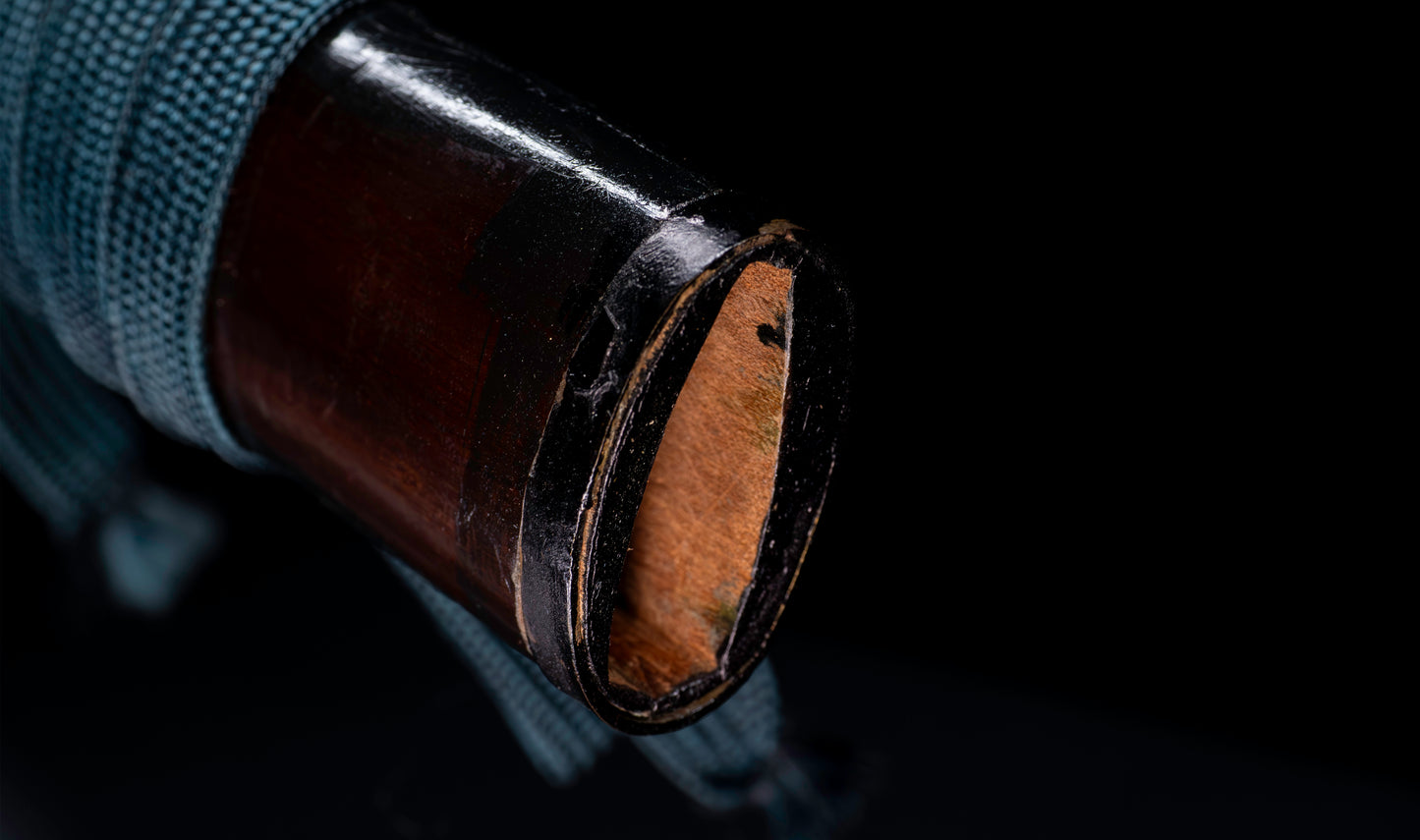
The sword comes complete in a period katana koshirae with an unusually good set of fittings. The saya is black lacquer, plain and glossy along its length, with a dark navy sageo.
The tsuba is the centrepiece: a round iron Namban (南蛮) tsuba worked in dense openwork, with a pair of confronting dragons at the top flanking a central jewel, their bodies dissolving into an all-over lattice of interlaced karakusa scrollwork. Traces of the original gold nunome-zōgan remain scattered across the plate, catching the light against the dark iron. The raised oval seppa-dai is carved with fine radiating lines, and both hitsu-ana are cut and open. Namban work of this type — European and Chinese motifs filtered through Nagasaki and the Kyūshū ports — is exactly what a Kyūshū sword of this history ought to be wearing.
The tsuka is wrapped in dark navy-black ito in hineri-maki over white same, with karashishi menuki — Chinese lions in gilt copper alloy, their curled manes and paws still bright where the gold survives — showing through successive openings in the wrap. The karashishi is a motif that entered Japan from Tang China and became a symbol of wisdom and of guardianship, familiar enough to have shaped the komainu that stand at shrine gates. The fuchi is iron, decorated with sprays of foliage in fine gold nunome-zōgan. Most distinctive of all, the pommel is an iron kabutogane in tachi taste, its edge cut in a scalloped cloud profile over the same, fitted with an iron sarute ring. The blade is seated in a single-piece gilt habaki with diagonal file finish, backed by gilt seppa with beaded rims.
The Takada School of Bungo
Takada was Kyūshū's workhorse school, and that is meant as a compliment. It was founded in Takada village in Bungo Province (modern Ōita) during the Nanbokuchō period by Takada Tomoyuki, a smith who travelled to Bizen Province — today's Okayama — to master the forging and tempering methods of the Bizen tradition before returning home to train his own apprentices. That Bizen schooling is the root of the school's character, and it stayed visible in Takada work for the next three hundred years.
The naming convention matters for anyone reading NBTHK papers. Smiths working at Takada before the Edo period are known collectively as Taira Takada (平高田); from the Edo period onward the line is called Fujiwara Takada (藤原高田), after the surname that becomes standard in their signatures. An NBTHK attribution to Taira Takada is therefore a period statement as much as a school one: it places the blade in the Kotō era, Muromachi period — which is precisely the reading given to this sword.
Takada blades were bought to be used. Through the Sengoku century the school forged in quantity for samurai across Kyūshū, and contemporary reputation placed their work close to Mino and Bizen, the two most celebrated sword-producing provinces in Japan. Their strength was reliability: sound steel, honest geometry, and a temper that cut. Surviving Takada work in good health, papered and mounted, is one of the most accessible ways into genuine Kotō collecting.
School History: Bungo, the Ōtomo Clan and the Kyūshū Sword Trade
Bungo during the Sengoku period was the domain of Ōtomo Yoshishige — better known as Ōtomo Sōrin, one of the most powerful warlords on Kyūshū, who built a formidable military and political base in the province. Takada swordsmiths are recorded as forging for the men who served the Ōtomo, and the school's fortunes rose with theirs. A Taira Takada blade is, in the most literal sense, a product of that alliance between a warlord's ambitions and a village of smiths who could meet the demand.
Two further factors explain why Takada grew as it did. The first is trade. Kyūshū had centuries of commerce with the Asian mainland behind it, and the island's daimyō fought one another for advantage in that trade — which meant standing armies, and standing armies meant orders for swords. Takada took a large share of them. The second is geology. The slopes of Mount Sobo-Katamuki, close to Takada village, held abundant high-quality iron sand and the timber for charcoal — the two raw materials on which any sword-making centre depends. Location and resources together made the school possible; the Ōtomo made it prosperous.
The workmanship reflects that scale and breadth. Takada smiths worked in several idioms across their history: Bizen-influenced gunome and chōji temper lines, Sōshū-leaning midare, Mino-style peaked gunome, and Yamashiro-taste suguha. The unifying thread is not a single look but an approach — tight, well-compacted ko-itame steel and a temper built for cutting rather than for display. This katana sits in the Bizen-derived branch of that output, its rolling gunome the clearest expression of Tomoyuki's original journey to Okayama.
Bungo's harbours also explain the sword's dress. The Namban tsuba mounted here is a direct artefact of Kyūshū's foreign traffic: local iron worked in an imported visual language, on a blade forged a few days' ride from the ports where that language arrived. Few swords carry their own regional history quite so legibly — an NBTHK-papered Muromachi katana, in sound polish with a bright regular hamon, registered in Japan since 1962, and dressed in fittings that tell the story of the province that made it.


Collapsible content
Payment
You can pay by Bank card or Bank transfer. If you wish to use bank transfer please contact us using the form bellow with the name of the sword you are willing to buy.
Customs and Taxes
・Import duties, taxes and charges are not included in the item price or shipping charges. These charges are the buyer’s responsibility.
・Please check with your country’s customs office to determine what these additional costs will be prior to bidding/buying.
・These charges are normally collected by the delivering freight (shipping) company or when you pick the item up - do not confuse them for additional shipping charges.
Shipping and Return
- Swords are shipped from Tokyo, Japan. We manage all the procedures to export the sword.
- You can't return sword to Japan because procedures are too strict.
- We work with a shipping company that have experience with Nihonto so you don't have to worry.
- Please check the rules of your country before importing the sword. We do not take any responsibility, including (not limited to) refund, due to the above reasons.
- We can NOT cancel an order once, we already applied for the export authorization. As this document is made to customer name.
We have shipped authentic Japanese swords to the USA, UK, Canada, Mexico, Germany, France, Hong Kong, and Australia. If you don’t live in these countries and like to order, please contact us first before purchasing. We normally ship by EMS (Express Mail Service) provided by Japan Post.
If you live in the UK, please contact us BEFORE order.
Export Procedure (We manage it)
・All our swords are registered in the Agency for Cultural Affairs as artwork and The Board of Education(Cultural properties protection Committee); therefore each sword has the registration card, issued by the Board of Education.
・After receiving the full payment of the items,we return the registration card and get the permission from Ministry of Cultural Affairs to export the swords legally from Japan. It will take about 1 to 3 months for that step.
・After the receiving the permission, we will inform you by email and send the items immediately.
Contact form
What Our Collectors Say
Independent reviews from verified buyers on Trustpilot
Wonderful folks to buy from
“Large selection to choose from. The katana were signed with Hozon and the blades in a shirasaya. My two katana and Kozuka came packed in a solid wooden crate. Great friendly communication.”
Got a beautiful sword delivered to NYC
“Condition is just as pictured. Took a little while to get all the way to the states, but I was very happy with this seller and plan to purchase more from them.”
Order with confidence
“In the end I received what I ordered, well-packaged and in the condition specified.”
Un katana antique magnifique
“J'ai posé beaucoup de questions au support qui a su répondre et m'aider dans mon choix. La commande est arrivée avec le certificat dans un emballage robuste et en parfait état, il est vraiment magnifique !”