


Tokyo Nihonto
Antique Japanese Muromachi Katana Sword with Suriage Nakago, Ishime Lacquer Saya and Inome-Pierced Horn Kojiri
Antique Japanese Muromachi Katana Sword with Suriage Nakago, Ishime Lacquer Saya and Inome-Pierced Horn Kojiri
Couldn't load pickup availability
- Signature (Mei): Mumei (無銘) — unsigned
- Period: Kotō — Muromachi period (15th–16th century)
- Attribution: No shinsa paper — offered without a smith or school attribution
- Registration (Tōroku-shō): Shizuoka No. 14601, issued 11 September 1956
- Mounting: Full katana koshirae — textured black lacquer saya, iron sukashi tsuba with brass fukurin, iroe menuki
- Blade Length (Nagasa): 63.6 cm (2 shaku 1 sun 0 bu)
- Curvature (Sori): 1.2 cm (4 bu) — shallow, compact
- Mekugi-ana: 2
- Shape: Shinogi-zukuri, iori-mune, chū-kissaki
- Nakago: Suriage, kiri-jiri, deep dark patina
- Jihada: Tight ko-itame, dark and quiet under the polish
- Hamon: Regular gunome on a straight base — evenly spaced rounded peaks in nioi-deki
- Bōshi: Sugu with ko-maru kaeri
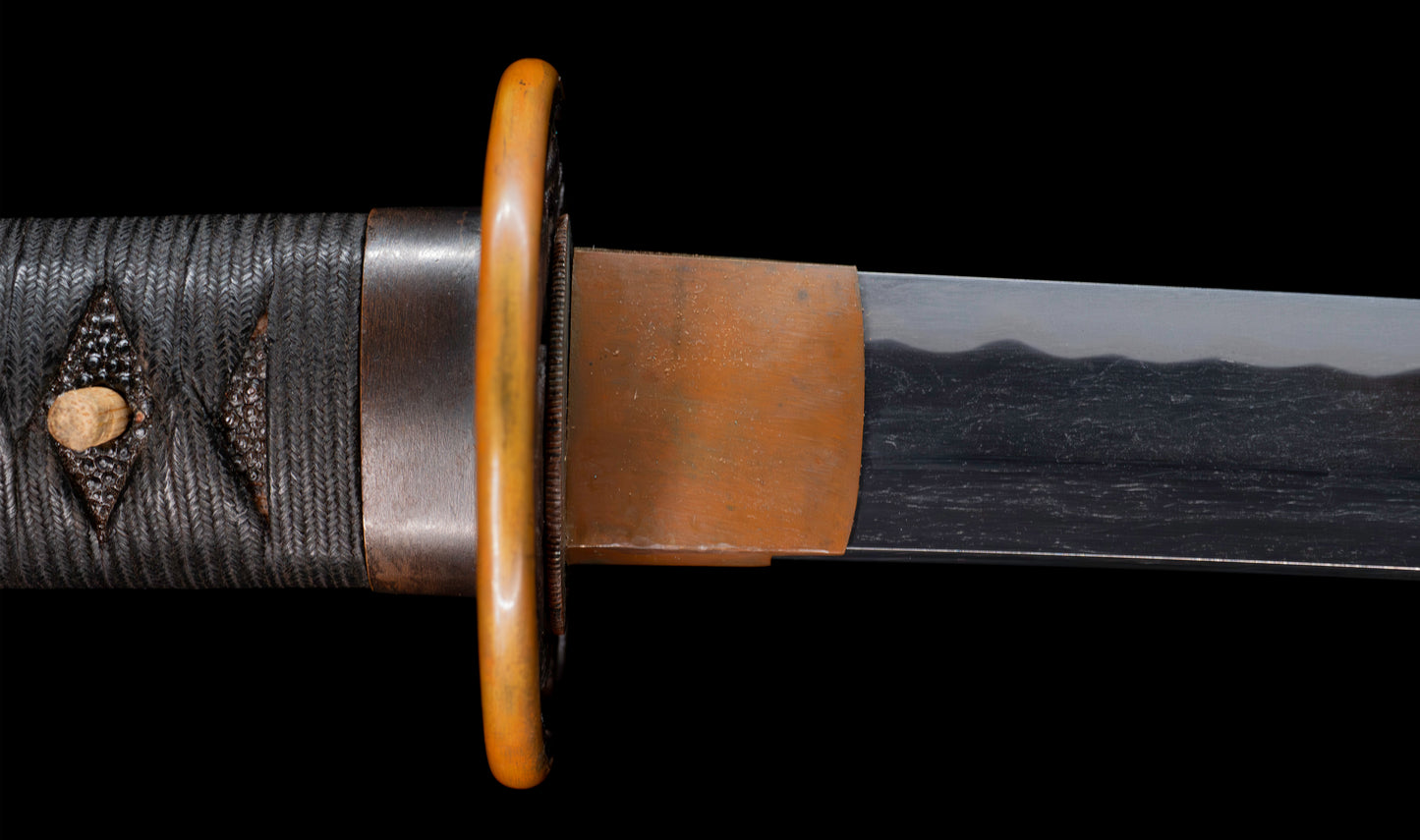
- Habaki: Single-piece copper-alloy habaki, plain
This unsigned Katana is a Kotō blade of the Muromachi period, measuring 63.6 cm with a shallow 1.2 cm sori — a compact, quick-handling sword with the balance of a weapon meant to be worn and drawn rather than admired from a stand. Five centuries on it survives complete in its koshirae, in polish, with its hamon reading clearly along the full length of the edge.
The blade is shinogi-zukuri with iori-mune and a well-proportioned chū-kissaki. The jihada is a tight, densely worked ko-itame, the ji dark and even under the polish, with a crisp shinogi line running straight to the yokote. The geometry is clean and the blade retains healthy thickness through the monouchi — no thinning, no waviness, nothing that says a tired sword.
The hamon is the feature that carries this piece: a regular gunome of small, evenly spaced rounded peaks marching along a straight base from koshimoto to yokote. The rhythm is remarkably consistent — peak after peak at almost metronomic spacing, the kind of controlled quenching that only comes from a smith who had done it a thousand times. It is a nioi-deki temper with a tight, bright nioiguchi that stays legible along the whole edge. At the point the bōshi runs sugu and turns back in a neat ko-maru.
The nakago is suriage — shortened at some point in the sword's working life, as Muromachi blades routinely were as fashions of wear changed — ending in a squared kiri-jiri, with two mekugi-ana recording successive mountings and a deep, dry black-brown patina. It is mumei: whatever signature the original tang carried went with the steel that was removed, the ordinary fate of a great many working blades. No attribution paper accompanies the sword, which makes it a straightforward shinsa candidate — a healthy Kotō blade in polish, with a characterful hamon and an undamaged tang, is exactly the sort of piece the NBTHK examines readily.
Koshirae Details
The sword is complete in its koshirae, and the fittings have real character. The saya is black lacquer over a granular ishime-textured ground, giving a matte, stone-like surface rather than the usual mirror gloss — a finish that hides handling and reads as quietly expensive in the hand. It is bound with a broad braided sageo in olive and indigo.
The saya terminates in a shaped dark horn kojiri carved with a raised profile and pierced with an inome — the heart-shaped "boar's eye" motif that runs through Japanese armour and architecture as a protective device. It is a small detail, and the kind that separates a mounting made for someone from a mounting made for stock.
The tsuba is a round iron plate cut in bold ji-sukashi openwork, with broad lobed leaf forms sweeping around the seppa-dai and both hitsu-ana left open. The plate is fitted with a brass fukurin — a soft-metal rim cover wrapped around the edge — which frames the dark iron in a warm gold line and lifts the whole mounting.
The tsuka is wrapped in black ito in hineri-maki over same, with the ray skin cut in a lobed panel where it shows beneath the rounded dark-alloy kashira. The menuki are the highlight: figural work in shakudō with gold and copper iroe, mythical beasts modelled in high relief with gilt manes and copper accents, still bright in the recesses where centuries of palms could not reach. The blade is seated in a plain single-piece copper-alloy habaki.
Reading an Unsigned Blade
A mumei blade is not a lesser blade. Shortening was routine in Japan: as fashions of wear changed and long tachi were cut down for use as katana thrust edge-up through the obi, the portion of the tang carrying the signature was simply removed. A shortened, unsigned tang tells you the sword was carried, remounted and kept in service — the opposite of a piece that sat untouched in a storehouse.
What the sword itself says is more useful than what the tang doesn't. The reading points here are the sugata — 63.6 cm with only 1.2 cm of curvature and a modest chū-kissaki, a compact and practical profile — the tight ko-itame steel, and above all the regular gunome, a temper that speaks to disciplined, repeatable heat treatment rather than improvisation. Taken together they place the blade in the Muromachi period, the Kotō era's last and most productive century.
What we do not claim is a smith or a school: no shinsa paper accompanies the blade, and the price reflects exactly that. For a collector this is the interesting position to be in. The blade is in polish, the hamon and jihada are legible, the tang is undamaged — the three things a shinsa panel needs in order to work. Submitting an unpapered Kotō blade of this health is one of the few moves in collecting where the upside is genuinely open-ended.
The Muromachi Katana: Kotō Sword-Making at Full Capacity
The Muromachi period closed the Kotō era, and it changed what a Japanese sword was for. Until then the long sword was the tachi, slung edge-down from the belt of a mounted man. As warfare moved to massed infantry, the katana took over: worn edge-up through the sash, shorter, with the curvature pulled shallower so the sword could be drawn and cut in a single movement. This blade sits squarely in that shift — 63.6 cm and 1.2 cm of sori is a sword built around the draw.
The Ōnin War of 1467 broke the country open, and the century of Sengoku warfare that followed created a demand for blades that Japan had never seen before. Every province with iron sand and charcoal put its smiths to work. Some of that output was kazu-uchimono — bundle-forged swords made fast and cheap for foot soldiers — but the same period also produced enormous quantities of properly made blades for men who intended to survive using them, and it is those that have come down to us in polish five centuries later.
The temper on this sword belongs to that world. A regular gunome is not decorative work; it is the mark of a smith with a settled, repeatable method, laying the clay the same way down the whole length of the blade because that is what produced a reliable edge. Muromachi steel of this kind was made to be used, and the fact that it is still healthy, still cutting-thick through the monouchi and still legible in the ji is the whole argument for buying Kotō.
What is offered here is an honest, complete Kotō katana of the Muromachi period — a healthy shortened blade in polish with a bright regular gunome, dressed in a full koshirae with an ishime-lacquer saya, a brass-rimmed iron sukashi guard and finely worked iroe menuki, and registered in Japan since 1956.


Collapsible content
Payment
You can pay by Bank card or Bank transfer. If you wish to use bank transfer please contact us using the form bellow with the name of the sword you are willing to buy.
Customs and Taxes
・Import duties, taxes and charges are not included in the item price or shipping charges. These charges are the buyer’s responsibility.
・Please check with your country’s customs office to determine what these additional costs will be prior to bidding/buying.
・These charges are normally collected by the delivering freight (shipping) company or when you pick the item up - do not confuse them for additional shipping charges.
Shipping and Return
- Swords are shipped from Tokyo, Japan. We manage all the procedures to export the sword.
- You can't return sword to Japan because procedures are too strict.
- We work with a shipping company that have experience with Nihonto so you don't have to worry.
- Please check the rules of your country before importing the sword. We do not take any responsibility, including (not limited to) refund, due to the above reasons.
- We can NOT cancel an order once, we already applied for the export authorization. As this document is made to customer name.
We have shipped authentic Japanese swords to the USA, UK, Canada, Mexico, Germany, France, Hong Kong, and Australia. If you don’t live in these countries and like to order, please contact us first before purchasing. We normally ship by EMS (Express Mail Service) provided by Japan Post.
If you live in the UK, please contact us BEFORE order.
Export Procedure (We manage it)
・All our swords are registered in the Agency for Cultural Affairs as artwork and The Board of Education(Cultural properties protection Committee); therefore each sword has the registration card, issued by the Board of Education.
・After receiving the full payment of the items,we return the registration card and get the permission from Ministry of Cultural Affairs to export the swords legally from Japan. It will take about 1 to 3 months for that step.
・After the receiving the permission, we will inform you by email and send the items immediately.
Contact form
What Our Collectors Say
Independent reviews from verified buyers on Trustpilot
Wonderful folks to buy from
“Large selection to choose from. The katana were signed with Hozon and the blades in a shirasaya. My two katana and Kozuka came packed in a solid wooden crate. Great friendly communication.”
Got a beautiful sword delivered to NYC
“Condition is just as pictured. Took a little while to get all the way to the states, but I was very happy with this seller and plan to purchase more from them.”
Order with confidence
“In the end I received what I ordered, well-packaged and in the condition specified.”
Un katana antique magnifique
“J'ai posé beaucoup de questions au support qui a su répondre et m'aider dans mon choix. La commande est arrivée avec le certificat dans un emballage robuste et en parfait état, il est vraiment magnifique !”