

Tokyo Nihonto
Antique Japanese Katana Sword with Broad Gunome Hamon, Tobiyaki and Diagonal Striped Lacquer Saya — Edo Shintō
Antique Japanese Katana Sword with Broad Gunome Hamon, Tobiyaki and Diagonal Striped Lacquer Saya — Edo Shintō
Couldn't load pickup availability
- Signature (Mei): Mumei (無銘) — unsigned
- Period: Shintō — Edo period
- Attribution: No shinsa paper — offered without a smith or school attribution
- Registration (Tōroku-shō): Tokushima No. 4692, issued 19 November 1958
- Mounting: Full katana koshirae — diagonally striped lacquer saya, large plain iron tsuba, shakudō fuchi-kashira with gold iroe, dragon menuki
- Blade Length (Nagasa): 68.8 cm
- Curvature (Sori): 1.4 cm
- Mekugi-ana: 1
- Shape: Shinogi-zukuri, iori-mune, chū-kissaki
- Jihada: Tight ko-itame, quiet and dark under the polish
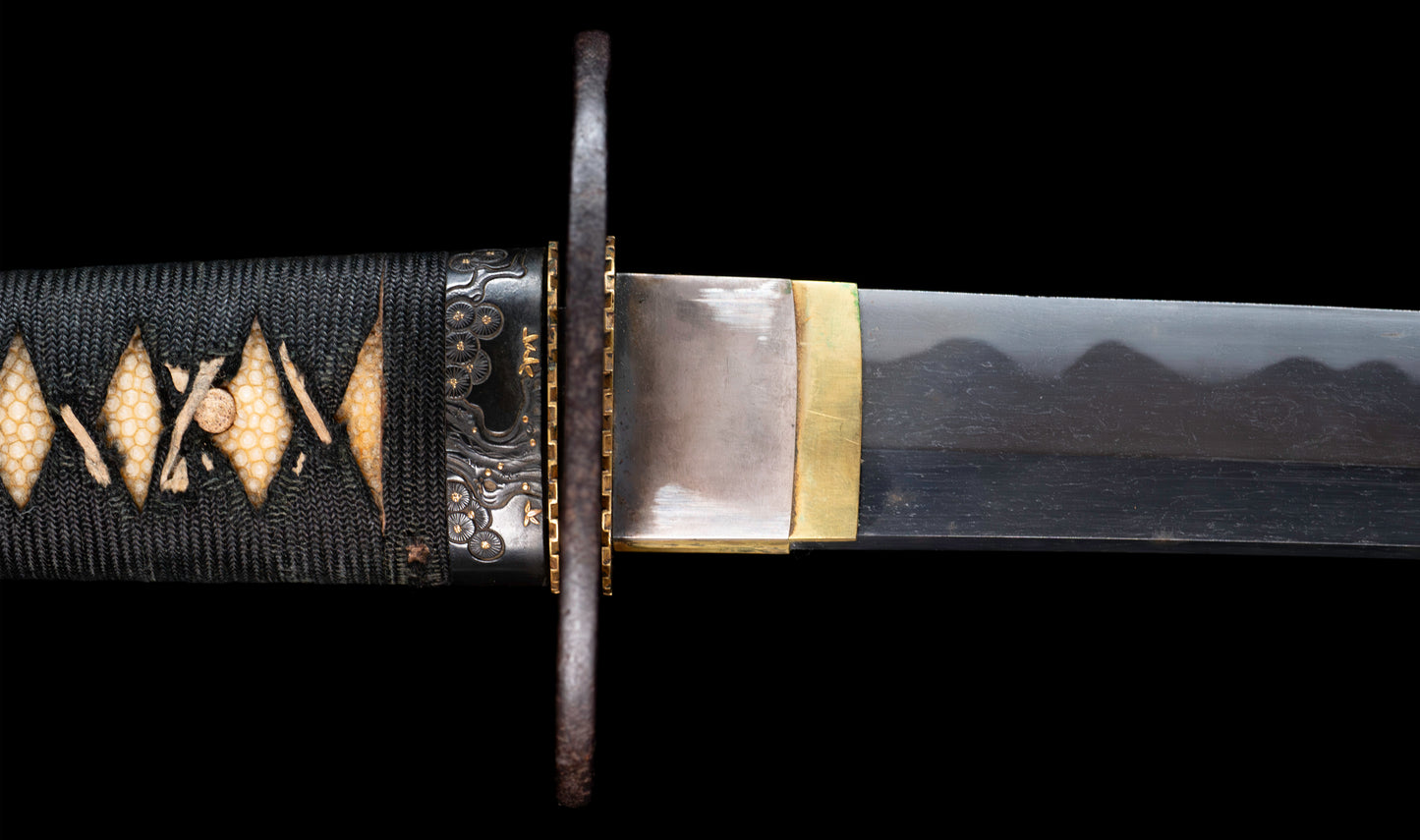
- Hamon: Broad gunome-midare with large rounded peaks, in nioi-deki, with tobiyaki above the habuchi
- Bōshi: Broad and rounded with a shallow kaeri
- Habaki: Two-piece habaki, silver-toned body with a gold-coloured collar
This unsigned Katana is a Shintō blade of the Edo period, and it is a full-sized one: 68.8 cm of nagasa with 1.4 cm of sori, long enough to have real reach and presence in the hand. It survives complete in an unusually striking koshirae, and the blade is in polish with the hamon reading boldly from machi to kissaki.
The blade is shinogi-zukuri with iori-mune and a well-shaped chū-kissaki. The jihada is a tight, densely worked ko-itame, the ji dark and calm under the polish, with a clean shinogi line and a crisply cut yokote. The blade carries substantial thickness through the monouchi — this is a sword with mass behind the edge, not a slender dress piece.
The hamon is the headline. It is a broad gunome-midare of large, generously rounded peaks that roll along the entire length of the ha, wide enough that the tempered band occupies a real share of the blade's width. The nioiguchi is soft and misty, and above the habuchi a scattering of tobiyaki floats free in the ji — isolated islands of hardened steel that catch the light as the blade turns and give the whole surface depth. At the point the bōshi runs broad and rounded with a shallow kaeri.
The nakago carries a single mekugi-ana and is mumei — no signature, and no attribution paper accompanies the sword. That makes it an obvious shinsa candidate: a full-length Shintō katana in polish, with a bold and legible hamon and an undamaged tang, is precisely the kind of blade the NBTHK is set up to examine.
Koshirae Details
The mounting on this sword is the reason to look twice. The saya is lacquered in diagonal bands that spiral the full length of the scabbard — polished black roiro alternating with a dense, glittering speckled ground that throws green and gold as it moves. It is a demanding finish to execute and an extremely effective one: from across a room the saya reads as plain black, and only in the hand does the stripe reveal itself. The sageo is navy blue edged in ivory.
The tsuba is the deliberate counterweight — a large, thick, entirely undecorated mumon iron plate in rounded-square form, with a heavy raised rim and a dense, granular forged skin that has taken on a warm brown-black patina. No inlay, no openwork, nothing but iron and surface. Both hitsu-ana are cut, each finished with small circular piercings at the corners, and brass sekigane seat the plate to this blade.
The fuchi answers with the opposite register: shakudō finely carved with plum blossoms over flowing water, the blossom centres picked out in gold, the current rendered in fluid kebori line work, and the whole framed by a stepped gilt border. The kashira continues the set in shakudō with silver and gold iroe — a fierce, wild-haired figure in a crown surmounted by a flame stares out of the metal in high relief, with a second, serene face beside him, the modelling deep and the expressions genuinely alive.
Beneath the black ito, wrapped hineri-maki over cream same, sits a dragon menuki in shakudō with gilt horns and claws, coiled and worked in full relief. The blade is seated in a two-piece habaki, silver-toned with a gold-coloured collar.
Reading an Unsigned Shintō Blade
Unsigned does not mean anonymous by accident. Plenty of Edo-period blades left the forge without a mei — made to order for a retainer, produced under a workshop rather than a master's own hand, or simply finished without the smith cutting his name. Others lost the signature to later work on the tang. What matters to a buyer is what the steel shows.
Here that is a full 68.8 cm of Shintō blade with a broad, confident gunome-midare and free tobiyaki in the ji — an ambitious temper, not a conservative one. The tight ko-itame and the healthy thickness through the monouchi say the same thing: this was a serious sword when it was made, and it has been looked after since.
What we will not do is put a name on it. No paper accompanies the blade, so we claim no smith and no school, and the price reflects that rather than an attribution we cannot support. For the buyer this is the useful position: the blade is in polish, the hamon and jihada are legible, the tang is sound. Everything a shinsa panel needs is present, and whatever the panel decides is upside that comes with the sword rather than something already priced into it.
The Shintō Katana: Swords in a Time of Peace
The Shintō era begins around 1596, and it begins because the wars stopped. With the Tokugawa settlement, swordsmiths lost their battlefield customers and gained a new one: a hereditary warrior class that wore two swords daily as a matter of law and status. Smiths left the old provincial villages and concentrated in the cities — Edo, Osaka, Kyoto — where the money and the patrons were.
The swords changed with the clientele. Steel became more uniform as smiths bought refined iron rather than smelting locally, so Shintō jihada is typically tighter and quieter than Kotō work. The hamon, by contrast, got louder: freed from pure battlefield economy and competing for attention in a crowded urban market, smiths produced wide, dramatic temper lines full of visible activity. The broad rolling gunome and scattered tobiyaki on this blade belong squarely to that world.
The same shift transformed the koshirae. When a sword is worn every day in public and drawn almost never, the mounting becomes the part everybody sees — and Edo-period fittings makers responded with some of the finest small-scale metalwork ever produced anywhere. This sword shows the taste at its best: a deliberately austere plain iron guard set against a shakudō fuchi-kashira with gold-centred plum blossoms and a figural scene in high relief, all carried on a striped lacquer saya. Restraint and display in the same object, which is exactly what an Edo samurai was aiming for.
What is offered here is a complete, honest Shintō katana — a full-length unsigned blade in polish with a broad gunome hamon and tobiyaki in the ji, dressed in a striking diagonal-striped saya with a heavy plain iron tsuba, finely carved shakudō fuchi-kashira and a gilt dragon menuki.


Collapsible content
Payment
You can pay by Bank card or Bank transfer. If you wish to use bank transfer please contact us using the form bellow with the name of the sword you are willing to buy.
Customs and Taxes
・Import duties, taxes and charges are not included in the item price or shipping charges. These charges are the buyer’s responsibility.
・Please check with your country’s customs office to determine what these additional costs will be prior to bidding/buying.
・These charges are normally collected by the delivering freight (shipping) company or when you pick the item up - do not confuse them for additional shipping charges.
Shipping and Return
- Swords are shipped from Tokyo, Japan. We manage all the procedures to export the sword.
- You can't return sword to Japan because procedures are too strict.
- We work with a shipping company that have experience with Nihonto so you don't have to worry.
- Please check the rules of your country before importing the sword. We do not take any responsibility, including (not limited to) refund, due to the above reasons.
- We can NOT cancel an order once, we already applied for the export authorization. As this document is made to customer name.
We have shipped authentic Japanese swords to the USA, UK, Canada, Mexico, Germany, France, Hong Kong, and Australia. If you don’t live in these countries and like to order, please contact us first before purchasing. We normally ship by EMS (Express Mail Service) provided by Japan Post.
If you live in the UK, please contact us BEFORE order.
Export Procedure (We manage it)
・All our swords are registered in the Agency for Cultural Affairs as artwork and The Board of Education(Cultural properties protection Committee); therefore each sword has the registration card, issued by the Board of Education.
・After receiving the full payment of the items,we return the registration card and get the permission from Ministry of Cultural Affairs to export the swords legally from Japan. It will take about 1 to 3 months for that step.
・After the receiving the permission, we will inform you by email and send the items immediately.
Contact form
What Our Collectors Say
Independent reviews from verified buyers on Trustpilot
Wonderful folks to buy from
“Large selection to choose from. The katana were signed with Hozon and the blades in a shirasaya. My two katana and Kozuka came packed in a solid wooden crate. Great friendly communication.”
Got a beautiful sword delivered to NYC
“Condition is just as pictured. Took a little while to get all the way to the states, but I was very happy with this seller and plan to purchase more from them.”
Order with confidence
“In the end I received what I ordered, well-packaged and in the condition specified.”
Un katana antique magnifique
“J'ai posé beaucoup de questions au support qui a su répondre et m'aider dans mon choix. La commande est arrivée avec le certificat dans un emballage robuste et en parfait état, il est vraiment magnifique !”