

Tokyo Nihonto
Antique Japanaese Katana Sword signed Omi no Kami Fujiwara Tsuguhiro Katana - NBTHK Hozon
Antique Japanaese Katana Sword signed Omi no Kami Fujiwara Tsuguhiro Katana - NBTHK Hozon
Couldn't load pickup availability
- Signature (Mei): 近江守藤原継広 Omi no Kami Fujiwara Tsuguhiro
- Swordsmith: Tsuguhiro (Apprentice of 3rd Gen Yasutsugu)
- School / Tradition: Echizen Shimosaka School (Mino-den roots)
- Period / Province: Early Edo Period (Kanbun era, 1661-1673) / Echizen & Edo
- Certificate: NBTHK Hozon (保存刀剣)
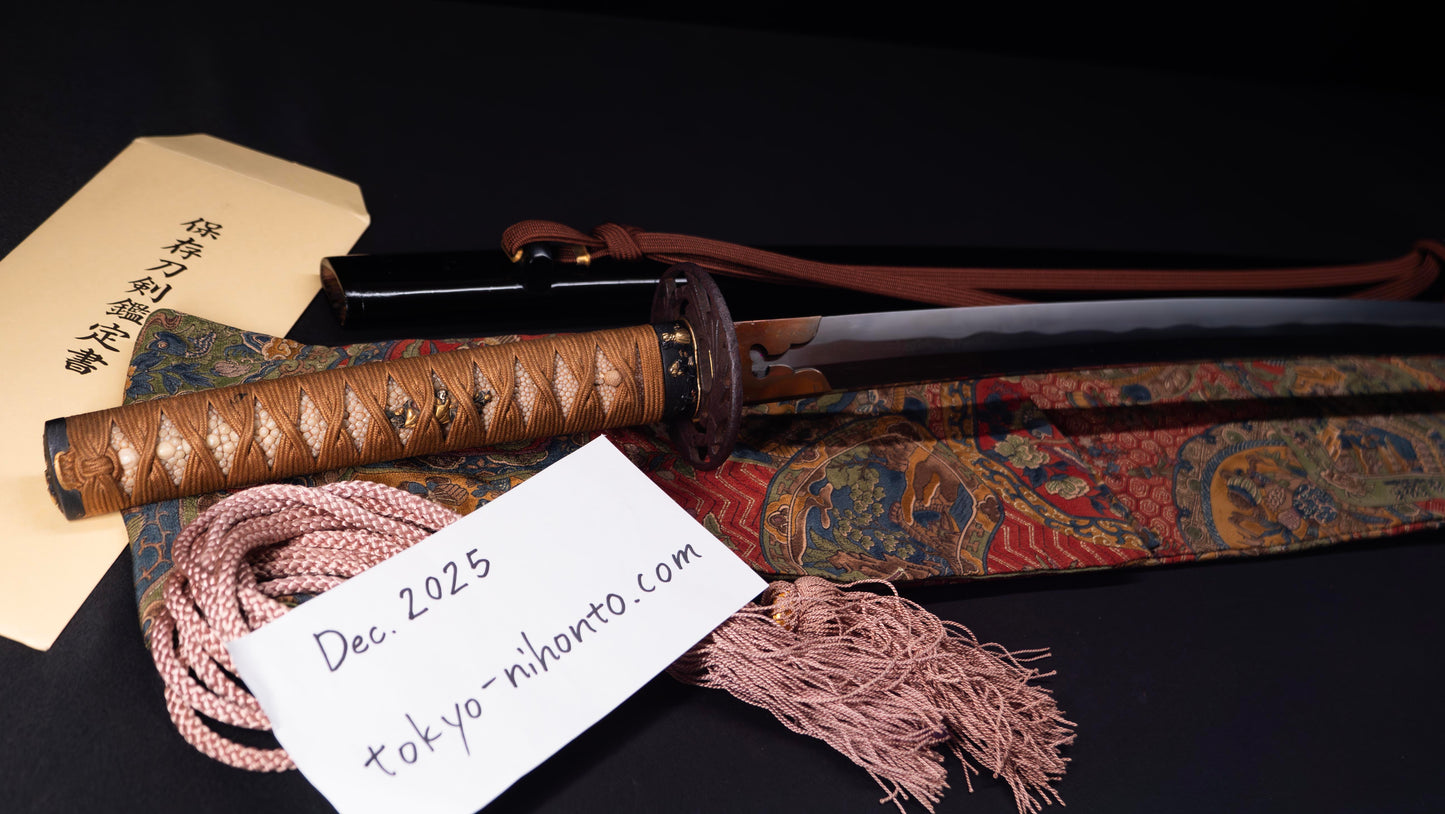
- Mounting: High-quality "Inaho" (Harvest) themed Koshirae
- Blade Length (Nagasa): 65.0 cm
- Curvature (Sori): 1.2 cm
- Mekugi-ana: 2
- Shape: Shinogi-zukuri with a shallow Kanbun-style curvature
- Jihada: Tight Itame with Mino-influenced Shirake-utsuri
- Hamon: Vibrant Gunome-midare with bright Nioikuchi
This refined Katana is a certified NBTHK Hozon work by the esteemed smith Omi no Kami Fujiwara Tsuguhiro. Measuring 65.0 cm with a 1.2 cm sori, the blade exhibits the characteristic "Kanbun Shinto" silhouette—a shape favored by the samurai of the early Edo period for its balanced handling and functional efficiency. The tang is remarkably preserved with two mekugi-ana and a clear, dual-sided signature: the front bearing his prestigious title and name, while the reverse indicates his residence in Echizen under the Shimosaka school name.
The blade's aesthetics are rooted in the Mino-den tradition, featuring a dense and well-forged itame grain. The hamon is a masterful gunome-midare, showing the bright, cloud-like nioikuchi that was a hallmark of the Shimosaka smiths who served the highest levels of the Tokugawa Shogunate.
Koshirae Details
The sword is adorned with a thematic koshirae celebrating Inaho (the rice harvest), a symbol of wealth and divine protection in Japanese culture. The tsuba is a masterful iron sukashi (openwork) piece depicting sheaves of ripening rice. This motif is elegantly continued in the menuki and fuchi-kashira, which feature high-relief carvings of farmers and scenes of abundance. The saya is finished in a deep, lustrous black lacquer, providing a sober yet high-status aesthetic that complements the golden silk tsuka-ito.
Swordsmith Background
Omi no Kami Tsuguhiro was a prominent figure within the Echizen Shimosaka school during the mid-17th century. As a direct apprentice to the third-generation Yasutsugu, Tsuguhiro inherited the elite technical secrets of the Okakaekaji (the official smiths to the Shogun). While primarily based in Echizen, historical records show that his skill was so highly regarded that he was also active in the capital city of Edo. His work is celebrated for bridging the gap between the rugged practicality of Sengoku-era blades and the refined artistry of the peaceful Edo period.
School History
The Echizen Shimosaka School rose to national fame under the patronage of the Tokugawa clan. Founded by the first-generation Yasutsugu—who was granted the use of the "Aoi" (Holly Oak) crest and the character "Yasu" by Tokugawa Ieyasu—the school became synonymous with the "Shinto" (New Sword) era. Blades from this lineage were world-renowned for their razor-sharpness and functional resilience, drawing heavily from the Mino-den style. This katana stands as a testament to that legacy, representing the peak of craftsmanship in the Hokuriku region under the service of the Matsudaira and Tokugawa families.


Collapsible content
Payment
You can pay by Bank card or Bank transfer. If you wish to use bank transfer please contact us using the form bellow with the name of the sword you are willing to buy.
Customs and Taxes
・Import duties, taxes and charges are not included in the item price or shipping charges. These charges are the buyer’s responsibility.
・Please check with your country’s customs office to determine what these additional costs will be prior to bidding/buying.
・These charges are normally collected by the delivering freight (shipping) company or when you pick the item up - do not confuse them for additional shipping charges.
Shipping and Return
- Swords are shipped from Tokyo, Japan. We manage all the procedures to export the sword.
- You can't return sword to Japan because procedures are too strict.
- We work with a shipping company that have experience with Nihonto so you don't have to worry.
- Please check the rules of your country before importing the sword. We do not take any responsibility, including (not limited to) refund, due to the above reasons.
- We can NOT cancel an order once, we already applied for the export authorization. As this document is made to customer name.
We have shipped authentic Japanese swords to the USA, UK, Canada, Mexico, Germany, France, Hong Kong, and Australia. If you don’t live in these countries and like to order, please contact us first before purchasing. We normally ship by EMS (Express Mail Service) provided by Japan Post.
If you live in the UK, please contact us BEFORE order.
Export Procedure (We manage it)
・All our swords are registered in the Agency for Cultural Affairs as artwork and The Board of Education(Cultural properties protection Committee); therefore each sword has the registration card, issued by the Board of Education.
・After receiving the full payment of the items,we return the registration card and get the permission from Ministry of Cultural Affairs to export the swords legally from Japan. It will take about 1 to 3 months for that step.
・After the receiving the permission, we will inform you by email and send the items immediately.
Contact form
What Our Collectors Say
Independent reviews from verified buyers on Trustpilot
Wonderful folks to buy from
“Large selection to choose from. The katana were signed with Hozon and the blades in a shirasaya. My two katana and Kozuka came packed in a solid wooden crate. Great friendly communication.”
Got a beautiful sword delivered to NYC
“Condition is just as pictured. Took a little while to get all the way to the states, but I was very happy with this seller and plan to purchase more from them.”
Order with confidence
“In the end I received what I ordered, well-packaged and in the condition specified.”
Un katana antique magnifique
“J'ai posé beaucoup de questions au support qui a su répondre et m'aider dans mon choix. La commande est arrivée avec le certificat dans un emballage robuste et en parfait état, il est vraiment magnifique !”