


Tokyo Nihonto
Antique Japanese Katana Sword with Floral Iron Sukashi Tsuba, Edo Period Mumei Blade
Antique Japanese Katana Sword with Floral Iron Sukashi Tsuba, Edo Period Mumei Blade
Couldn't load pickup availability
- Signature (Mei): Mumei (無銘) - unsigned
- Type: Katana
- Period: Edo Period (Shintō)
- Mounting: Black urushi koshirae with iron sukashi tsuba and black leather-wrapped tsuka
- Blade Length (Nagasa): approx. 69 cm
- Curvature (Sori): 1.4 cm
- Mekugi-ana: 1
- Shape: Shinogi-zukuri with iori-mune and chū-kissaki
- Jihada: Tight, bright ko-itame
- Hamon: Suguha-chō with gentle notare, nioiguchi with ko-nie
- Boshi: Ko-maru
This Katana is a mumei (unsigned) blade of the Edo period, presented on its own merits—an honest antique Japanese sword, registered in Japan and offered for what the steel itself shows rather than for a name on the tang.
The sugata is a clean shinogi-zukuri with iori-mune, a balanced chū-kissaki, and a moderate 1.4 cm sori—the composed, practical profile of an Edo-period katana made for a samurai to wear and use. In hand the blade is healthy and well-polished, with good substance from machi to point.
The jihada is a tight, well-packed ko-itame, bright and cleanly forged, the kind of disciplined grain that reads as quiet quality rather than showmanship. Against it, the hamon runs as a calm suguha-chō—a straight temper line with a gentle notare undulation—set in a soft nioiguchi with fine ko-nie. The boshi turns back in a tidy ko-maru. This is a restrained, classical aesthetic: the appeal is in the evenness of the work and the brightness of the steel, not in dramatic activity.
A mumei Edo blade like this is exactly what many collectors are looking for as a first authentic nihonto—a genuine, traditionally-forged Japanese sword in honest condition, without the price premium a signature commands. A buyer who later wants formal papers can submit it to NBTHK shinsa.
Koshirae Details
The sword comes in a complete and coordinated black koshirae. The saya is finished in glossy black urushi lacquer—plain and dignified—and dressed with a black sageo.
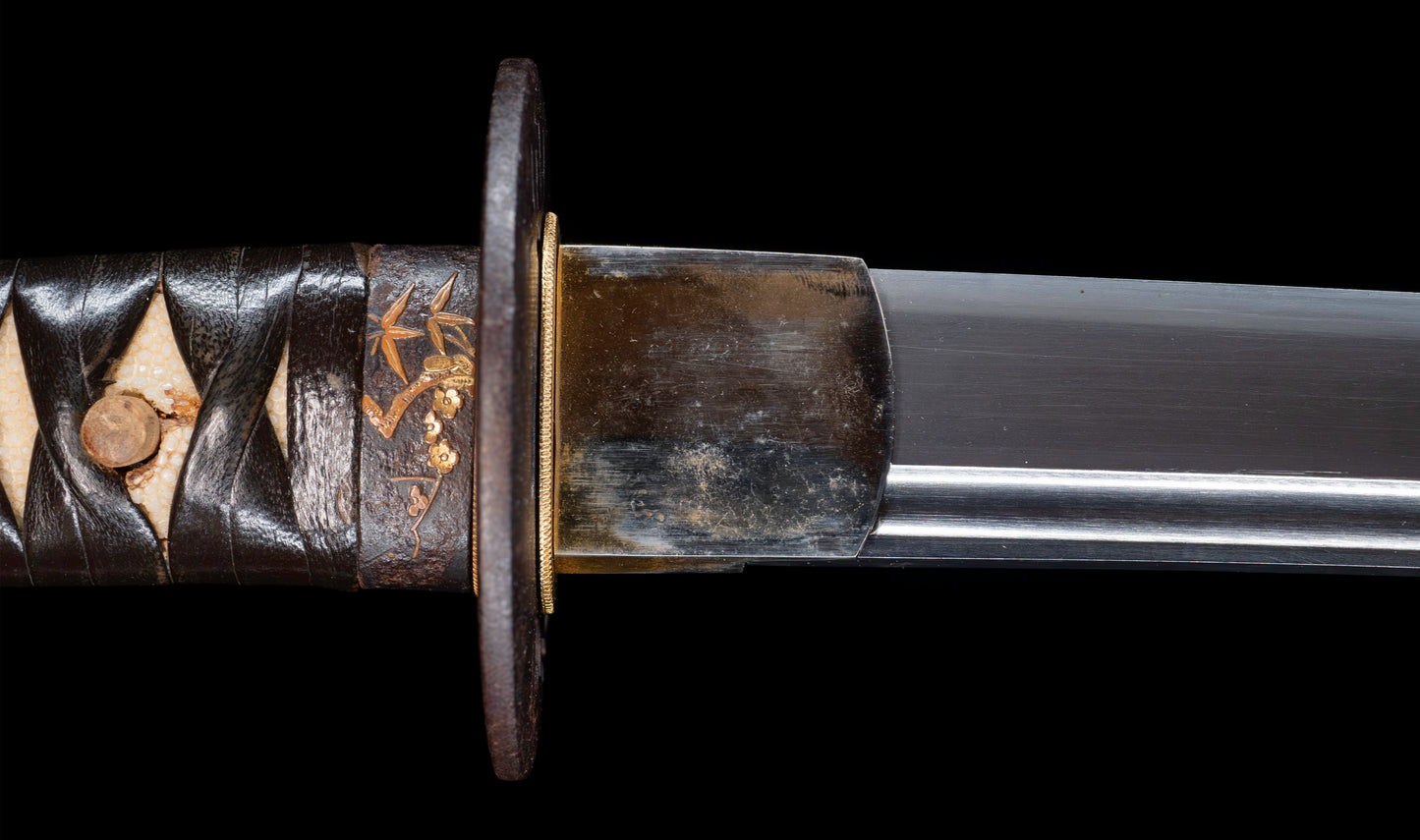
The tsuba is a round tetsu (iron) plate with a dark patina, cut in ji-sukashi (openwork): a stylized floral spray with radiating petals above and a leafy foliage sprig below, with two hitsu-ana for kozuka and kōgai. The fuchi is worked in dark soft metal with a delicate floral design—plum and foliage—picked out in gilt, a refined touch against the sober mounting.
The tsuka is wrapped in black leather (kawa) over white same (rayskin) in the traditional hineri-maki diamond pattern, with finely detailed gilt-highlighted dragon menuki set beneath the wrap. The leather shows honest age and a little minor wear—the kind of character expected of a sword that has been carried and kept rather than locked away. The habaki is a gilt collar. Altogether the fittings make a quiet, tasteful samurai mounting.
About Mumei Edo Katana
A mumei (unsigned) blade is not a lesser blade—it is simply one without a signature on the nakago (tang). Plenty of Edo-period swords left the forge unsigned, and many others lost their signature when shortened over the centuries. What matters is the workmanship: the steel, the temper line, the shape, and the health of the blade. Those are things you can see and hold, and they are the real basis on which a nihonto should be judged.
For a collector, a mumei Edo katana offers a genuine, traditionally-made Japanese sword—forged from tamahagane, hardened with the clay-and-water method that produces the hamon—at a more accessible level than a signed, papered piece by a famous name. This example is an honest, attractive representative of that category: a real Edo blade in full mounts, registered in Japan and ready to study, display, or build a collection around.


Collapsible content
Payment
You can pay by Bank card or Bank transfer. If you wish to use bank transfer please contact us using the form bellow with the name of the sword you are willing to buy.
Customs and Taxes
・Import duties, taxes and charges are not included in the item price or shipping charges. These charges are the buyer’s responsibility.
・Please check with your country’s customs office to determine what these additional costs will be prior to bidding/buying.
・These charges are normally collected by the delivering freight (shipping) company or when you pick the item up - do not confuse them for additional shipping charges.
Shipping and Return
- Swords are shipped from Tokyo, Japan. We manage all the procedures to export the sword.
- You can't return sword to Japan because procedures are too strict.
- We work with a shipping company that have experience with Nihonto so you don't have to worry.
- Please check the rules of your country before importing the sword. We do not take any responsibility, including (not limited to) refund, due to the above reasons.
- We can NOT cancel an order once, we already applied for the export authorization. As this document is made to customer name.
We have shipped authentic Japanese swords to the USA, UK, Canada, Mexico, Germany, France, Hong Kong, and Australia. If you don’t live in these countries and like to order, please contact us first before purchasing. We normally ship by EMS (Express Mail Service) provided by Japan Post.
If you live in the UK, please contact us BEFORE order.
Export Procedure (We manage it)
・All our swords are registered in the Agency for Cultural Affairs as artwork and The Board of Education(Cultural properties protection Committee); therefore each sword has the registration card, issued by the Board of Education.
・After receiving the full payment of the items,we return the registration card and get the permission from Ministry of Cultural Affairs to export the swords legally from Japan. It will take about 1 to 3 months for that step.
・After the receiving the permission, we will inform you by email and send the items immediately.
Contact form
What Our Collectors Say
Independent reviews from verified buyers on Trustpilot
Wonderful folks to buy from
“Large selection to choose from. The katana were signed with Hozon and the blades in a shirasaya. My two katana and Kozuka came packed in a solid wooden crate. Great friendly communication.”
Got a beautiful sword delivered to NYC
“Condition is just as pictured. Took a little while to get all the way to the states, but I was very happy with this seller and plan to purchase more from them.”
Order with confidence
“In the end I received what I ordered, well-packaged and in the condition specified.”
Un katana antique magnifique
“J'ai posé beaucoup de questions au support qui a su répondre et m'aider dans mon choix. La commande est arrivée avec le certificat dans un emballage robuste et en parfait état, il est vraiment magnifique !”