

Tokyo Nihonto
Antique Japanese Katana Sword with Karakusa Tsuba, signed Chōshū Fujiwara Kiyoshige — NBTHK Hozon
Antique Japanese Katana Sword with Karakusa Tsuba, signed Chōshū Fujiwara Kiyoshige — NBTHK Hozon
Couldn't load pickup availability
- Signature (Mei): 長州住藤原清重 Chōshū jū Fujiwara Kiyoshige - zaimei (signed)
- Swordsmith: Fujiwara Kiyoshige (Hasegawa Hachizaemon line, Chōshū / Nagato Province)
- School / Tradition: Chōshū school, descended from the Nioh (二王) lineage
- Period / Province: Edo Period (Shintō, early Edo per NBTHK) / Nagato Province
- Certificate: NBTHK Hozon Kanteishō No. 3036993 (Reiwa 7 / 2025)
- Mounting: Black lacquer koshirae with karakusa iron tsuba and gold-highlighted fittings
- Blade Length (Nagasa): 68.4 cm (2 shaku 2 sun 6 bu jaku)
- Curvature (Sori): approx. 1.5 cm - to be confirmed
- Mekugi-ana: 3
- Shape: Shinogi-zukuri with iori-mune and chū-kissaki
- Jihada: Bright, tightly forged itame
- Hamon: Suguha-chō with gentle notare, soft nioiguchi with ko-nie
- Boshi: Ko-maru
This Katana is a signed (zaimei) work by Chōshū jū Fujiwara Kiyoshige, a swordsmith of Nagato Province (Chōshū, today's Yamaguchi Prefecture), certified by the NBTHK in a current Hozon appraisal (Reiwa 7 / 2025) and classified as a Shintō work of the early Edo period. The signature runs clearly down the nakago; the tang carries three mekugi-ana, the record of a long working life and repeated remounting, with the mei preserved throughout.
The sugata is a clean shinogi-zukuri with iori-mune and a balanced chū-kissaki, measuring 68.4 cm - the composed, practical proportions of an Edo-period katana made to be worn and used. The blade is healthy and bright in polish.
The jihada is a tightly forged itame, bright and well-packed. The hamon is a calm suguha-chō - a straight-based temper with a gentle notare movement - set in a soft nioiguchi with fine ko-nie, running to a tidy ko-maru boshi. This restrained, disciplined suguha is exactly the manner for which the Chōshū Kiyoshige smiths are known: the appeal lies in the clarity of the steel and the evenness of the temper rather than in flamboyant activity.
Koshirae Details
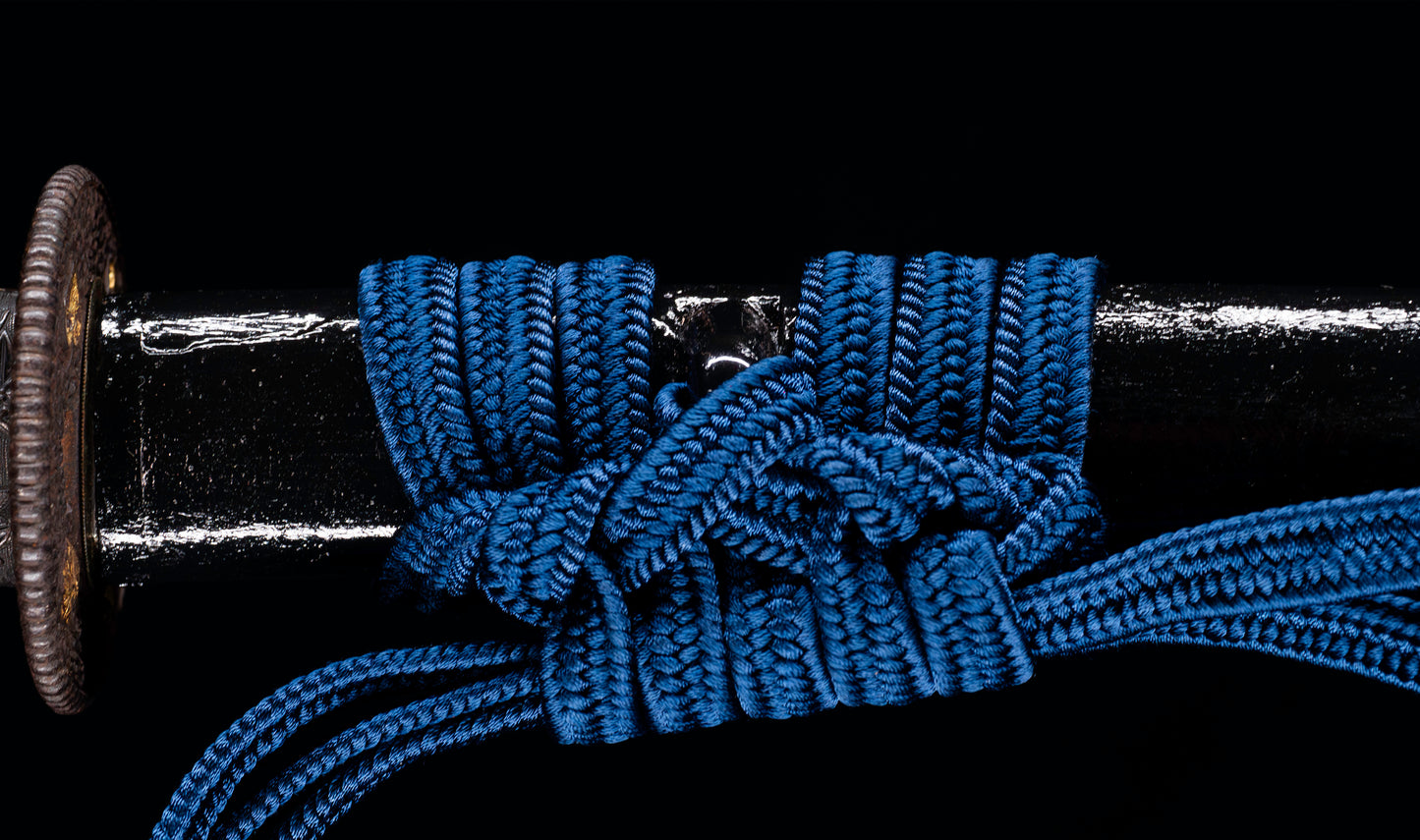
The blade is housed in a coherent black koshirae. The saya is finished in black lacquer with honest surface texture, dressed with a dark-blue sageo. The tsuba is a round iron plate worked with a dense karakusa (arabesque scrollwork) ground and a carved rope-twist (nawame) rim, accented with gold-highlighted heart-shaped leaf motifs arranged around the seppa-dai - a rich, decorative piece of ironwork.
The fuchi is a dark soft-metal fitting with a fine nanako (stippled) ground and a floral/foliate design in relief, edged in gilt; the kashira is a dark, ishime-textured cap. Beneath the wrap sit finely cast dark menuki. The tsuka is wrapped in deep purple-brown silk ito over bright white same (rayskin) in the traditional hineri-maki diamond pattern, and the blade seats into a two-tone, vertically filed habaki. The whole is a tasteful, well-matched samurai mounting in good order.
Swordsmith Background: Chōshū Fujiwara Kiyoshige
Fujiwara Kiyoshige (藤原清重) worked in Chōshū - the old name for Nagato Province, in the far west of Honshū (today Yamaguchi Prefecture). "Chōshū jū" on the tang means he was resident there when he forged the blade. The Kiyoshige name continued across several generations in Chōshū through the Edo period, from the late 17th into the mid-19th century; the NBTHK attributes work of this signature to the early Edo generation (late 17th century).
The early Kiyoshige smiths are identified with the Hasegawa Hachizaemon line of Hagi in Nagato - specifically Nagato no Kuni Abu-gun Hagi jū Hasegawa Hachizaemon no Jō Kiyoshige, whose real name was Hasegawa Kanbei (長谷川勘兵衛), and his son the second-generation Hasegawa Hachizaemon Kiyoshige. The first generation moved from Bizen to Hagi around the Kan'ei era (early-to-mid 17th century) and became okakae-kaji - the exclusive retained swordsmith - to the Mōri family, lords of the Chōshū domain. The second generation, working from Hagi and later Susa in Abu-gun, served as okakae-kaji to the Masuda family, chief retainers of the domain.
The Kiyoshige family is said to have held the head position among the Chōshū domain's swordsmiths for generations. Tellingly, when Minamoto Kiyomaro - counted among the three greatest smiths of the late Edo period - stayed in Hagi for a time during the Tenpō era, it was the Kiyoshige line that stood as the domain's chief swordsmiths. That standing speaks to how highly the family's craftsmanship was regarded.
Lineage: The Nioh (二王) School and the Chōshū Tradition
Behind the Chōshū Kiyoshige smiths lies one of the oldest lineages in Japanese sword history - the Nioh (二王) school. Founded by Nioh Tarō Kiyotsuna (二王太郎清綱) in Suō Province (also in today's Yamaguchi Prefecture), the school is traditionally said to have begun forging in the early Kamakura period; its oldest surviving dated blade was made in 1265 and is enshrined at the Itsukushima Shrine in Hiroshima. The Nioh school flourished from the mid-Kamakura through the late Muromachi period, its smiths passing down the founder's character 清 (Kiyo) in names such as Kiyofusa, Kiyonaga - and, in the Edo period, Kiyoshige.
As the old Nioh school declined in the early Edo period, the first Hasegawa Hachizaemon Kiyoshige carried its "Kiyo" name west to Hagi and into the service of the Mōri domain, effectively transplanting this ancient tradition into Chōshū's Shintō-era workshops. Chōshū itself was a productive sword province throughout the Edo period - famous twice over, for its swordsmiths and for the celebrated Chōshū school of iron tsuba and fittings, whose pierced ironwork collectors prize to this day.
A signed, NBTHK-papered Chōshū Kiyoshige katana therefore offers more than a single blade: it is a documented Shintō sword carrying a lineage that reaches back through the Nioh school to the Kamakura age - a genuine, traditionally forged nihonto in honest mounts, authenticated by Japan's principal appraisal body.


Collapsible content
Payment
You can pay by Bank card or Bank transfer. If you wish to use bank transfer please contact us using the form bellow with the name of the sword you are willing to buy.
Customs and Taxes
・Import duties, taxes and charges are not included in the item price or shipping charges. These charges are the buyer’s responsibility.
・Please check with your country’s customs office to determine what these additional costs will be prior to bidding/buying.
・These charges are normally collected by the delivering freight (shipping) company or when you pick the item up - do not confuse them for additional shipping charges.
Shipping and Return
- Swords are shipped from Tokyo, Japan. We manage all the procedures to export the sword.
- You can't return sword to Japan because procedures are too strict.
- We work with a shipping company that have experience with Nihonto so you don't have to worry.
- Please check the rules of your country before importing the sword. We do not take any responsibility, including (not limited to) refund, due to the above reasons.
- We can NOT cancel an order once, we already applied for the export authorization. As this document is made to customer name.
We have shipped authentic Japanese swords to the USA, UK, Canada, Mexico, Germany, France, Hong Kong, and Australia. If you don’t live in these countries and like to order, please contact us first before purchasing. We normally ship by EMS (Express Mail Service) provided by Japan Post.
If you live in the UK, please contact us BEFORE order.
Export Procedure (We manage it)
・All our swords are registered in the Agency for Cultural Affairs as artwork and The Board of Education(Cultural properties protection Committee); therefore each sword has the registration card, issued by the Board of Education.
・After receiving the full payment of the items,we return the registration card and get the permission from Ministry of Cultural Affairs to export the swords legally from Japan. It will take about 1 to 3 months for that step.
・After the receiving the permission, we will inform you by email and send the items immediately.
Contact form
What Our Collectors Say
Independent reviews from verified buyers on Trustpilot
Wonderful folks to buy from
“Large selection to choose from. The katana were signed with Hozon and the blades in a shirasaya. My two katana and Kozuka came packed in a solid wooden crate. Great friendly communication.”
Got a beautiful sword delivered to NYC
“Condition is just as pictured. Took a little while to get all the way to the states, but I was very happy with this seller and plan to purchase more from them.”
Order with confidence
“In the end I received what I ordered, well-packaged and in the condition specified.”
Un katana antique magnifique
“J'ai posé beaucoup de questions au support qui a su répondre et m'aider dans mon choix. La commande est arrivée avec le certificat dans un emballage robuste et en parfait état, il est vraiment magnifique !”