

Tokyo Nihonto
Antique Japanese Katana with Black Lacquer Koshirae and Feather-Motif Iron Tsuba signed Chikushi Tadamasa - Hozon
Antique Japanese Katana with Black Lacquer Koshirae and Feather-Motif Iron Tsuba signed Chikushi Tadamasa - Hozon
Couldn't load pickup availability
- Signature (Mei): 筑紫忠正作 Chikushi Tadamasa saku
- Swordsmith: Chikushi Tadamasa
- Classification: Gendaitō (現代刀) - modern traditionally-made nihonto, Shōwa era
- Certificate: NBTHK Hozon Tōken (保存刀剣) No. 361035 - issued February 2002 (Heisei 14)
- Mounting: Full black urushi koshirae with iron feather-motif tsuba
- Blade Length (Nagasa): 62.7 cm (2 shaku 0 sun 6 bu 5 rin)
- Curvature (Sori): 1.3 cm - elegant, restrained torii-zori
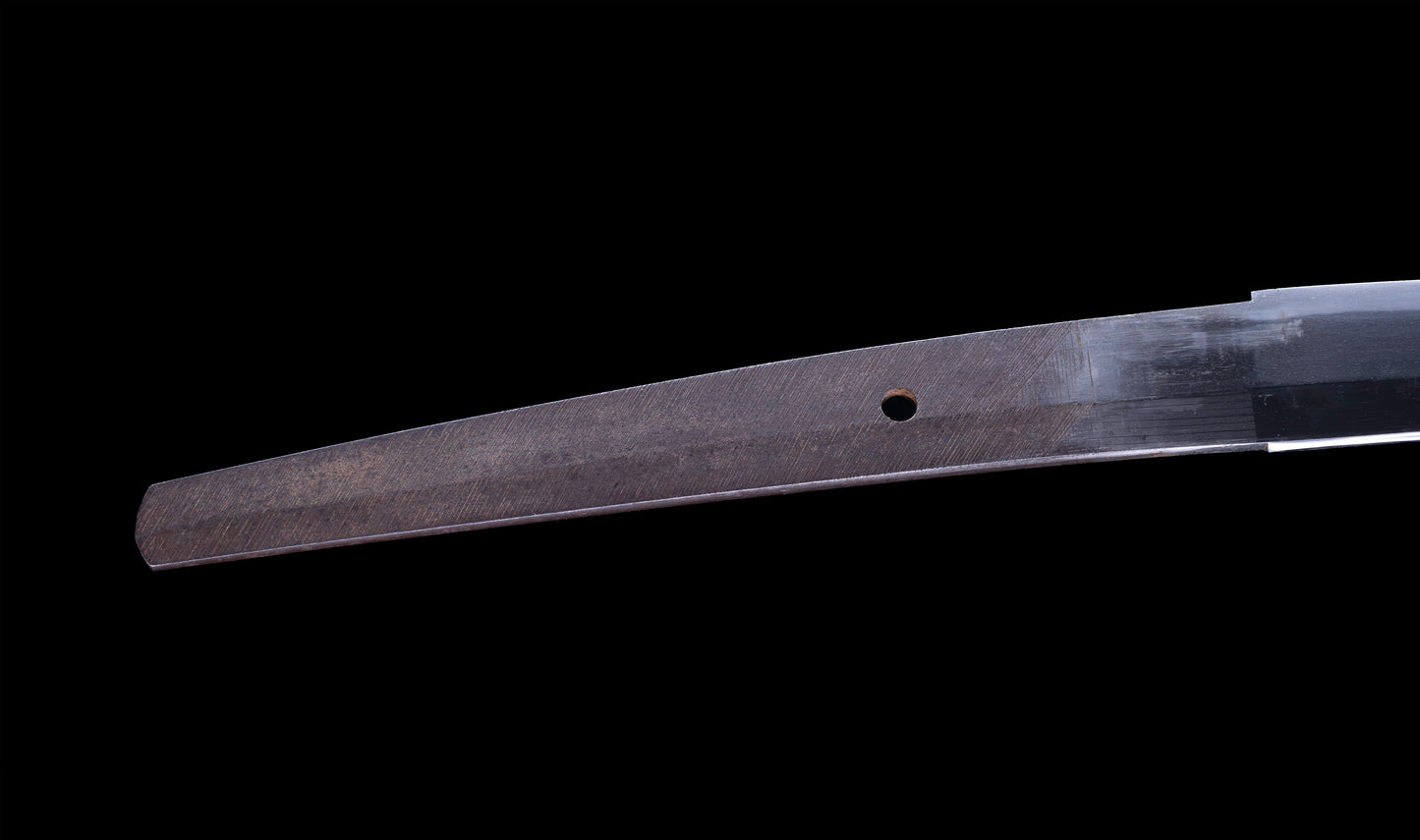
- Mekugi-ana: 1 (ubu - original, unaltered nakago)
- Shape: Shinogi-zukuri with iori-mune and chū-kissaki
- Jihada: Tight, well-forged ko-itame
- Hamon: Notare with gunome, bright nioiguchi, ko-nie and prominent ashi
This Katana is a signed, NBTHK Hozon-certified gendaitō bearing the mei 筑紫忠正作 (Chikushi Tadamasa saku) and dated by the NBTHK to the Shōwa era. Measuring 62.7 cm with a controlled 1.3 cm sori, it is a fully traditional Japanese sword forged from tamahagane in the classical manner—not a wartime arsenal blade and not a replica. For a 20th-century work to pass NBTHK shinsa and receive Hozon papers, the appraisers must confirm both that the signature is authentic and that the blade was made by genuine traditional methods. That distinction is exactly what separates a real nihonto from the oil-quenched showatō that flood the modern market.
The blade is healthy and full-bodied, presented in shinogi-zukuri with iori-mune and a balanced chū-kissaki. The jihada is a dense, tightly forged ko-itame, clean and well-controlled across the ji—the kind of disciplined grain a properly trained Shōwa smith achieved through patient folding. Against this ground, the hamon runs as a flowing notare with gunome undulations, set in a bright nioiguchi with a covering of fine ko-nie.
What gives this blade its character under close inspection is the activity inside the hardened edge: pronounced ashi reach down toward the cutting edge in clear diagonal lines, breaking the hamon into lively, rhythmic compartments. This is workmanship meant to be studied in hand and under proper light. The boshi turns back in a tidy ko-maru, with controlled hamon carried cleanly to the point.
The nakago is ubu (original and unshortened), retaining its single mekugi-ana and the smith's clearly chiseled sashimei. An untouched tang on a signed blade is the ideal state of preservation—nothing has been altered, the signature stands exactly as the smith left it, and the NBTHK has confirmed it.
Koshirae Details
The sword is mounted in a complete black koshirae built for quiet elegance rather than display. The saya is finished in deep, glossy black urushi lacquer—smooth and unadorned, letting the form of the mounting speak for itself—and is dressed with a black-and-white speckled sageo.
The tsuba is the standout fitting: a robust tetsu (iron) guard in mokkō-gata (four-lobed) form, its plate showing honest forged-iron texture. Across both faces it is decorated with scattered feathers in soft-metal zōgan (inlay), each one detailed with fine kebori hair-line engraving to render the quill and barbs. The feather—and the arrow-fletching it evokes—is a classic samurai motif, read as an emblem of resolve and forward purpose. Two hitsu-ana flank the central nakago-ana for kozuka and kōgai.
The tsuka is wrapped in black ito over white same (rayskin) in the traditional hineri-maki diamond pattern, the white nodules of the samegawa showing crisply through the lattice. Beneath the wrap sit finely cast menuki in dark patinated metal, worked in detailed figural relief. The overall presentation is restrained and confident—a working samurai aesthetic rather than a decorative one.
Swordsmith Background
This blade is signed 筑紫忠正作 (Chikushi Tadamasa saku)—"made by Chikushi Tadamasa." The NBTHK has examined the work, confirmed the signature, and dated the blade to the Shōwa period, the era of modern traditional sword-making that began once licensed forging resumed in postwar Japan.
The art-name Chikushi (also read Tsukushi) is the classical name for the lands of northern Kyushu—the old Chikuzen and Chikugo provinces, in present-day Fukuoka—a region with a long sword-making heritage. The blade itself reflects sound, orthodox training: a clean ko-itame jihada and a controlled notare-gunome hamon with bright nioiguchi and active ashi, executed with the discipline expected of a properly licensed Shōwa smith working in tamahagane.
Rather than attach romanticized provenance to this piece, we let the evidence stand: a signed blade, an ubu tang, genuine traditional workmanship, and NBTHK Hozon papers confirming all of it. That is a more honest foundation for a collector than an invented backstory.
Gendaitō: Modern Swords in the Traditional Tradition
A gendaitō (現代刀, "modern sword") is a Japanese blade made from 1876 onward by traditional methods—tamahagane steel, folded and forged by hand, differentially hardened with a clay coating and water quench. The category is frequently misunderstood: a gendaitō is a true nihonto in every technical sense, distinct from the mass-produced, machine-made, oil-quenched showatō turned out as wartime sidearms, and worlds apart from the cast or stainless replicas sold as decoration.
The dividing line is precisely what NBTHK certification establishes. When the NBTHK awards Hozon Tōken ("worthy of preservation") status to a modern blade, it is certifying that the sword was made by hand in the traditional manner and that its signature is authentic. For a buyer, that paper removes the single biggest risk in the modern-sword market: paying nihonto money for something that was never traditionally forged at all.
This katana sits firmly on the right side of that line—a signed, Hozon-certified Shōwa work in honest black koshirae, preserving the full discipline of the Japanese swordsmith's craft into the modern age.


Collapsible content
Payment
You can pay by Bank card or Bank transfer. If you wish to use bank transfer please contact us using the form bellow with the name of the sword you are willing to buy.
Customs and Taxes
・Import duties, taxes and charges are not included in the item price or shipping charges. These charges are the buyer’s responsibility.
・Please check with your country’s customs office to determine what these additional costs will be prior to bidding/buying.
・These charges are normally collected by the delivering freight (shipping) company or when you pick the item up - do not confuse them for additional shipping charges.
Shipping and Return
- Swords are shipped from Tokyo, Japan. We manage all the procedures to export the sword.
- You can't return sword to Japan because procedures are too strict.
- We work with a shipping company that have experience with Nihonto so you don't have to worry.
- Please check the rules of your country before importing the sword. We do not take any responsibility, including (not limited to) refund, due to the above reasons.
- We can NOT cancel an order once, we already applied for the export authorization. As this document is made to customer name.
We have shipped authentic Japanese swords to the USA, UK, Canada, Mexico, Germany, France, Hong Kong, and Australia. If you don’t live in these countries and like to order, please contact us first before purchasing. We normally ship by EMS (Express Mail Service) provided by Japan Post.
If you live in the UK, please contact us BEFORE order.
Export Procedure (We manage it)
・All our swords are registered in the Agency for Cultural Affairs as artwork and The Board of Education(Cultural properties protection Committee); therefore each sword has the registration card, issued by the Board of Education.
・After receiving the full payment of the items,we return the registration card and get the permission from Ministry of Cultural Affairs to export the swords legally from Japan. It will take about 1 to 3 months for that step.
・After the receiving the permission, we will inform you by email and send the items immediately.
Contact form
What Our Collectors Say
Independent reviews from verified buyers on Trustpilot
Wonderful folks to buy from
“Large selection to choose from. The katana were signed with Hozon and the blades in a shirasaya. My two katana and Kozuka came packed in a solid wooden crate. Great friendly communication.”
Got a beautiful sword delivered to NYC
“Condition is just as pictured. Took a little while to get all the way to the states, but I was very happy with this seller and plan to purchase more from them.”
Order with confidence
“In the end I received what I ordered, well-packaged and in the condition specified.”
Un katana antique magnifique
“J'ai posé beaucoup de questions au support qui a su répondre et m'aider dans mon choix. La commande est arrivée avec le certificat dans un emballage robuste et en parfait état, il est vraiment magnifique !”