


Tokyo Nihonto
Antique Japanese Katana Sword with Toran Hamon and Cherry-Blossom Iron Tsuba — Osaka Shintō
Antique Japanese Katana Sword with Toran Hamon and Cherry-Blossom Iron Tsuba — Osaka Shintō
Couldn't load pickup availability
- Signature (Mei): Mumei (無銘) - unsigned
- Tradition: Osaka Shintō workmanship
- Period: Edo Period, Kanbun era (mid-17th century)
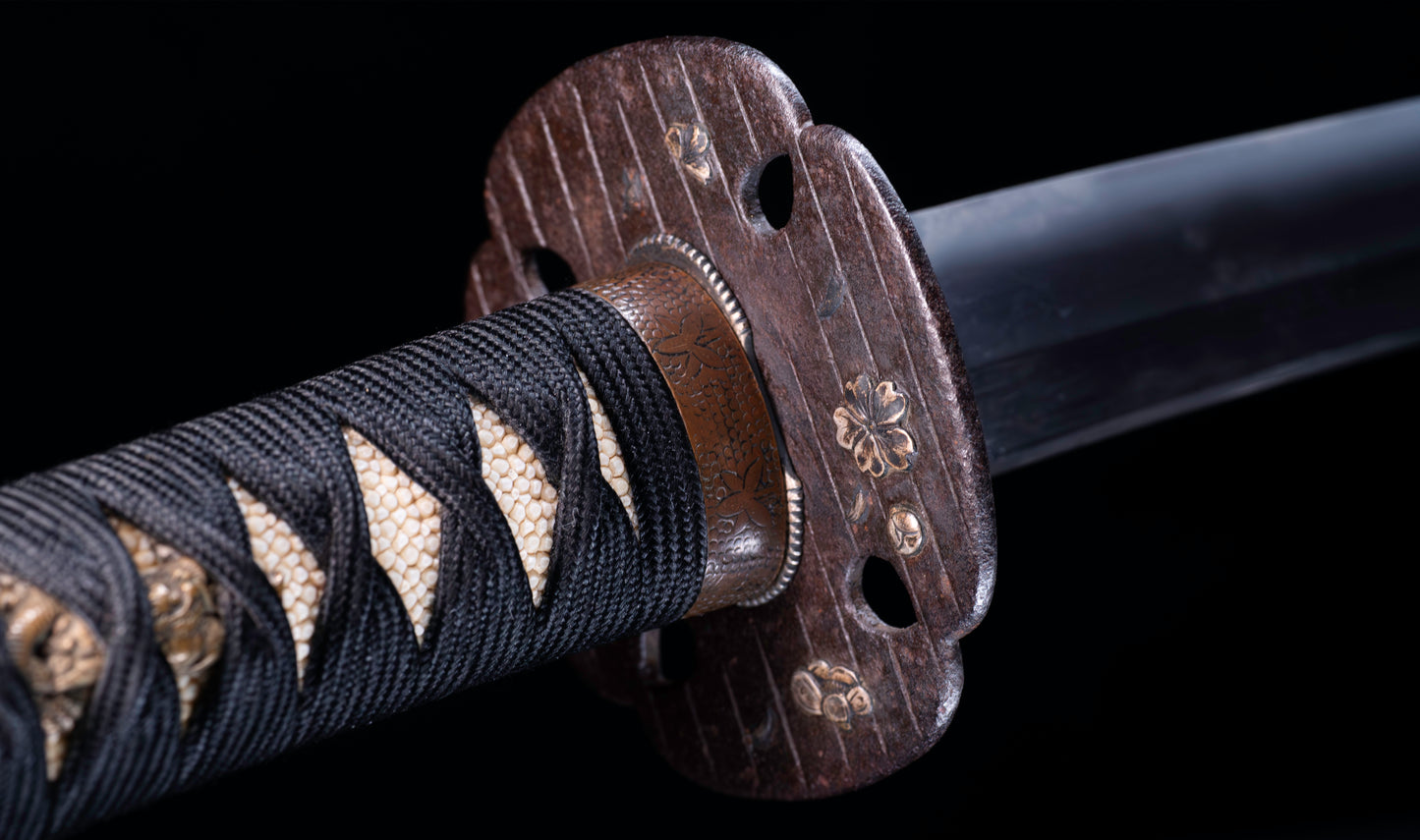
- Mounting: Black-and-russet mottled urushi koshirae with iron mokkō tsuba and silver cherry-blossom decoration
- Blade Length (Nagasa): approx. 63.0 cm (2 shaku 0 sun 8 bu)
- Curvature (Sori): approx. 1.1 cm - shallow Kanbun-Shintō curve
- Mekugi-ana: 2 (suriage - shortened)
- Shape: Shinogi-zukuri with iori-mune and chū-kissaki
- Jihada: Tight, bright ko-itame - classic Osaka jigane
- Hamon: Notare tending to toran-midare, nioiguchi with ko-nie and ashi
This Katana is a mumei (unsigned), suriage (shortened) blade in the unmistakable manner of the Osaka Shintō tradition. We describe it on the evidence of the steel itself rather than a signature—because the signature was lost when an older, longer blade was cut down from the tang. What survives is the workmanship, and it reads clearly.
The first thing a trained eye looks for in an Osaka blade is the steel, and this one delivers it: a jihada of tight, well-packed ko-itame, bright and nearly without visible openings—the refined ō-saka-tetsu (Osaka steel) that made the school's reputation. Against that clean ground, the hamon runs as a generous notare swelling toward toran-midare—the rolling, wave-like temper line popularized by Tsuda Sukehiro and his circle—set in a soft nioiguchi with ko-nie and ashi reaching into the hardened edge.
The sugata is textbook Kanbun Shintō: shinogi-zukuri with iori-mune, a controlled chū-kissaki, and the characteristically shallow sori of the 1660s–70s, when Osaka smiths favored a straighter, businesslike profile. The boshi follows the hamon into the point with a tidy turnback. In hand, the blade is healthy and well-polished, showing the bright, frosty hardened edge collectors associate with this school.
The nakago shows two mekugi-ana, the physical record of its shortening. This is an honest antique blade, valued for what it plainly is: quality Osaka Shintō steel and tempering from the heart of the Shintō period.
Koshirae Details
The sword is mounted in a handsome, sober black koshirae with one genuinely distinctive element. The saya is finished in a mottled black-and-russet urushi lacquer—a variegated, bark-like surface where warm reddish-brown breaks through the black ground, giving the scabbard real depth and movement under light rather than a flat finish. It is dressed with a navy-blue (kon-iro) sageo.
The tsuba is an iron mokkō-gata (four-lobed) plate worked with fine vertical line-carving across both faces and decorated with applied silver cherry blossoms (sakura) and buds scattered as if drifting—a quiet, elegant contrast of bright silver against dark iron. The fuchi continues the floral theme in patinated soft metal with engraved blossoms and foliage picked out in gilt, over a finely textured ground.
The habaki is a clean silver single-piece collar cut with diagonal file-lines (neko-gaki). The tsuka is wrapped in black ito over white same (rayskin) in the traditional hineri-maki diamond pattern, with gilt figural menuki set beneath the wrap. Taken together, the fittings are coordinated and tasteful—a samurai mounting assembled with care rather than for show.
Osaka Shintō: The School of Beautiful Steel
After Toyotomi Hideyoshi built Osaka Castle, the city grew into Japan's commercial heart, and swordsmiths flocked there to work for the merchants, samurai, and feudal lords who passed through. Out of that concentration of talent came Osaka Shintō—a tradition defined above all by the beauty of its jigane. The access to high-quality material and water in Osaka let its smiths forge a steel so tight and luminous it is recognizable on sight, often described simply as ō-saka-tetsu.
The three giants of the school—the Sanketsu—were Awataguchi Tadatsuna, Inoue Shinkai, and Tsuda Sukehiro, the last of whom perfected the flamboyant toranba ("billowing-wave") hamon that influenced the entire city. Osaka Shintō blades pair that refined steel with bold, rhythmic temper lines—an aesthetic prized by collectors precisely because it is so hard to imitate convincingly.
This katana belongs to that world. Its tight, bright jigane and Sukehiro-influenced notare-toran hamon place it firmly within the Osaka Shintō idiom—an authentic mid-Edo blade carrying the hallmarks that made these swords the gold standard of their era.


Collapsible content
Payment
You can pay by Bank card or Bank transfer. If you wish to use bank transfer please contact us using the form bellow with the name of the sword you are willing to buy.
Customs and Taxes
・Import duties, taxes and charges are not included in the item price or shipping charges. These charges are the buyer’s responsibility.
・Please check with your country’s customs office to determine what these additional costs will be prior to bidding/buying.
・These charges are normally collected by the delivering freight (shipping) company or when you pick the item up - do not confuse them for additional shipping charges.
Shipping and Return
- Swords are shipped from Tokyo, Japan. We manage all the procedures to export the sword.
- You can't return sword to Japan because procedures are too strict.
- We work with a shipping company that have experience with Nihonto so you don't have to worry.
- Please check the rules of your country before importing the sword. We do not take any responsibility, including (not limited to) refund, due to the above reasons.
- We can NOT cancel an order once, we already applied for the export authorization. As this document is made to customer name.
We have shipped authentic Japanese swords to the USA, UK, Canada, Mexico, Germany, France, Hong Kong, and Australia. If you don’t live in these countries and like to order, please contact us first before purchasing. We normally ship by EMS (Express Mail Service) provided by Japan Post.
If you live in the UK, please contact us BEFORE order.
Export Procedure (We manage it)
・All our swords are registered in the Agency for Cultural Affairs as artwork and The Board of Education(Cultural properties protection Committee); therefore each sword has the registration card, issued by the Board of Education.
・After receiving the full payment of the items,we return the registration card and get the permission from Ministry of Cultural Affairs to export the swords legally from Japan. It will take about 1 to 3 months for that step.
・After the receiving the permission, we will inform you by email and send the items immediately.
Contact form
What Our Collectors Say
Independent reviews from verified buyers on Trustpilot
Wonderful folks to buy from
“Large selection to choose from. The katana were signed with Hozon and the blades in a shirasaya. My two katana and Kozuka came packed in a solid wooden crate. Great friendly communication.”
Got a beautiful sword delivered to NYC
“Condition is just as pictured. Took a little while to get all the way to the states, but I was very happy with this seller and plan to purchase more from them.”
Order with confidence
“In the end I received what I ordered, well-packaged and in the condition specified.”
Un katana antique magnifique
“J'ai posé beaucoup de questions au support qui a su répondre et m'aider dans mon choix. La commande est arrivée avec le certificat dans un emballage robuste et en parfait état, il est vraiment magnifique !”