

Tokyo Nihonto
Antikes japanisches Katana-Schwert mit floralem Eisen-Sukashi-Tsuba, Edo-Periode Mumei-Klinge
Antikes japanisches Katana-Schwert mit floralem Eisen-Sukashi-Tsuba, Edo-Periode Mumei-Klinge
Verfügbarkeit für Abholungen konnte nicht geladen werden
- Signatur (Mei): Mumei (無銘) - unsigniert
- Typ: Katana
- Periode: Edo-Zeit (Shintō)
- Montierung: Schwarze Urushi-Koshirae mit Eisen-Sukashi-Tsuba und schwarzem lederumwickeltem Tsuka
- Klingenlänge (Nagasa): ca. 69 cm
- Krümmung (Sori): 1,4 cm
- Mekugi-ana: 1
- Form: Shinogi-zukuri mit Iori-mune und Chū-kissaki
- Jihada: Dichtes, helles Ko-itame
- Hamon: Suguha-chō mit sanftem Notare, Nioiguchi mit Ko-nie
- Boshi: Ko-maru
Dieses Katana ist eine mumei (unsignierte) Klinge aus der Edo-Zeit, präsentiert auf ihre eigenen Verdienste hin—ein ehrliches antikes japanisches Schwert, in Japan registriert und angeboten für das, was der Stahl selbst zeigt, statt für einen Namen auf der Angel.
Die Sugata ist eine saubere Shinogi-zukuri mit Iori-mune, ein ausgewogenes Chū-kissaki und eine moderate 1,4 cm Sori—das ausgewogene, praktische Profil eines Edo-zeitlichen Katana, das für einen Samurai zum Tragen und Gebrauchen gefertigt wurde. In der Hand ist die Klinge gesund und gut poliert, mit guter Substanz von der Machi bis zur Spitze.
Die Jihada ist ein dichtes, gut gepacktes Ko-itame, hell und sauber geschmiedet, die Art von diszipliniertem Gefüge, das als stille Qualität statt Showmanship wirkt. Dagegen verläuft die Hamon als eine ruhige Suguha-chō—eine gerade Härtungslinie mit sanfter Notare-Wellenbewegung—in einer weichen Nioiguchi mit feinem Ko-nie. Die Boshi wendet sich in einem ordentlichen Ko-maru zurück. Dies ist eine zurückhaltende, klassische Ästhetik: der Reiz liegt in der Gleichmäßigkeit der Arbeit und der Helligkeit des Stahls, nicht in dramatischer Aktivität.
Ein mumei Edo-Schwert wie dieses ist genau das, was viele Sammler als erstes authentisches Nihonto suchen—ein echtes, traditionell geschmiedetes japanisches Schwert in ehrlicher Verfassung, ohne die Preisaufschlag, den eine Signatur fordert. Ein Käufer, der später offizielle Papiere möchte, kann es zur NBTHK Shinsa einreichen.
Koshirae-Details
Das Schwert kommt in einer vollständigen und aufeinander abgestimmten schwarzen Koshirae. Die Saya ist mit glänzendem schwarzem Urushi-Lack fertiggestellt—schlicht und würdevoll—und mit einem schwarzen Sageo ausgestattet.
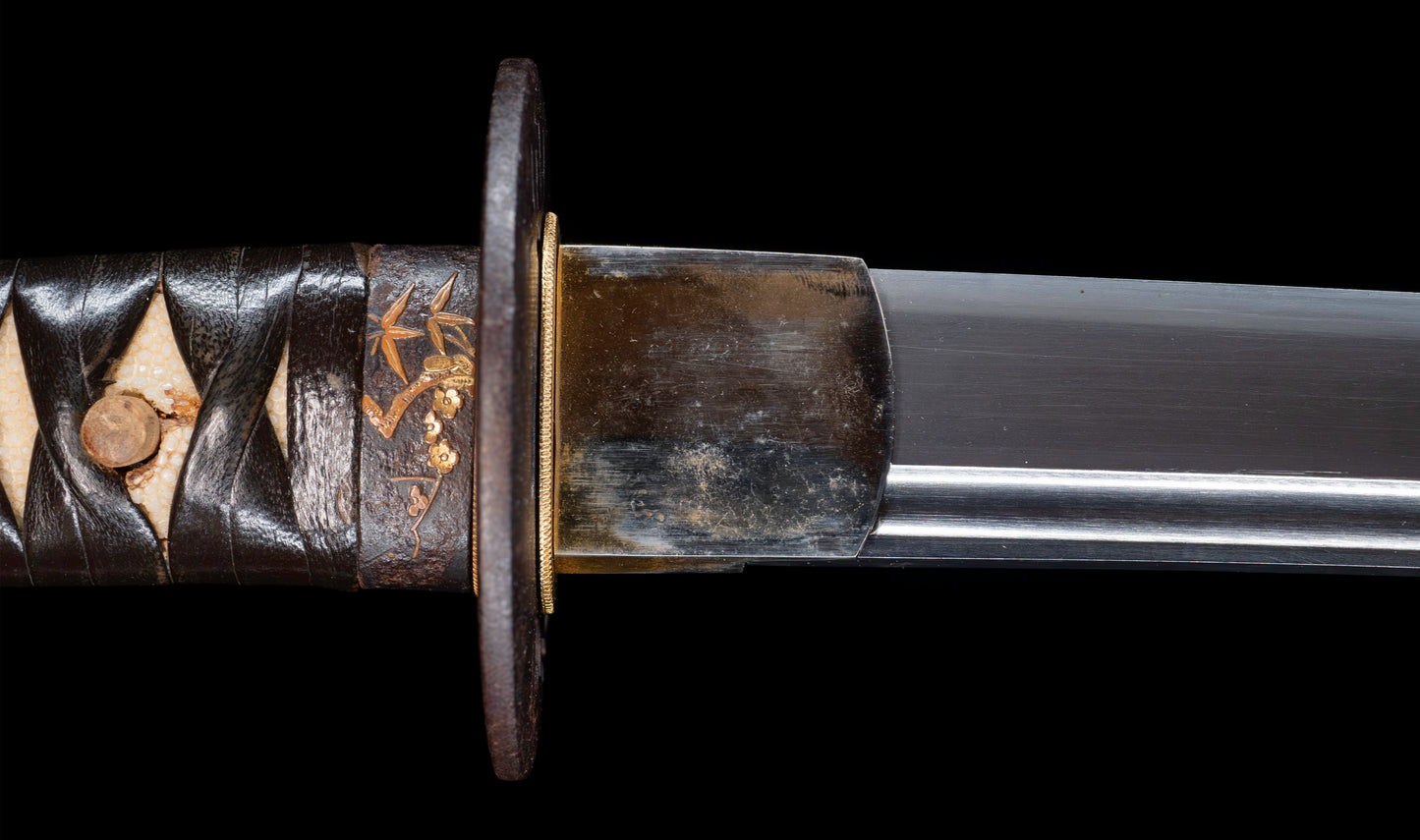
Die Tsuba ist eine runde Tetsu (Eisen)-Platte mit dunkler Patina, geschnitten in Ji-sukashi (Durchbrucharbeit): ein stilisiertes Blütensprenkelmuster mit ausstrahlenden Blütenblättern oben und einem belaubten Blattspross unten, mit zwei Hitsu-ana für Kozuka und Kōgai. Der Fuchi ist aus dunklem weichem Metall mit feinem Blütendesign—Pflaume und Laub—mit Vergoldung hervorgehoben, ein raffinierter Akzent gegen die nüchterne Montierung.
Der Tsuka ist mit schwarzem Leder (Kawa) über weißem Same (Rochen-Haut) im traditionellen Hineri-maki-Rautenmuster umwickelt, mit fein ausgearbeiteten, vergoldungshighlighteten Drachen-Menuki unter dem Wickel. Das Leder zeigt ehrlichen Verschleiß und etwas geringen Gebrauchsspuren—die Art von Charakter, die man von einem Schwert erwartet, das getragen und gepflegt wurde, statt es einzusperren. Der Habaki ist ein vergoldeter Kragen. Insgesamt bilden die Beschläge eine ruhige, geschmackvolle Samurai-Montierung.
Über Mumei Edo-Katana
Ein mumei (unsigniertes) Schwert ist nicht ein minderwertiges Schwert—es ist einfach eines ohne Signatur auf der Nakago (Angel). Viele Edo-zeitliche Schwerter verließen die Schmiede unsigniert, und viele andere verloren ihre Signatur, als sie über die Jahrhunderte verkürzt wurden. Was zählt, ist die Handwerkskunst: der Stahl, die Härtungslinie, die Form und der Zustand der Klinge. Das sind Dinge, die man sehen und halten kann, und sie sind die wirkliche Grundlage, auf der ein Nihonto beurteilt werden sollte.
Für einen Sammler bietet ein mumei Edo-Katana ein echtes, traditionell gefertigtes japanisches Schwert—aus Tamahagane geschmiedet, gehärtet mit der Ton-und-Wasser-Methode, die die Hamon erzeugt—auf einer zugänglicheren Stufe als ein signiertes, dokumentiertes Stück eines berühmten Namens. Dieses Exemplar ist ein ehrlicher, attraktiver Vertreter dieser Kategorie: ein echtes Edo-Schwert in vollständiger Montierung, in Japan registriert und bereit zum Studieren, Ausstellen oder um eine Sammlung herum aufzubauen.


Einklappbarer Inhalt
Payment
You can pay by Bank card or Bank transfer. If you wish to use bank transfer please contact us using the form bellow with the name of the sword you are willing to buy.
Customs and Taxes
・Import duties, taxes and charges are not included in the item price or shipping charges. These charges are the buyer’s responsibility.
・Please check with your country’s customs office to determine what these additional costs will be prior to bidding/buying.
・These charges are normally collected by the delivering freight (shipping) company or when you pick the item up - do not confuse them for additional shipping charges.
Shipping and Return
- Swords are shipped from Tokyo, Japan. We manage all the procedures to export the sword.
- You can't return sword to Japan because procedures are too strict.
- We work with a shipping company that have experience with Nihonto so you don't have to worry.
- Please check the rules of your country before importing the sword. We do not take any responsibility, including (not limited to) refund, due to the above reasons.
- We can NOT cancel an order once, we already applied for the export authorization. As this document is made to customer name.
We have shipped authentic Japanese swords to the USA, UK, Canada, Mexico, Germany, France, Hong Kong, and Australia. If you don’t live in these countries and like to order, please contact us first before purchasing. We normally ship by EMS (Express Mail Service) provided by Japan Post.
If you live in the UK, please contact us BEFORE order.
Export Procedure (We manage it)
・All our swords are registered in the Agency for Cultural Affairs as artwork and The Board of Education(Cultural properties protection Committee); therefore each sword has the registration card, issued by the Board of Education.
・After receiving the full payment of the items,we return the registration card and get the permission from Ministry of Cultural Affairs to export the swords legally from Japan. It will take about 1 to 3 months for that step.
・After the receiving the permission, we will inform you by email and send the items immediately.
Contact form
What Our Collectors Say
Independent reviews from verified buyers on Trustpilot
Wonderful folks to buy from
“Large selection to choose from. The katana were signed with Hozon and the blades in a shirasaya. My two katana and Kozuka came packed in a solid wooden crate. Great friendly communication.”
Got a beautiful sword delivered to NYC
“Condition is just as pictured. Took a little while to get all the way to the states, but I was very happy with this seller and plan to purchase more from them.”
Order with confidence
“In the end I received what I ordered, well-packaged and in the condition specified.”
Un katana antique magnifique
“J'ai posé beaucoup de questions au support qui a su répondre et m'aider dans mon choix. La commande est arrivée avec le certificat dans un emballage robuste et en parfait état, il est vraiment magnifique !”