

Tokyo Nihonto
Antique Japanese Katana by Tango no Kami Fujiwara Kanemichi with Imperial Kikumon, Suguha Hamon and Gold-Inlaid Tsuba - NBTHK Hozon
Antique Japanese Katana by Tango no Kami Fujiwara Kanemichi with Imperial Kikumon, Suguha Hamon and Gold-Inlaid Tsuba - NBTHK Hozon
Verfügbarkeit für Abholungen konnte nicht geladen werden
- Signature (Mei): 丹後守藤原兼 (Tango no Kami Fujiwara Kane...), omote, the final character lost when the blade was shortened. The NBTHK reads the name as 兼道 Kanemichi
- Reverse (Ura): 菊級 the sixteen-petal imperial chrysanthemum crest, followed by the character 一 (ichi)
- Swordsmith: Tango no Kami Fujiwara Kanemichi 丹後守藤原兼道
- School / Tradition: Mishina 三品 school, Osaka branch
- Period / Province: Edo period, shinto, Settsu Province (Osaka)
- Certificate: NBTHK Hozon Token no. 3038158, issued 1 December 2025
- Registration: Japanese torokusho Wakayama no. 435, issued 15 May 1951
- Mounting: Complete katana koshirae, black ishime lacquer saya, iron landscape tsuba with gold inlay, archery menuki
- Blade Length (Nagasa): 69.5 cm (2 shaku 3 sun scant, as recorded on the NBTHK certificate)
- Curvature (Sori): 1.36 cm
- Mekugi-ana: 2
- Shape (Sugata): Shinogi-zukuri, iori-mune, chu-kissaki, shallow torii-zori
- Jihada: Very tight ko-itame, clear and bright
- Hamon: Chu-suguha, regular and even in width from machi to yokote, nioi-deki with a tight bright nioiguchi
- Boshi: Suguha continuing past the yokote into a clean ko-maru, ample hardened width remaining
- Habaki: Single-piece copper with gold foil (kin-kise)
- Polish: Excellent modern polish. No hagire, fukure, ware or kizu
This katana is signed 丹後守藤原兼 on the omote of the tang: Tango no Kami Fujiwara Kane, the last character cut away when the blade was shortened. On the ura, deeply struck, is the sixteen-petal imperial chrysanthemum, and beneath it the single character 一, ichi.
The blade was submitted to the NBTHK and papered Hozon Token under certificate no. 3038158 on 1 December 2025. The certificate transcribes the signature exactly as it survives and identifies the smith as Kanemichi 兼道. It records the length as 2 shaku 3 sun scant, about 69.5 cm. The sword is registered in Japan under torokusho Wakayama no. 435, issued on 15 May 1951, which is one of the earliest registration numbers we have handled and places the sword in recorded Japanese ownership within a few years of the post-war registration system being created.
The chrysanthemum is the part that deserves attention, because it is not decoration. It is an imperial privilege, and the story of how a sword comes to carry it is told in the sections below.
As for the blade itself: shinogi-zukuri with an iori-mune and a chu-kissaki, shallow torii-zori, 69.5 cm for 1.36 cm of curvature. It is shortened, with two mekugi-ana and the machi moved up, which is why the signature is truncated. The forging is a very tight ko-itame, the steel clear and bright in the way refined shinto work is. The temper is a chu-suguha of remarkable evenness, holding one width from the machi all the way to the yokote, in nioi-deki with a tight, bright nioiguchi. The boshi carries straight through the point and turns in a clean ko-maru with plenty of hardened steel left.
The sword is in an excellent modern polish and is entirely healthy. There is no hagire, no fukure, no ware, no kizu, no active rust and no core steel showing. Unlike most antique blades, this one needs nothing done to it.
The mounting is deliberately restrained, and the taste behind it is shibui: everything quiet except one thing.
That one thing is the tsuba. Iron, maru-gata, carved in low relief and inlaid with gold nunome-zogan, it carries a landscape: mountains, water, a boat under sail, and a scatter of geese coming down out of the sky. Those two motifs together are not decoration chosen at random. A returning sail and descending geese are two of the Eight Views, the set of classical scenes that Japanese painters took from Chinese models and moved to the shores of Lake Biwa. Put on a sword guard they carry what the Eight Views always carry: autumn, distance, and the idea of coming home. The kozuka-hitsu-ana has been plugged with a shakudo plate worked in nanako with gold highlights, which is the kind of detail a careless owner does not pay for. Copper sekigane sit at both ends of the nakago-ana. It is unsigned; the iron, the landscape subject and the gold overlay point to provincial Edo work, most likely Shoami.
The fuchi and kashira are austere by comparison, dark and finished in ishime stippling, the kashira carrying a low-relief scroll near its edges and the fuchi a fine gold line at the seppa-dai. The kojiri repeats the kashira's scroll exactly, which ties the whole scabbard together.
The menuki are shakudo with gold, and the subject is archery equipment: arrow shafts with their gold bindings clearly visible under the wrap. Arrows were never only weapons in Japan. A decorated arrow hung in the house is a hama-ya 破魔矢, an evil-dispelling arrow, and the custom of keeping one for the new year survives to this day. A samurai who chose arrows for the palm of his sword hand was choosing something that goes straight and does not turn aside. The habaki is single-piece copper under gold foil, filed with diagonal yasurime, the foil worn away along the edges where a lifetime of drawing and sheathing rubbed it back to the copper. The seppa are a gilt pair with coin-edge filing.
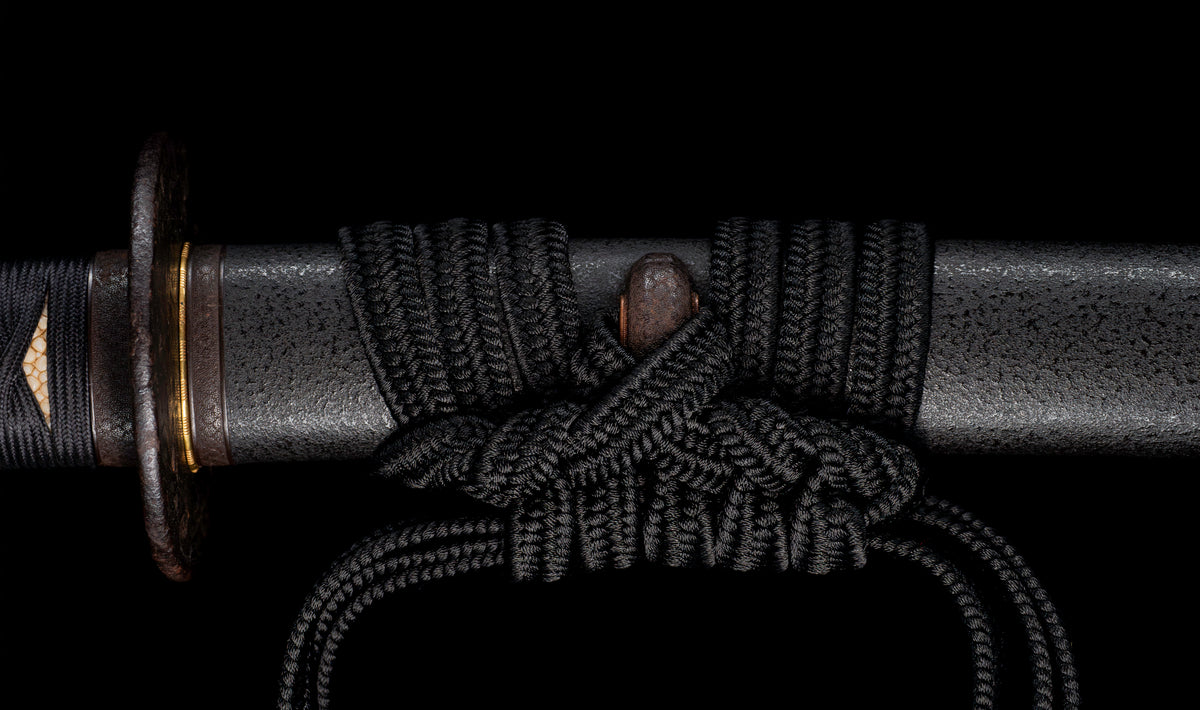
The saya is black ishime lacquer, the tsuka is wrapped in black silk over white samegawa in hineri-maki, and the sageo is black. Both are pristine, which means the organic parts of this mounting were professionally renewed in the modern era over the original antique metal fittings. The work is excellent and the result is a sword that presents as it would have when it was worn.
Tango no Kami Fujiwara Kanemichi 丹後守藤原兼道 is the smith who took the Mishina name out of Kyoto and planted it in Osaka. He was a son of Tanba no Kami Yoshimichi of the Kyoto line, which makes him a grandson of the Kanemichi of Seki who founded the school.
He received the court title of Tango no Kami in 1625 and left for Osaka almost immediately afterwards. The timing is the interesting part. Osaka had been burned ten years before, in 1615, when Tokugawa Ieyasu took the castle and finished the Toyotomi. What rose from those ashes was not a fortress town but a merchant one: the rice exchange of the entire country, the port through which the western domains shipped everything they sold, a city being rebuilt from nothing with money moving through it. A young swordsmith with a fresh court title was not being sentimental in going there.
For a smith, Osaka meant two things. It meant customers, because the western lords kept residences and agents in the city and ordered their blades where their money already was. And it meant steel. Osaka sat at the end of the sea route from the San'in coast, where the best tamahagane in Japan was smelted from the iron sands of Izumo and Hoki. A smith in Kyoto worked with what came to him overland; a smith in Osaka had the pick of the cargo as it was unloaded.
That is why Osaka Shinto blades are remembered for their jigane before anything else: a steel surface forged so tightly and so cleanly that the grain almost disappears, bright and close to liquid under raking light. The very tight, clear ko-itame on this blade is that tradition doing exactly what it was famous for.
The title passed down the family and later generations signed the same name, so Tango no Kami Kanemichi on its own does not tell you which man held the hammer. One detail does. Japanese sources record consistently that the first generation cut the chrysanthemum together with the character 一 on the tang, and that his successors did not. This blade carries exactly that pairing. The NBTHK certificate attributes the sword to Kanemichi without naming a generation, and the marks on this tang match the documented practice of the first master, which is a point a serious buyer will want to weigh.
The first generation was born around 1603 and worked until his death in 1672, at the age of seventy. He is recorded for two very different registers: the sudare-ba, the bamboo-blind temper line he inherited from his father, and an elegant gunome with choji character. This blade is neither. It is a disciplined chu-suguha, which is what a smith of this standing does across a working life of nearly fifty years: he does not repeat one trick.
The Mishina school begins in 1593, when a smith named Kanemichi left Seki in Mino province and moved to Kyoto with his four sons. The sons are the school: Iga no Kami Kinmichi, Rai Kinmichi, Tanba no Kami Yoshimichi, who invented the sudare-ba temper that looks like a bamboo blind, and Etchu no Kami Masatoshi, rated the most gifted of the four. Together with Omi no Kami Hisamichi they are remembered as the Kyo-go-kaji, the five smiths of Kyoto.
The eldest, Iga no Kami Kinmichi, changed the family's standing permanently. Tokugawa Ieyasu ordered one thousand tachi from him, and in return the court granted him the title Nihon Kaji Sosho, master of all the swordsmiths of Japan, and with it the right to cut the imperial chrysanthemum on his tangs.
That title was not ceremonial. From then on the Kinmichi house acted as the official intermediary to the imperial court for the granting of court titles to swordsmiths across the entire country. A smith anywhere in Japan who wanted to call himself no Kami had to go through them. The privilege of the chrysanthemum extended to the Mishina family, which is how a sword signed Tango no Kami Kanemichi comes to carry an imperial crest at all.
So the two marks on this tang record the same fact from two directions. The court title was obtained through the family that controlled access to court titles; the chrysanthemum is the visible sign of belonging to that family. Very few shinto smiths were ever in a position to cut either one.
What is offered here is a signed katana of the Mishina school's Osaka branch, papered NBTHK Hozon, bearing the imperial chrysanthemum and the character ichi, registered in Japan since 1951, in excellent modern polish and complete in a period mounting with a gold-inlaid landscape tsuba.


Einklappbarer Inhalt
Payment
You can pay by Bank card or Bank transfer. If you wish to use bank transfer please contact us using the form bellow with the name of the sword you are willing to buy.
Customs and Taxes
・Import duties, taxes and charges are not included in the item price or shipping charges. These charges are the buyer’s responsibility.
・Please check with your country’s customs office to determine what these additional costs will be prior to bidding/buying.
・These charges are normally collected by the delivering freight (shipping) company or when you pick the item up - do not confuse them for additional shipping charges.
Shipping and Return
- Swords are shipped from Tokyo, Japan. We manage all the procedures to export the sword.
- You can't return sword to Japan because procedures are too strict.
- We work with a shipping company that have experience with Nihonto so you don't have to worry.
- Please check the rules of your country before importing the sword. We do not take any responsibility, including (not limited to) refund, due to the above reasons.
- We can NOT cancel an order once, we already applied for the export authorization. As this document is made to customer name.
We have shipped authentic Japanese swords to the USA, UK, Canada, Mexico, Germany, France, Hong Kong, and Australia. If you don’t live in these countries and like to order, please contact us first before purchasing. We normally ship by EMS (Express Mail Service) provided by Japan Post.
If you live in the UK, please contact us BEFORE order.
Export Procedure (We manage it)
・All our swords are registered in the Agency for Cultural Affairs as artwork and The Board of Education(Cultural properties protection Committee); therefore each sword has the registration card, issued by the Board of Education.
・After receiving the full payment of the items,we return the registration card and get the permission from Ministry of Cultural Affairs to export the swords legally from Japan. It will take about 1 to 3 months for that step.
・After the receiving the permission, we will inform you by email and send the items immediately.
Contact form
What Our Collectors Say
Independent reviews from verified buyers on Trustpilot
Wonderful folks to buy from
“Large selection to choose from. The katana were signed with Hozon and the blades in a shirasaya. My two katana and Kozuka came packed in a solid wooden crate. Great friendly communication.”
Got a beautiful sword delivered to NYC
“Condition is just as pictured. Took a little while to get all the way to the states, but I was very happy with this seller and plan to purchase more from them.”
Order with confidence
“In the end I received what I ordered, well-packaged and in the condition specified.”
Un katana antique magnifique
“J'ai posé beaucoup de questions au support qui a su répondre et m'aider dans mon choix. La commande est arrivée avec le certificat dans un emballage robuste et en parfait état, il est vraiment magnifique !”