

Tokyo Nihonto
Japanischer gendaitō Katana mit eiserner durchbrochener Tsuba und Feder-Menuki, von Kazunori, datiert 1942
Japanischer gendaitō Katana mit eiserner durchbrochener Tsuba und Feder-Menuki, von Kazunori, datiert 1942
Verfügbarkeit für Abholungen konnte nicht geladen werden
- Signatur (Mei): 一則 Kazunori (omote); 昭和十七年六月 - datiert Juni, Shōwa 17 (1942) (ura)
- Schwertschmied: Kazunori (Schwertschmied der Shōwa-Ära)
- Typ / Klassifizierung: Katana - Gendaitō (moderner traditionell gefertigter Katana)
- Periode: Shōwa, datiert Juni 1942
- Registrierung: Tokyo Tōroku-shō Nr. 141502 (Japanische Schwertregistrierung)
- Montierung: Schwarzer lackierter koshirae mit eiserner sukashi tsuba und Feder (hane) menuki
- Klingenlänge (Nagasa): 66,3 cm
- Krümmung (Sori): 1,4 cm
- Mekugi-ana: 1 (ubu)
- Motohaba: 31,0 mm | Sakihaba: 21,0 mm
- Motokasane: 7,0 mm | Sakikasane: 5,5 mm
- Form: Shinogi-zukuri mit iori-mune und chū-kissaki
- Jihada: Hell, dicht geschmiedetes ko-itame
- Hamon: Gunome-notare midare (midareba) in hellblauem nioiguchi mit nie
- Boshi: Midare-komi mit ko-maru Umkehrung
Dieser Katana ist ein signiertes Werk (zaimei) des Schmieds Kazunori (一則), auf dem Nakago datiert auf Juni 1942 (Shōwa 17) - ein gendaitō, ein Japanischer Katana, der während der modernen Ära auf traditionelle Weise geschmiedet wurde. Der Nakago ist ubu (unverändert), mit einem einzelnen mekugi-ana und der Signatur des Schmieds auf der omote sowie dem Datum auf der ura.
Dies ist eine robuste, gesunde Klinge: ein shinogi-zukuri mit iori-mune, eine 66,3 cm nagasa und ein starker Aufbau – etwa 31 mm an der Basis verjüngend sich auf 21 mm, mit einer beträchtlichen 7 mm kasane. Die Politur ist hell und das Stahl gesund.
Die jihada ist ein dicht geschmiedetes, helles ko-itame, und die hamon ist eine lebendige gunome-notare midare (乱刃) – eine undulierend, aktiv bearbeitete Härtungslinie in hellblauem nioiguchi mit nie, übergehend in einen midare-komi boshi mit ko-maru Umkehrung. Ein sichtbares Korn und eine aktive hamon dieser Art sind genau die Eigenschaften, die einen traditionell gefertigten gendaitō von einem nicht-traditionellen Kriegszeit-shōwatō unterscheiden.
Die Klinge trägt eine gültige japanische Schwertregistrierung (Tokyo tōroku-shō) – in Japan nur an Klingen vergeben, die als traditionell gefertigt anerkannt sind – was seinen Status als echter gendaitō statt eines Arsenal-Produktionsstücks unterstützt. Er trägt kein NBTHK-Zertifikat; ein Käufer, der eine formale Bestätigung der Handwerkskunst wünscht, kann ihn zur NBTHK shinsa einreichen. Mit seinem soliden, kraftvollen Aufbau ist er ein Katana, der sich gleichermaßen für eine Sammlung eignet oder – für einen trainierten Praktizierenden – für ernsthaften iaidō / battō und tameshigiri Einsatz.
Koshirae Details
Der Katana ist in einem funktionalen schwarzen koshirae montiert. Die saya ist in glänzend schwarzem urushi Lack mit einem braunen sageo fertiggestellt. Die tsuba ist eine runde Eisenplatte mit ji-sukashi (Durchbrucharbeit) Schnitt mit Wolken- und Blattmotiven, mit ehrlicher dunkler Patina.
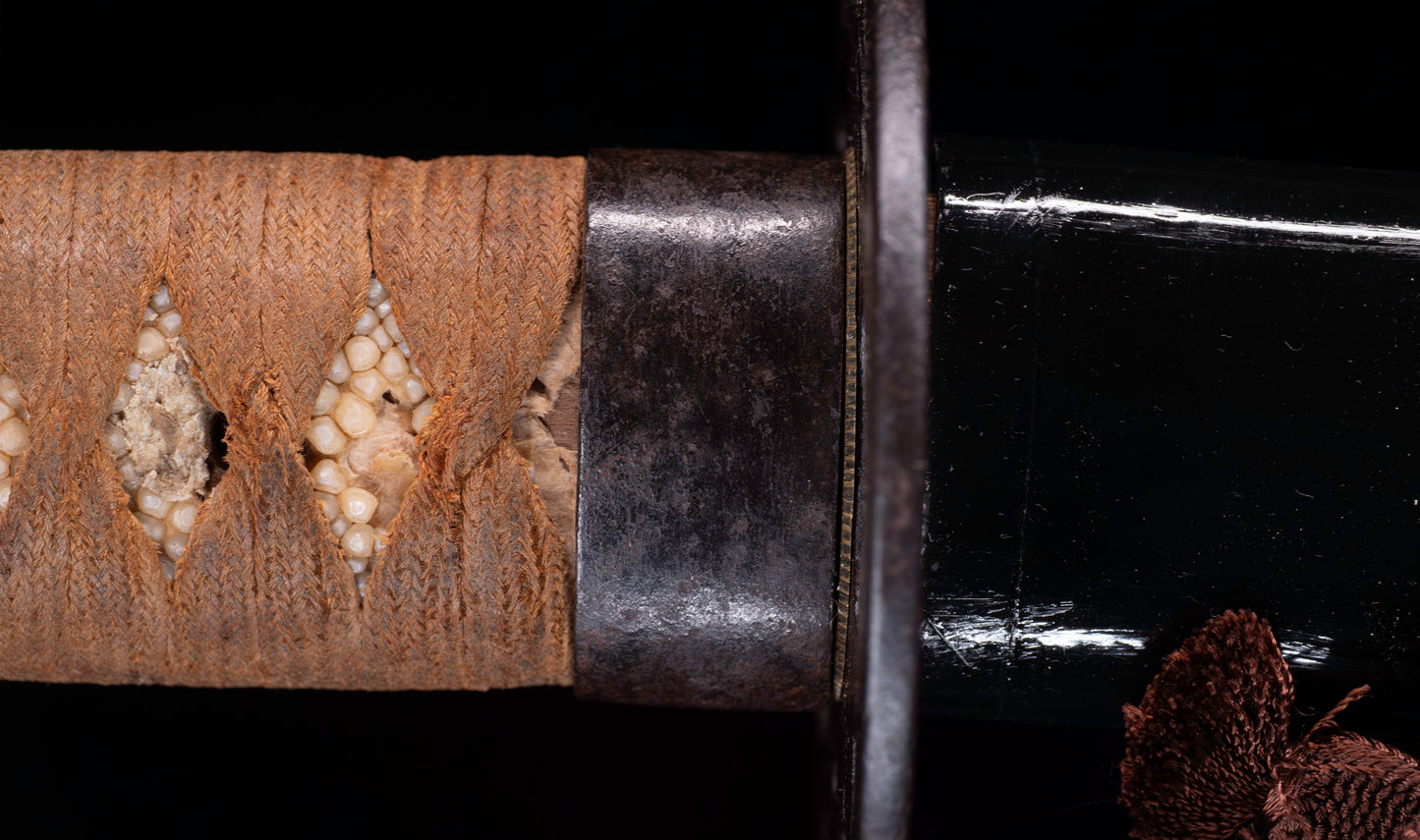
Am charaktervollsten sind die menuki: fein detaillierte Feder (hane) menuki in dunklem Weichmetall mit Goldhighlights, unter dem Griff montiert. Der fuchi ist ein schlichtes, gebürstetes Messingbeschlag. Der tsuka ist in braunem ito über weißem same (Rochenleder) im traditionellen hineri-maki Rautenmuster gewickelt; die Wicklung zeigt echtes Alter und Abnutzung, das mit einem Katana übereinstimmt, der gehandhabt und benutzt wurde. Insgesamt eine ehrliche, funktionsfähige Montierung um eine solide Klinge.
Über den Schmied und das Datum
Die Klinge ist signiert Kazunori (一則) und datiert Juni 1942. Sie gehört zur gendaitō Tradition – Klingen von Schmieden, die nach der Meiji-Periode mit traditionellen Methoden arbeiteten, wassergekühlt und geschmiedet statt maschinell gefertigt. Die Kriegsjahre produzierten ein breites Spektrum von Klingen, vom vollständig traditionellen gendaitō von erfahrenen Schmieden bis zu Massen-produzierten nicht-traditionellen shōwatō; die beiden lassen sich nach Handwerkskunst unterscheiden – sichtbare hada und aktive hamon – und danach, ob eine Klinge sich als registrierbarer Japanischer Kunstkatana in Japan qualifiziert.
In beiden Punkten präsentiert sich diese Klinge als echter gendaitō: ein helles ko-itame Korn, eine aktive gunome-notare midare hamon und eine gültige Tokyo-Registrierung. Wir beschreiben den Schmied konservativ aus der Signatur und dem Datum auf dem Nakago; eine formale generationenabhängige oder Ranking-Zuschreibung würde NBTHK shinsa erfordern. Ehrlich verkauft für das, was er ist – ein gesunder, signierter, traditionell gestalteter Shōwa Katana in ehrlichen Montierungen.


Einklappbarer Inhalt
Payment
You can pay by Bank card or Bank transfer. If you wish to use bank transfer please contact us using the form bellow with the name of the sword you are willing to buy.
Customs and Taxes
・Import duties, taxes and charges are not included in the item price or shipping charges. These charges are the buyer’s responsibility.
・Please check with your country’s customs office to determine what these additional costs will be prior to bidding/buying.
・These charges are normally collected by the delivering freight (shipping) company or when you pick the item up - do not confuse them for additional shipping charges.
Shipping and Return
- Swords are shipped from Tokyo, Japan. We manage all the procedures to export the sword.
- You can't return sword to Japan because procedures are too strict.
- We work with a shipping company that have experience with Nihonto so you don't have to worry.
- Please check the rules of your country before importing the sword. We do not take any responsibility, including (not limited to) refund, due to the above reasons.
- We can NOT cancel an order once, we already applied for the export authorization. As this document is made to customer name.
We have shipped authentic Japanese swords to the USA, UK, Canada, Mexico, Germany, France, Hong Kong, and Australia. If you don’t live in these countries and like to order, please contact us first before purchasing. We normally ship by EMS (Express Mail Service) provided by Japan Post.
If you live in the UK, please contact us BEFORE order.
Export Procedure (We manage it)
・All our swords are registered in the Agency for Cultural Affairs as artwork and The Board of Education(Cultural properties protection Committee); therefore each sword has the registration card, issued by the Board of Education.
・After receiving the full payment of the items,we return the registration card and get the permission from Ministry of Cultural Affairs to export the swords legally from Japan. It will take about 1 to 3 months for that step.
・After the receiving the permission, we will inform you by email and send the items immediately.
Contact form
What Our Collectors Say
Independent reviews from verified buyers on Trustpilot
Wonderful folks to buy from
“Large selection to choose from. The katana were signed with Hozon and the blades in a shirasaya. My two katana and Kozuka came packed in a solid wooden crate. Great friendly communication.”
Got a beautiful sword delivered to NYC
“Condition is just as pictured. Took a little while to get all the way to the states, but I was very happy with this seller and plan to purchase more from them.”
Order with confidence
“In the end I received what I ordered, well-packaged and in the condition specified.”
Un katana antique magnifique
“J'ai posé beaucoup de questions au support qui a su répondre et m'aider dans mon choix. La commande est arrivée avec le certificat dans un emballage robuste et en parfait état, il est vraiment magnifique !”