
- NEWHozon

-

-

-

-

-

-

-

-

-

-

-

-

-

-

-

-

-

-

-

-

-

-

-

-

-

-

-

-

-

-

-

-

-

-

-

-

-

-

-


Tokyo Nihonto
Antique Japanese Katana Sword by Kanabō Hayato no Jō Masazane with Gunome-Midare Hamon, Sakura Fittings and Red Lacquer Saya - NBTHK Hozon
Antique Japanese Katana Sword by Kanabō Hayato no Jō Masazane with Gunome-Midare Hamon, Sakura Fittings and Red Lacquer Saya - NBTHK Hozon
Insured worldwide shipping from Tokyo
Verfügbarkeit für Abholungen konnte nicht geladen werden
- Signature (Mei): 金房隼人 (Kanabō Hayato), omote, the remainder of the signature lost when the tang was shortened. The NBTHK reads the full name as 隼人丞正真
- Swordsmith: Kanabō Hayato no Jō Masazane 金房隼人丞正真
- School / Tradition: Kanabō 金房 school, Nara, Yamato tradition
- Period / Province: Late Muromachi period, koto, 16th century, Yamato Province (Nara)
- Certificate: NBTHK Hozon Token no. 3038155, issued 1 December 2025
- Japanese Registration (Tōroku-shō): Gifu no. 002558, originally issued 31 March 1951, reissued 5 February 2025
- Mounting: Complete katana koshirae, red-and-black textured lacquer saya, iron mokkō tsuba, sakura fuchi-kashira, gold chrysanthemum menuki
- Blade Length (Nagasa): 61.7 cm (2 shaku 0 sun 3.5 bu, as recorded on the NBTHK certificate)
- Curvature (Sori): 1.4 cm
- Mekugi-ana: 2
- Shape (Sugata): Shinogi-zukuri, iori-mune, chū-kissaki, shortened (suriage)
- Jihada: Itame mixed with mokume, with masame flowing along the shinogi-ji, ji-nie
- Hamon: Gunome-midare mixed with notare and pointed elements, nie-deki, with ashi and sunagashi
- Bōshi: Midare-komi with a ko-maru turn-back
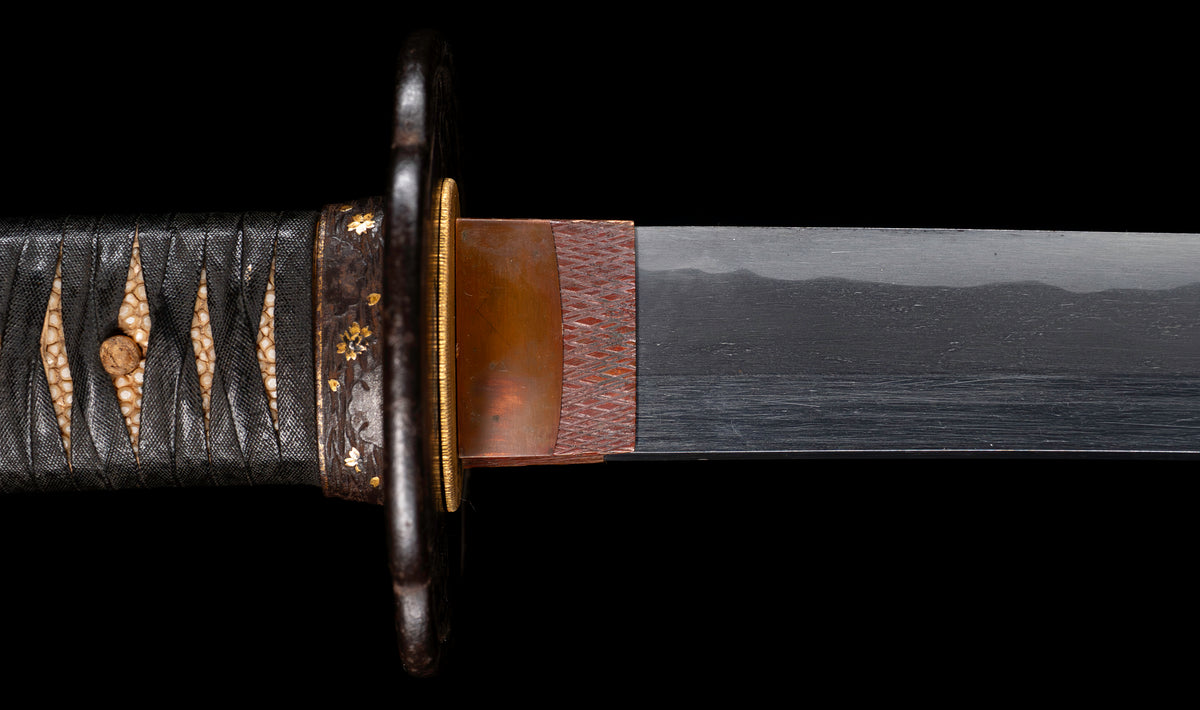
- Habaki: Single-piece copper, filed with diagonal yasurime
A signed katana by Kanabō Hayato no Jō Masazane 金房隼人丞正真, the best-known name of the Kanabō school of Nara, papered NBTHK Hozon in December 2025. The blade measures 61.7 cm with 1.4 cm of curvature and remains in a complete, recently restored period mounting.
The signature survives on the omote of the tang as 金房隼人, cut just above the tip. The rest of the inscription disappeared when the blade was shortened, which the NBTHK records as ika kiri (以下切, "cut below"), before reading the full name as 隼人丞正真. That kind of partially surviving signature is typical of late Muromachi blades that stayed in service and were adapted to the fighting style of the following generation.
The shape is a shinogi-zukuri katana with an iori-mune and a chū-kissaki. At 61.7 cm and with a shallow curvature, it has the compact, quick profile of the uchigatana carried in the late 16th century, when swords were drawn and used with one hand as often as two.
The hamon is the main event: a lively gunome-midare mixed with notare and pointed elements, in nie-deki, with ashi running down into the edge and streaks of sunagashi through the nie. It continues into the point as midare-komi and turns back in a ko-maru. This is the Mino-influenced, practical temper the Kanabō smiths were known for, rather than the quiet straight temper of older Yamato work.
The steel is an itame mixed with mokume, with masame flowing along the shinogi-ji and visible ji-nie, the standing, slightly open grain typical of late Yamato forging. The tang carries a deep, even age patina and two mekugi-ana.
Koshirae Details
The saya is the first thing anyone sees: a striking red-and-black textured lacquer that reads like the grain of weathered wood, finished with black horn koiguchi, kurigata and kojiri, and dressed with a deep crimson sageo.
The tsuba is iron, in a four-lobed mokkō shape, with a dark, dense patina and fine engraving worn soft by age; what appears to be a dragonfly (tombo) is engraved at the top of one face. Dragonflies were a favourite samurai emblem, the kachi-mushi or "victory insect", because they only fly forward. Both hitsu-ana are plugged and copper sekigane sit in the central opening. An engraved inscription is visible beside the seppa-dai but is too worn to read.
The fuchi and kashira are a matching pair, dark metal carved to imitate rough tree bark, scattered with falling cherry blossoms in gold. The menuki are gold chrysanthemums with leaves, set under a black silk wrap in hineri-maki over white same, with a prominent oyatsubu nodule on the omote.
The wrap and the lacquer are in excellent, fresh condition, a professional modern restoration built around genuine Edo-period metal fittings. The habaki is single-piece copper filed with diagonal yasurime, and the pair of seppa have coin-edge filing.
The Swordsmith: Kanabō Hayato no Jō Masazane 金房隼人丞正真
Masazane is the leading name of the Kanabō school, a group of smiths who lived in the Kanabō-tsuji 金房辻 district of Nara, in front of Kōfuku-ji, and took the name of the street as their family name. He signed with the court title Hayato no Jō (also written Hayato no Suke), and his known signatures include 南都住金房隼人丞正真作, "made by Kanabō Hayato no Jō Masazane, resident of Nanto (Nara)".
Japanese references place the first Masazane around the Tenbun era (1532–1555), with a second generation of the same name recorded around Tenshō (1573–1592). The NBTHK certificate attributes this blade to Hayato no Jō Masazane without naming a generation, and we do not claim one.
The Kanabō smiths are remembered above all for their spears. Their yari and cross-bladed jūmonji-yari armed the warrior monks of the Hōzō-in, the temple that gave its name to one of the most famous spear schools in Japanese history, and many Sengoku warlords besides. Their katana are less common and are valued for the same qualities: sturdy, sharp, made to be used.
The Kanabō School and Late Yamato
Yamato, the old Nara region, is the oldest of the five classical sword traditions, built around the great temples and their armed monks. Its classic style is conservative: straight grain, a restrained straight temper. The Kanabō school, which appears in the early 16th century, broke with that convention. Working for temple forces and warlords in the middle of the Sengoku wars, its smiths borrowed freely from the Mino and Bizen traditions and produced practical, hard-cutting blades with active gunome tempers. This katana shows exactly that mix: Yamato steel under a Mino-style hamon.
What is offered here is a signed late Muromachi katana by Kanabō Hayato no Jō Masazane, papered NBTHK Hozon, registered in Japan since 1951, complete in a restored koshirae with a red textured-lacquer saya, sakura fuchi-kashira and gold chrysanthemum menuki.


Einklappbarer Inhalt
Payment
You can pay by Bank card or Bank transfer. If you wish to use bank transfer please contact us using the form bellow with the name of the sword you are willing to buy.
Customs and Taxes
・Import duties, taxes and charges are not included in the item price or shipping charges. These charges are the buyer’s responsibility.
・Please check with your country’s customs office to determine what these additional costs will be prior to bidding/buying.
・These charges are normally collected by the delivering freight (shipping) company or when you pick the item up - do not confuse them for additional shipping charges.
Shipping and Return
- Swords are shipped from Tokyo, Japan. We manage all the procedures to export the sword.
- You can't return sword to Japan because procedures are too strict.
- We work with a shipping company that have experience with Nihonto so you don't have to worry.
- Please check the rules of your country before importing the sword. We do not take any responsibility, including (not limited to) refund, due to the above reasons.
- We can NOT cancel an order once, we already applied for the export authorization. As this document is made to customer name.
We have shipped authentic Japanese swords to the USA, UK, Canada, Mexico, Germany, France, Hong Kong, and Australia. If you don’t live in these countries and like to order, please contact us first before purchasing. We normally ship by EMS (Express Mail Service) provided by Japan Post.
If you live in the UK, please contact us BEFORE order.
Export Procedure (We manage it)
・All our swords are registered in the Agency for Cultural Affairs as artwork and The Board of Education(Cultural properties protection Committee); therefore each sword has the registration card, issued by the Board of Education.
・After receiving the full payment of the items,we return the registration card and get the permission from Ministry of Cultural Affairs to export the swords legally from Japan. It will take about 1 to 3 months for that step.
・After the receiving the permission, we will inform you by email and send the items immediately.
Contact form
What Our Collectors Say
Independent reviews from verified buyers on Trustpilot
Wonderful folks to buy from
“Large selection to choose from. The katana were signed with Hozon and the blades in a shirasaya. My two katana and Kozuka came packed in a solid wooden crate. Great friendly communication.”
Got a beautiful sword delivered to NYC
“Condition is just as pictured. Took a little while to get all the way to the states, but I was very happy with this seller and plan to purchase more from them.”
Order with confidence
“In the end I received what I ordered, well-packaged and in the condition specified.”
Un katana antique magnifique
“J'ai posé beaucoup de questions au support qui a su répondre et m'aider dans mon choix. La commande est arrivée avec le certificat dans un emballage robuste et en parfait état, il est vraiment magnifique !”