


Tokyo Nihonto
Trusted by collectors · TrustpilotAntikes japanisches Katana-Schwert mit Toran Hamon und Kirschblüten-Eisen Tsuba — Osaka Shintō
Antikes japanisches Katana-Schwert mit Toran Hamon und Kirschblüten-Eisen Tsuba — Osaka Shintō
Verfügbarkeit für Abholungen konnte nicht geladen werden
- Signature (Mei): Mumei (無銘) - unsigniert
- Tradition: Osaka Shintō-Handwerkskunst
- Period: Edo-Periode, Kanbun-Ära (Mitte des 17. Jahrhunderts)
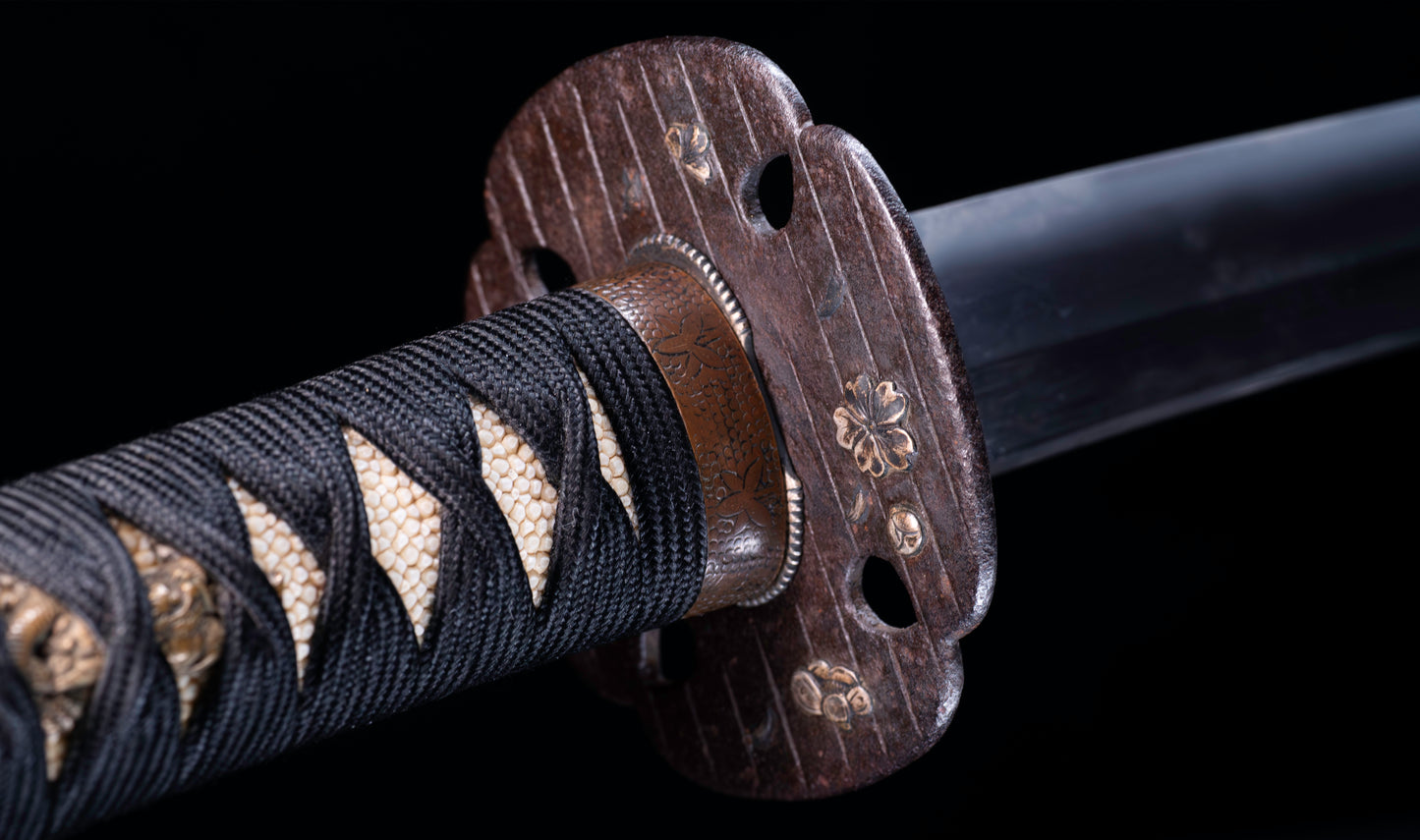
- Montage: Schwarze und rostbraun geflammte Urushi-Koshirae mit eiserner Mokkō-Tsuba und silberner Kirschblüten-Verzierung
- Klingenlänge (Nagasa): ca. 63,0 cm (2 Shaku 0 Sun 8 Bu)
- Krümmung (Sori): ca. 1,1 cm - flache Kanbun-Shintō-Krümmung
- Mekugi-ana: 2 (Suriage - gekürzt)
- Form: Shinogi-zukuri mit Iori-mune und Chū-kissaki
- Jihada: Dichte, helle Ko-itame - klassisches Osaka-Jigane
- Hamon: Notare mit Toran-midare-Neigung, Nioiguchi mit Ko-nie und Ashi
Diese Katana ist eine mumei (unsignierte), suriage (gekürzte) Klinge in der unverwechselbaren Art der Osaka Shintō-Tradition. Wir beschreiben sie anhand des Stahls selbst und nicht anhand einer Signatur – denn die Signatur ging verloren, als eine ältere, längere Klinge am Tang gekürzt wurde. Was bleibt, ist die Handwerkskunst, und sie ist deutlich lesbar.
Das erste, worauf ein geschultes Auge bei einer Osaka-Klinge achtet, ist der Stahl, und diese Klinge liefert ihn: ein Jihada aus dichtem, gut gepacktem Ko-itame, hell und nahezu ohne sichtbare Öffnungen – der verfeinerte Ō-saka-tetsu (Osaka-Stahl), der den Ruf der Schule begründete. Vor diesem sauberen Untergrund verläuft der Hamon als großzügiges Notare, das zu Toran-midare anschwillt – die rollende, wellenartige Härtungslinie, die von Tsuda Sukehiro und seinem Kreis populär gemacht wurde – in einem weichen Nioiguchi mit Ko-nie und Ashi, die bis zur gehärteten Kante reichen.
Die Sugata ist klassisches Kanbun Shintō: Shinogi-zukuri mit Iori-mune, eine kontrollierte Chū-kissaki und die charakteristisch flache Sori der 1660er–70er Jahre, als Osaka-Schmied ein gerades, geschäftsmäßiges Profil bevorzugten. Der Boshi folgt dem Hamon bis zur Spitze mit einer ordentlichen Rückkehr. In der Hand ist die Klinge gesund und gut poliert und zeigt die helle, frostige Härtungskante, die Sammler mit dieser Schule assoziieren.
Der Nakago zeigt zwei Mekugi-ana, die physische Aufzeichnung seiner Verkürzung. Dies ist eine ehrliche antike Klinge, geschätzt für das, was sie deutlich ist: hochwertiger Osaka Shintō-Stahl und Härtung aus dem Herzen der Shintō-Periode.
Koshirae-Details
Das Schwert ist in einer ansehnlichen, nüchternen schwarzen Koshirae montiert mit einem wirklich charakteristischen Element. Die Saya ist in einem geflammten schwarz-und-rostbraun Urushi-Lack vollendet – eine schillernde, rindenähnliche Oberfläche, bei der warmbraun-rötliche Töne durch den schwarzen Untergrund scheinen und der Scheide echte Tiefe und Bewegung unter Licht verleihen, anstatt einer flachen Oberfläche. Sie ist mit einem marineblauen (Kon-iro) Sageo ausgestattet.
Die Tsuba ist eine eiserne Mokkō-gata (vierlappige) Platte mit feiner vertikaler Liniengravur auf beiden Seiten und verziert mit angebrachten silbernen Kirschblüten (Sakura) und Knospen, die wie treibende verstreut sind – ein stilles, elegantes Gegensatzspiel von hellem Silber gegen dunkles Eisen. Der Fuchi setzt das Blüthenmotiv in patiniertem Buntmetall fort mit gravierten Blüten und Laub, das mit Gold hervorgehoben ist, über einem fein strukturierten Untergrund.
Der Habaki ist ein sauberer silberner einteiliger Kragen, der mit diagonalen Feilerlinien (Neko-gaki) geschnitten ist. Der Tsuka ist in schwarzem Ito über weißem Same (Rochenhaut) in dem traditionellen Hineri-maki-Rautenmuster umwickelt, mit vergoldeten figürlichen Menuki unter der Umwicklung. Insgesamt sind die Beschläge koordiniert und geschmackvoll – eine Samurai-Montage, die mit Sorgfalt und nicht zur Schau gestellt wurde.
Osaka Shintō: Die Schule des schönen Stahls
Nachdem Toyotomi Hideyoshi die Osaka-Burg erbaute, wuchs die Stadt zum kommerziellen Zentrum Japans, und Schwertschmiede strömten dorthin, um für die Kaufleute, Samurai und Feudalherren zu arbeiten, die hindurchkamen. Aus dieser Konzentration von Talent entstand Osaka Shintō – eine Tradition, die vor allem durch die Schönheit ihres Jigane definiert wird. Der Zugang zu hochwertigem Material und Wasser in Osaka ermöglichte es seinen Schmieden, einen Stahl zu schmieden, der so dicht und strahlend ist, dass er auf den ersten Blick erkennbar ist, oft einfach als Ō-saka-tetsu bezeichnet.
Die drei Giganten der Schule – die Sanketsu – waren Awataguchi Tadatsuna, Inoue Shinkai und Tsuda Sukehiro, von denen letztere den prachtvollen Toranba („wogender Wellen")-Hamon perfektionierte, der die ganze Stadt beeinflusste. Osaka Shintō-Klingen verbinden diesen verfeinerten Stahl mit kühnen, rhythmischen Härtungslinien – eine Ästhetik, die von Sammlern gerade deshalb geschätzt wird, weil sie so schwer überzeugend zu imitieren ist.
Diese Katana gehört zu dieser Welt. Ihr dichtes, helles Jigane und der von Sukehiro beeinflusste Notare-Toran-Hamon platzieren sie fest innerhalb der Osaka Shintō-Idiomatik – eine authentische Blade aus der Mitte der Edo-Zeit, die die Merkmale trägt, die diese Schwerter zum Goldstandard ihrer Ära machten.


Einklappbarer Inhalt
Payment
You can pay by Bank card or Bank transfer. If you wish to use bank transfer please contact us using the form bellow with the name of the sword you are willing to buy.
Customs and Taxes
・Import duties, taxes and charges are not included in the item price or shipping charges. These charges are the buyer’s responsibility.
・Please check with your country’s customs office to determine what these additional costs will be prior to bidding/buying.
・These charges are normally collected by the delivering freight (shipping) company or when you pick the item up - do not confuse them for additional shipping charges.
Shipping and Return
- Swords are shipped from Tokyo, Japan. We manage all the procedures to export the sword.
- You can't return sword to Japan because procedures are too strict.
- We work with a shipping company that have experience with Nihonto so you don't have to worry.
- Please check the rules of your country before importing the sword. We do not take any responsibility, including (not limited to) refund, due to the above reasons.
- We can NOT cancel an order once, we already applied for the export authorization. As this document is made to customer name.
We have shipped authentic Japanese swords to the USA, UK, Canada, Mexico, Germany, France, Hong Kong, and Australia. If you don’t live in these countries and like to order, please contact us first before purchasing. We normally ship by EMS (Express Mail Service) provided by Japan Post.
If you live in the UK, please contact us BEFORE order.
Export Procedure (We manage it)
・All our swords are registered in the Agency for Cultural Affairs as artwork and The Board of Education(Cultural properties protection Committee); therefore each sword has the registration card, issued by the Board of Education.
・After receiving the full payment of the items,we return the registration card and get the permission from Ministry of Cultural Affairs to export the swords legally from Japan. It will take about 1 to 3 months for that step.
・After the receiving the permission, we will inform you by email and send the items immediately.
Contact form
What Our Collectors Say
Independent reviews from verified buyers on Trustpilot
Wonderful folks to buy from
“Large selection to choose from. The katana were signed with Hozon and the blades in a shirasaya. My two katana and Kozuka came packed in a solid wooden crate. Great friendly communication.”
Got a beautiful sword delivered to NYC
“Condition is just as pictured. Took a little while to get all the way to the states, but I was very happy with this seller and plan to purchase more from them.”
Order with confidence
“In the end I received what I ordered, well-packaged and in the condition specified.”
Un katana antique magnifique
“J'ai posé beaucoup de questions au support qui a su répondre et m'aider dans mon choix. La commande est arrivée avec le certificat dans un emballage robuste et en parfait état, il est vraiment magnifique !”