

Tokyo Nihonto
Antique Japanaese Katana Sword signed Omi no Kami Fujiwara Tsuguhiro Katana - NBTHK Hozon
Antique Japanaese Katana Sword signed Omi no Kami Fujiwara Tsuguhiro Katana - NBTHK Hozon
Impossible de charger la disponibilité du service de retrait
Save 3% with bank transfer payment, no transaction fees. Contact us here.
LIVRAISON AUX ÉTATS-UNIS ⚠️
À partir du 9 octobre 2025
LIVRAISON AUX ÉTATS-UNIS ⚠️
À partir du 9 octobre 2025
En raison de récents changements réglementaires aux États-Unis en vertu d'un décret présidentiel, Japan Post (EMS) a suspendu toutes les livraisons commerciales aux États-Unis.
Par conséquent, nous faisons désormais appel à des transporteurs privés alternatifs. Ces options étant nettement plus onéreuses, nous demandons à nos clients américains de participer aux frais de livraison (100 $ pour les commandes américaines).
Nous apprécions sincèrement votre compréhension et votre soutien continu.
- Signature (Mei): 近江守藤原継広 Omi no Kami Fujiwara Tsuguhiro
- Swordsmith: Tsuguhiro (Apprentice of 3rd Gen Yasutsugu)
- School / Tradition: Echizen Shimosaka School (Mino-den roots)
- Period / Province: Early Edo Period (Kanbun era, 1661-1673) / Echizen & Edo
- Certificate: NBTHK Hozon (保存刀剣)
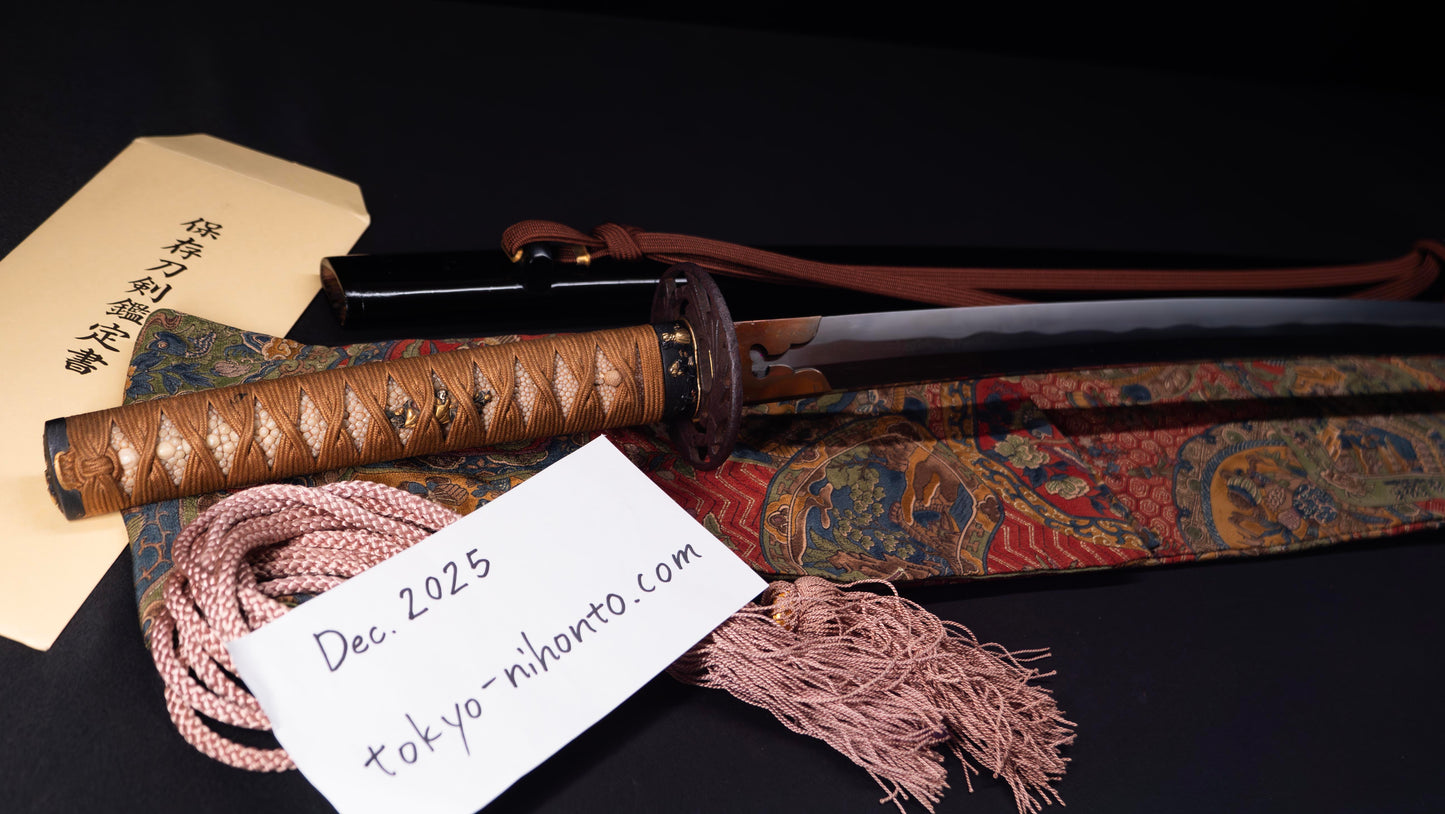
- Mounting: High-quality "Inaho" (Harvest) themed Koshirae
- Blade Length (Nagasa): 65.0 cm
- Curvature (Sori): 1.2 cm
- Mekugi-ana: 2
- Shape: Shinogi-zukuri with a shallow Kanbun-style curvature
- Jihada: Tight Itame with Mino-influenced Shirake-utsuri
- Hamon: Vibrant Gunome-midare with bright Nioikuchi
This refined Katana is a certified NBTHK Hozon work by the esteemed smith Omi no Kami Fujiwara Tsuguhiro. Measuring 65.0 cm with a 1.2 cm sori, the blade exhibits the characteristic "Kanbun Shinto" silhouette—a shape favored by the samurai of the early Edo period for its balanced handling and functional efficiency. The tang is remarkably preserved with two mekugi-ana and a clear, dual-sided signature: the front bearing his prestigious title and name, while the reverse indicates his residence in Echizen under the Shimosaka school name.
The blade's aesthetics are rooted in the Mino-den tradition, featuring a dense and well-forged itame grain. The hamon is a masterful gunome-midare, showing the bright, cloud-like nioikuchi that was a hallmark of the Shimosaka smiths who served the highest levels of the Tokugawa Shogunate.
Koshirae Details
The sword is adorned with a thematic koshirae celebrating Inaho (the rice harvest), a symbol of wealth and divine protection in Japanese culture. The tsuba is a masterful iron sukashi (openwork) piece depicting sheaves of ripening rice. This motif is elegantly continued in the menuki and fuchi-kashira, which feature high-relief carvings of farmers and scenes of abundance. The saya is finished in a deep, lustrous black lacquer, providing a sober yet high-status aesthetic that complements the golden silk tsuka-ito.
Swordsmith Background
Omi no Kami Tsuguhiro was a prominent figure within the Echizen Shimosaka school during the mid-17th century. As a direct apprentice to the third-generation Yasutsugu, Tsuguhiro inherited the elite technical secrets of the Okakaekaji (the official smiths to the Shogun). While primarily based in Echizen, historical records show that his skill was so highly regarded that he was also active in the capital city of Edo. His work is celebrated for bridging the gap between the rugged practicality of Sengoku-era blades and the refined artistry of the peaceful Edo period.
School History
The Echizen Shimosaka School rose to national fame under the patronage of the Tokugawa clan. Founded by the first-generation Yasutsugu—who was granted the use of the "Aoi" (Holly Oak) crest and the character "Yasu" by Tokugawa Ieyasu—the school became synonymous with the "Shinto" (New Sword) era. Blades from this lineage were world-renowned for their razor-sharpness and functional resilience, drawing heavily from the Mino-den style. This katana stands as a testament to that legacy, representing the peak of craftsmanship in the Hokuriku region under the service of the Matsudaira and Tokugawa families.


Contenu réductible
Paiement
Vous pouvez payer par carte bancaire ou virement bancaire. Si vous souhaitez utiliser le virement bancaire, veuillez nous contacter en utilisant le formulaire ci-dessous avec le nom du sabre que vous souhaitez acheter.
Douanes et Taxes
・Les droits d'importation, les taxes et les frais ne sont pas inclus dans le prix de l'article ou les frais d'expédition. Ces charges sont sous la responsabilité de l'acheteur.
・Veuillez vérifier auprès du bureau de douane de votre pays pour déterminer quels seront ces coûts supplémentaires avant d'enchérir/d'acheter.
・Ces frais sont normalement collectés par la société de livraison de fret (expédition) ou lorsque vous récupérez l'article - ne les confondez pas avec des frais d'expédition supplémentaires.
Expédition et retour
Les sabres sont expédiées de Tokyo, au Japon . Nous gérons toutes les procédures pour exporter le sabre.
Vous ne pouvez pas renvoyer le sabre au Japon car les procédures sont trop strictes.
Nous travaillons avec une compagnie maritime qui a de l'expérience avec Nihonto afin que vous n'ayez pas à vous inquiéter.
Veuillez vérifier les règles de votre pays avant d'importer le sabr. Nous n'assumons aucune responsabilité, y compris (sans s'y limiter) le remboursement, pour les raisons ci-dessus.
Procédure d'exportation (nous la gérons)
・Tous nos sabres sont enregistrées auprès de l'Agence des affaires culturelles en tant qu'œuvres d'art et du Conseil de l'éducation (Comité de protection des biens culturels) ; donc chaque sabre a la carte d'enregistrement, délivrée par le Board of Education.
・Après avoir reçu le paiement intégral des articles, nous renvoyons la carte d'enregistrement et obtenons l'autorisation du ministère des Affaires culturelles d'exporter légalement les sabres du Japon. Il faudra environ 20 jours ouvrables pour effectuer cette procédure.
・Après réception de l'autorisation, nous vous informerons par e-mail et enverrons les articles immédiatement.