


Tokyo Nihonto
Antique Japanese Katana Sword - Muromachi Uda School, Double NBTHK Hozon
Antique Japanese Katana Sword - Muromachi Uda School, Double NBTHK Hozon
Impossible de charger la disponibilité du service de retrait
Save 3% with bank transfer payment, no transaction fees. Contact us here.
LIVRAISON AUX ÉTATS-UNIS ⚠️
À partir du 9 octobre 2025
LIVRAISON AUX ÉTATS-UNIS ⚠️
À partir du 9 octobre 2025
En raison de récents changements réglementaires aux États-Unis en vertu d'un décret présidentiel, Japan Post (EMS) a suspendu toutes les livraisons commerciales aux États-Unis.
Par conséquent, nous faisons désormais appel à des transporteurs privés alternatifs. Ces options étant nettement plus onéreuses, nous demandons à nos clients américains de participer aux frais de livraison (100 $ pour les commandes américaines).
Nous apprécions sincèrement votre compréhension et votre soutien continu.
- Signature (Mei): Mumei (無銘) - Unsigned
- Attribution: Uda School (宇多) - NBTHK Hozon certified
- School / Tradition: Uda School - One of the Five Great Yamato Traditions
- Period / Province: Muromachi Period (1336-1573) / Yamato Province
- Certificate: NBTHK Hozon (保存刀剣) - Double certification: Blade + Tsuba
- Tsuba Attribution: Aizu Shōami School (會津正阿弥) - Separately certified
- Mounting: Period koshirae with museum-quality certified tsuba
- Blade Length (Nagasa): 69.8 cm
- Curvature (Sori): 1.3 cm - elegant shallow curve
- Hi (Groove): Bo-hi (full-length groove) on both sides
- Mekugi-ana: 3 (indicating centuries of use and remounting)
- Shape: Shinogi-zukuri with graceful Yamato proportions and shallow sori
- Jihada: Well-forged with refined grain structure
- Hamon: Suguha-style characteristic of Uda tradition
This exceptional Muromachi period katana represents one of the most significant offerings in Japanese sword collecting—a blade attributed by the NBTHK to the legendary Uda School (宇多), one of the Five Great Yamato Traditions that shaped Japanese sword history. With dual Hozon certification covering both the blade and its magnificent Aizu Shōami tsuba, this sword stands as a museum-quality example of Japan's martial heritage at its finest.
Measuring 69.8 cm with an elegant shallow 1.3 cm sori, this blade exemplifies the refined proportions characteristic of Yamato tradition work. The Uda School favored these well-balanced dimensions that combined practical maneuverability with substantial cutting power. The exceptionally shallow curvature represents the Yamato aesthetic of elegant restraint, creating a blade that embodies both martial effectiveness and refined beauty.
The Uda School holds a position of supreme importance in nihonto history. Founded by the legendary smith Uda Kunimitsu during the Kamakura period, the Uda tradition became renowned for producing blades of exceptional cutting ability combined with refined aesthetic beauty. Uda swords were prized by high-ranking samurai throughout Japanese history, and many Uda works have been designated as Important Cultural Properties and National Treasures. The school's characteristic approach to steel forging and tempering created blades that balanced practical battlefield effectiveness with the understated elegance that defined the Yamato aesthetic.
While this blade is mumei (unsigned)—a common practice among many Uda smiths—the NBTHK's Hozon attribution confirms its authenticity through careful examination of its construction, hamon pattern, jihada characteristics, and overall workmanship. This level of professional authentication transforms an unsigned blade into a documented historical artifact with confirmed lineage to one of Japan's most important smithing traditions.
The blade features a bo-hi (full-length groove) running cleanly along both sides, a practical refinement that reduces weight without compromising structural integrity while creating the distinctive tachikaze (sword wind) sound when cutting through air. This feature, combined with the blade's excellent preservation and professional polish, reveals the masterful forging techniques that made Uda blades legendary among warriors. The presence of three mekugi-ana (peg holes) speaks to the sword's authentic age—over 500 years of history during which it was carefully maintained and remounted by successive generations of owners.
Museum-Quality Aizu Shōami Tsuba - Separately Certified
In an extraordinary distinction, this sword's tsuba has received its own independent NBTHK certification, recognizing it as an authenticated work of the prestigious Aizu Shōami School (會津正阿弥). This dual certification—covering both blade and tsuba separately—is exceptionally rare and signifies that both components are considered worthy of individual preservation as important examples of Japanese metalworking art.
The Shōami School represented the pinnacle of Japanese metalworking, serving as official suppliers of armor and sword fittings to the shogunate and major daimyō families. The Aizu branch, based in what is now Fukushima Prefecture under the powerful Aizu domain, became particularly renowned for their sophisticated iron tsuba work. The Aizu Shōami tradition emphasized technical mastery combined with refined artistic sensibility, creating pieces that were both functionally superior and aesthetically compelling.
This iron tsuba showcases the Aizu Shōami aesthetic at its finest, featuring an exquisite yamagata-zu (mountain and tree) design executed in deep relief carving. The naturalistic composition depicts a serene landscape of mountains and trees, rendered with the sculptural depth and attention to detail that characterizes master-level metalwork. The tsuchime-ji (textured ground) creates visual interest while the relief carving demonstrates exceptional technical skill. The iron shows beautiful age patina developed over centuries, enhancing rather than diminishing its artistic impact.
The fact that this tsuba warranted separate certification by the NBTHK—an honor reserved for exceptionally fine examples—underscores its significance as an independent work of art beyond its functional role as sword furniture. Collectors of Japanese metalwork actively seek attributed Shōami pieces, and having one paired with an Uda blade creates a combination of extraordinary historical and artistic value.
Period Koshirae with Premium Fittings
Fuchi-Kashira: Dual-Theme Composition
The sword's fuchi (collar) presents a sophisticated asymmetric design featuring different motifs on each side—an artistic approach favored by discerning collectors who appreciated narrative complexity in their sword fittings.
One side depicts a beautifully carved pine tree (松 - matsu), rendered in high relief with careful attention to the texture of bark and the distinctive pattern of pine needles. In Japanese culture, the pine represents longevity, steadfastness, and the warrior virtue of remaining strong through adversity—perfectly appropriate symbolism for a samurai's sword. The carving shows exceptional detail in the natural forms, demonstrating the metalworker's observational skill and technical mastery.
The reverse side features samurai warriors in full armor, depicted in dynamic poses that suggest martial action. The figures are rendered with remarkable detail—individual armor plates, helmet ornaments, and weapons are clearly defined through sophisticated relief carving. The contrast between the serene natural imagery of the pine and the dynamic warrior scene creates a philosophical balance reflecting core samurai values: the harmony between peaceful cultivation and martial readiness, contemplation and action.
Tsuka: Traditional Premium Construction
The handle exemplifies traditional high-quality construction using the finest materials. The foundation is wrapped with genuine same (鮫 - rayskin/shagreen), the traditional premium covering material reserved for quality swords. The white diamond pattern of polished rayskin is clearly visible through the wrapping, creating both aesthetic beauty and functional grip texture. Over this foundation, brown silk tsuka-ito is bound in the traditional hishimaki (diamond) pattern with professional tightness and evenness that has endured for centuries.
Beneath the wrap, substantial menuki (handle ornaments) provide both symbolic meaning and enhanced grip. The overall construction represents the traditional approach to sword mounting that prioritized both functionality and artistry, creating handles that were as beautiful as they were practical.
Habaki: Traditional Construction
The blade is fitted with a traditional two-piece habaki in copper alloy, showing honest age with natural patina. The habaki remains functionally sound, properly securing the blade within the scabbard while protecting the koiguchi (scabbard mouth) from wear.
Saya: Period Black Lacquer
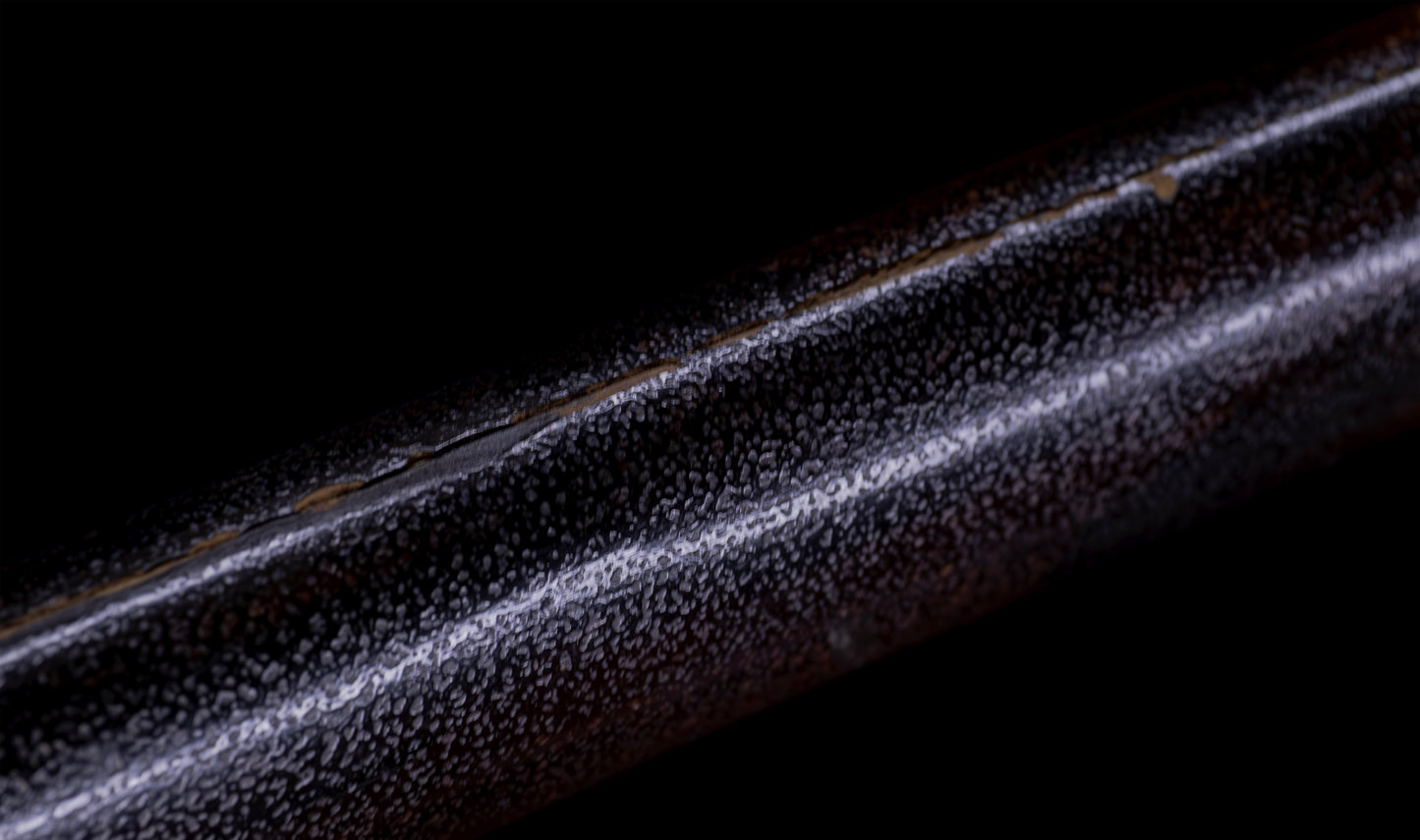
The black lacquered saya (scabbard) presents an elegant, understated aesthetic appropriate to the sword's historical significance. The traditional hon-nuri (full lacquer) finish shows honest age with the fine surface checking (craquelure) that develops in authentic urushi lacquer over centuries. This natural aging pattern—impossible to convincingly replicate—serves as visual confirmation of the mounting's authentic age, likely dating to the late Muromachi or Edo period.
The koiguchi (mouth reinforcement) appears to be buffalo horn or similar traditional dark material, properly fitted and showing appropriate wear from centuries of use. The overall construction maintains the functional integrity necessary for proper blade storage and protection while displaying the honest patina of a genuinely historical mounting.
The Uda School: Yamato's Supreme Tradition
To fully appreciate this sword's significance, one must understand the Uda School's place in Japanese sword history. The Yamato tradition—centered in the ancient capital region around Nara—represented one of the five major sword-making traditions (Gokaden) that defined Japanese blade craftsmanship. Within Yamato, five schools stood above all others, collectively known as the Yamato Godenchū (Five Great Yamato Traditions). The Uda School numbered among these elite five, alongside Senjuin, Taima, Tegai, and Hōshō.
The Uda tradition originated with Uda Kunimitsu during the late Kamakura period (circa 1300s), quickly establishing a reputation for blades of exceptional quality. The school's location in Yamato—Japan's spiritual and cultural heartland—meant that Uda smiths forged swords for the imperial court, major temples, and the highest-ranking samurai families. Many Uda works survive in temple collections and among designated Important Cultural Properties, testament to their historical significance and the care with which they were preserved.
Technical Characteristics of Uda Work:
Uda blades are characterized by refined jihada (grain structure) showing tight, well-forged steel with subtle beauty rather than flashy effects. The typical Uda hamon follows a suguha pattern—relatively straight with subtle variations—that demonstrates mastery of heat treatment while maintaining elegant simplicity. This restrained aesthetic reflects the Yamato philosophical approach: beauty through refinement rather than ostentation, power through technical perfection rather than crude force.
The school's reputation for cutting ability made Uda blades highly prized by warriors who needed swords that would perform reliably in combat. Historical cutting test records (tameshigiri) frequently note exceptional results with Uda blades, and the saying "Uda cuts well" became proverbial among samurai. This combination of aesthetic refinement and practical effectiveness—the ultimate expression of bi (beauty) and yō (function) in harmony—elevated Uda works to the highest tier of collector desirability.
Many Uda smiths, following a tradition common among the greatest makers, did not sign their work. This practice reflected both humility and confidence: the quality would speak for itself to those educated enough to recognize it. For modern collectors, this means that attributed Uda blades—especially those with NBTHK Hozon certification—represent authenticated examples of work from this legendary tradition, carrying the full weight of historical significance even without a visible signature.
Aizu Shōami: Official Metalworkers to the Samurai Class
The Shōami School (正阿弥) represented the official metalworking establishment of feudal Japan, holding hereditary positions as suppliers to the shogunate and major daimyō families. The school's founding reaches back to the Muromachi period, and by the Edo period, Shōami workshops operated in multiple locations under the patronage of different domains, all maintaining the technical standards and artistic sophistication that justified their official status.
The Aizu branch worked under the powerful Aizu domain (in present-day Fukushima), one of the most important han in Japan with deep connections to the Tokugawa shogunate. The Aizu Matsudaira family—a cadet branch of the Tokugawa—maintained their own Shōami workshop to supply the domain's samurai with high-quality sword fittings, armor components, and metal decorations. Aizu Shōami artists were particularly noted for their iron tsuba work, mastering the difficult art of creating sculptural relief in hard iron while maintaining the material's structural integrity.
The naturalistic landscapes that characterize much Aizu Shōami work reflect both Chinese-influenced artistic conventions and native Japanese aesthetic sensibilities. Mountains and trees—symbols of permanence, natural power, and the untamed strength underlying civilization—provided appropriate imagery for samurai sword fittings. The technical challenge of creating depth, texture, and narrative in iron through carving and chasing demonstrated the metalworker's skill while producing pieces that functioned as miniature sculptural works.
The Muromachi Period: An Age of War and Refinement
This sword was forged during the Muromachi period (1336-1573), one of the most turbulent yet culturally productive eras in Japanese history. Following the fall of the Kamakura shogunate, Japan entered a period of increasing political fragmentation that would eventually erupt into the century-long Sengoku period of constant warfare. Yet paradoxically, this age of conflict also saw remarkable cultural achievements—the perfection of tea ceremony, the development of Noh theater, and the refinement of sword-making traditions like Uda to their highest expression.
Swords of this era were forged for actual warfare, not ceremonial display. Every Muromachi blade was made with the understanding that it would see battle, that a samurai's life might depend on its performance. The Uda School's reputation for cutting ability made their blades particularly sought after during this period when effectiveness was measured in survival rather than aesthetic appreciation. Yet even as practical weapons, these swords embodied the Japanese insistence on beauty even in implements of war—the belief that a sword should be both a perfect tool and a work of art.
The presence of three mekugi-ana tells this sword's story across centuries: forged in the Muromachi period for a warrior who may have carried it through actual combat, passed down and remounted during the peaceful Edo period when it became a symbol of samurai status and heritage, carefully preserved through the Meiji Restoration when the samurai class was abolished, and ultimately authenticated in our modern era by the NBTHK as a work worthy of preservation as cultural heritage.


Contenu réductible
Paiement
Vous pouvez payer par carte bancaire ou virement bancaire. Si vous souhaitez utiliser le virement bancaire, veuillez nous contacter en utilisant le formulaire ci-dessous avec le nom du sabre que vous souhaitez acheter.
Douanes et Taxes
・Les droits d'importation, les taxes et les frais ne sont pas inclus dans le prix de l'article ou les frais d'expédition. Ces charges sont sous la responsabilité de l'acheteur.
・Veuillez vérifier auprès du bureau de douane de votre pays pour déterminer quels seront ces coûts supplémentaires avant d'enchérir/d'acheter.
・Ces frais sont normalement collectés par la société de livraison de fret (expédition) ou lorsque vous récupérez l'article - ne les confondez pas avec des frais d'expédition supplémentaires.
Expédition et retour
Les sabres sont expédiées de Tokyo, au Japon . Nous gérons toutes les procédures pour exporter le sabre.
Vous ne pouvez pas renvoyer le sabre au Japon car les procédures sont trop strictes.
Nous travaillons avec une compagnie maritime qui a de l'expérience avec Nihonto afin que vous n'ayez pas à vous inquiéter.
Veuillez vérifier les règles de votre pays avant d'importer le sabr. Nous n'assumons aucune responsabilité, y compris (sans s'y limiter) le remboursement, pour les raisons ci-dessus.
Procédure d'exportation (nous la gérons)
・Tous nos sabres sont enregistrées auprès de l'Agence des affaires culturelles en tant qu'œuvres d'art et du Conseil de l'éducation (Comité de protection des biens culturels) ; donc chaque sabre a la carte d'enregistrement, délivrée par le Board of Education.
・Après avoir reçu le paiement intégral des articles, nous renvoyons la carte d'enregistrement et obtenons l'autorisation du ministère des Affaires culturelles d'exporter légalement les sabres du Japon. Il faudra environ 20 jours ouvrables pour effectuer cette procédure.
・Après réception de l'autorisation, nous vous informerons par e-mail et enverrons les articles immédiatement.