


Tokyo Nihonto
Katana Giapponese Antica con Tsuba in Ferro Sukashi a Motivi Floreali, Lama Mumei Periodo Edo
Katana Giapponese Antica con Tsuba in Ferro Sukashi a Motivi Floreali, Lama Mumei Periodo Edo
Impossibile caricare la disponibilità di ritiro
- Firma (Mei): Mumei (無銘) - non firmato
- Tipo: Katana
- Periodo: Periodo Edo (Shintō)
- Montatura: Koshirae nero in urushi con tsuba in ferro sukashi e tsuka avvolto in pelle nera
- Lunghezza della lama (Nagasa): circa 69 cm
- Curvatura (Sori): 1,4 cm
- Mekugi-ana: 1
- Forma: Shinogi-zukuri con iori-mune e chū-kissaki
- Jihada: Ko-itame stretto e luminoso
- Hamon: Suguha-chō con notare delicato, nioiguchi con ko-nie
- Boshi: Ko-maru
Questa Katana è una lama mumei (non firmata) del periodo Edo, presentata per i suoi meriti intrinseci—una genuina spada giapponese antica, registrata in Giappone e offerta per quello che l'acciaio stesso mostra piuttosto che per un nome sulla spina.
La sugata è una pulita shinogi-zukuri con iori-mune, un bilanciato chū-kissaki, e un moderato sori di 1,4 cm—il profilo composto e pratico di una katana del periodo Edo realizzata per essere indossata e utilizzata da un samurai. In mano la lama è in buone condizioni e ben lucida, con buona sostanza da machi a punta.
La jihada è un ko-itame stretto e ben compatto, luminoso e forgiato con pulizia, il tipo di grana disciplinata che si legge come qualità silenziosa piuttosto che ostentazione. Contro di essa, l'hamon scorre come una calma suguha-chō—una linea di tempra diritta con una delicata ondulazione notare—inserita in un morbido nioiguchi con fine ko-nie. Il boshi si piega in un ordinato ko-maru. Questo è un'estetica sobria e classica: l'appeal sta nell'uniformità del lavoro e nella luminosità dell'acciaio, non in un'attività drammatica.
Una lama Edo mumei come questa è esattamente quello che molti collezionisti cercano come primo nihonto autentico—una genuina spada giapponese forgiata tradizionalmente in condizioni oneste, senza il premio di prezzo che una firma richiede. Un acquirente che in seguito desiderasse carte formali potrebbe sottoporla a shinsa dell'NBTHK.
Dettagli della Koshirae
La spada è accompagnata da una completa e coordinata koshirae nera. La saya è rifinita in lucida lacca urushi nera—semplice e dignitosa—e vestita con un nero sageo.
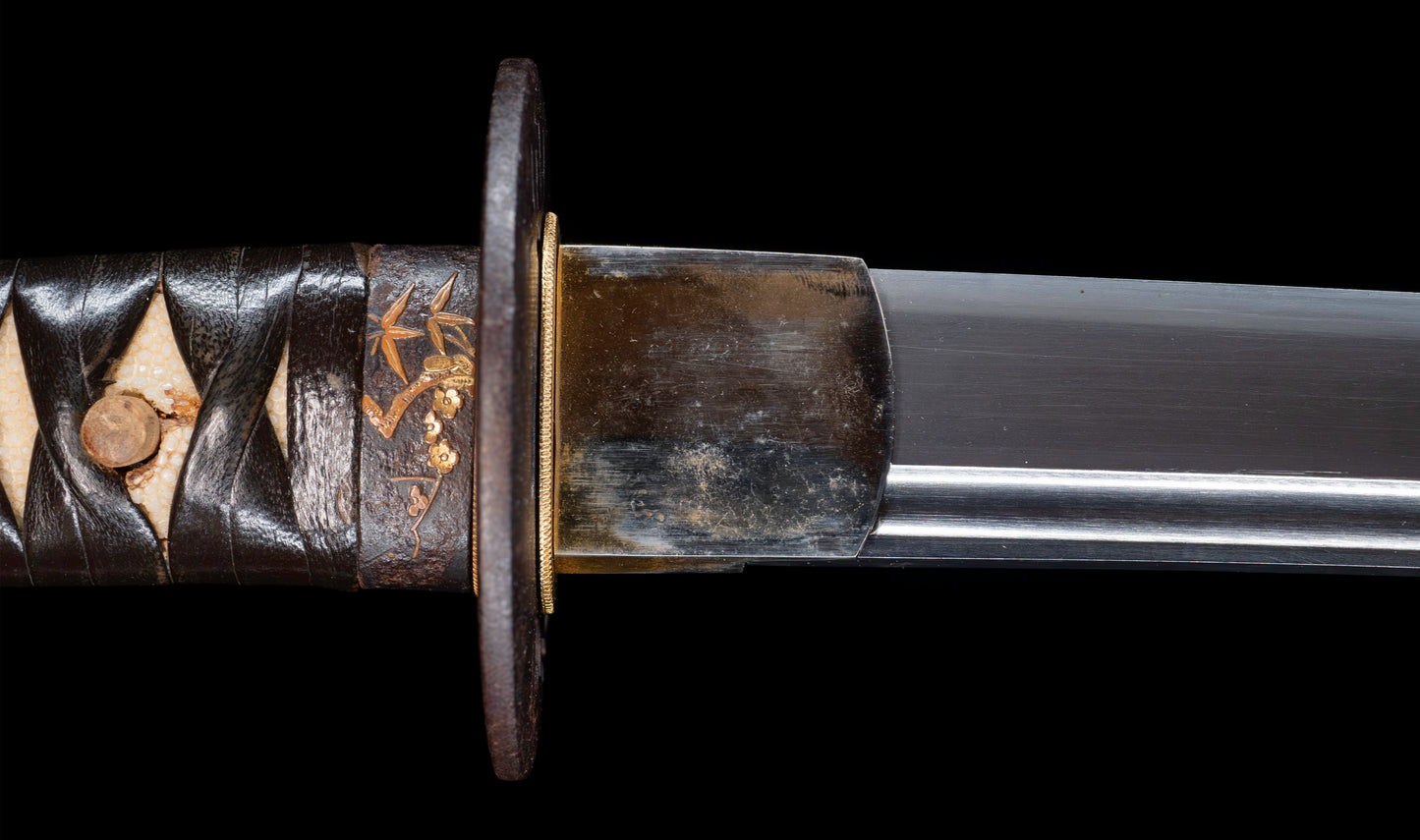
Il tsuba è una piastra rotonda in tetsu (ferro) con una patina scura, tagliata in ji-sukashi (traforata): uno stile floreale con petali radianti sopra e un rametto di fogliame sotto, con due hitsu-ana per kozuka e kōgai. Il fuchi è lavorato in metallo morbido scuro con un delicato disegno floreale—prugna e fogliame—evidenziato in doratura, un tocco raffinato contro la sobria montatura.
La tsuka è avvolta in pelle nera (kawa) su same bianco (pelle di razza) nel tradizionale motivo a diamante hineri-maki, con menuki del drago finemente dettagliati e in evidenza dorata sotto l'avvolgimento. La pelle mostra un'onesta età e un leggero usura minore—il tipo di carattere atteso di una spada che è stata indossata e conservata piuttosto che rinchiusa. L'habaki è un collare dorato. Nel complesso i fittings creano una discreta e raffinata montatura samurai.
Informazioni su Mumei Katana Edo
Una lama mumei (non firmata) non è una lama inferiore—è semplicemente una senza firma sul nakago (spina). Molte spade del periodo Edo uscirono dalla fucina non firmate, e molte altre persero la loro firma quando accorciate nei secoli. Quello che importa è l'artigianato: l'acciaio, la linea di tempra, la forma e le condizioni della lama. Queste sono cose che puoi vedere e tenere in mano, e sono il vero fondamento su cui un nihonto dovrebbe essere giudicato.
Per un collezionista, una katana mumei Edo offre una genuina spada giapponese tradizionalmente forgiata—realizzata in tamahagane, indurita con il metodo argilla-e-acqua che produce l'hamon—a un livello più accessibile di un pezzo firmato e cartaceo da un nome famoso. Questo esempio è un rappresentante onesto e attraente di quella categoria: una vera lama Edo in montature complete, registrata in Giappone e pronta per essere studiata, esposta o usata come base per una collezione.


Contenuto comprimibile
Payment
You can pay by Bank card or Bank transfer. If you wish to use bank transfer please contact us using the form bellow with the name of the sword you are willing to buy.
Customs and Taxes
・Import duties, taxes and charges are not included in the item price or shipping charges. These charges are the buyer’s responsibility.
・Please check with your country’s customs office to determine what these additional costs will be prior to bidding/buying.
・These charges are normally collected by the delivering freight (shipping) company or when you pick the item up - do not confuse them for additional shipping charges.
Shipping and Return
- Swords are shipped from Tokyo, Japan. We manage all the procedures to export the sword.
- You can't return sword to Japan because procedures are too strict.
- We work with a shipping company that have experience with Nihonto so you don't have to worry.
- Please check the rules of your country before importing the sword. We do not take any responsibility, including (not limited to) refund, due to the above reasons.
- We can NOT cancel an order once, we already applied for the export authorization. As this document is made to customer name.
We have shipped authentic Japanese swords to the USA, UK, Canada, Mexico, Germany, France, Hong Kong, and Australia. If you don’t live in these countries and like to order, please contact us first before purchasing. We normally ship by EMS (Express Mail Service) provided by Japan Post.
If you live in the UK, please contact us BEFORE order.
Export Procedure (We manage it)
・All our swords are registered in the Agency for Cultural Affairs as artwork and The Board of Education(Cultural properties protection Committee); therefore each sword has the registration card, issued by the Board of Education.
・After receiving the full payment of the items,we return the registration card and get the permission from Ministry of Cultural Affairs to export the swords legally from Japan. It will take about 1 to 3 months for that step.
・After the receiving the permission, we will inform you by email and send the items immediately.
Contact form
What Our Collectors Say
Independent reviews from verified buyers on Trustpilot
Wonderful folks to buy from
“Large selection to choose from. The katana were signed with Hozon and the blades in a shirasaya. My two katana and Kozuka came packed in a solid wooden crate. Great friendly communication.”
Got a beautiful sword delivered to NYC
“Condition is just as pictured. Took a little while to get all the way to the states, but I was very happy with this seller and plan to purchase more from them.”
Order with confidence
“In the end I received what I ordered, well-packaged and in the condition specified.”
Un katana antique magnifique
“J'ai posé beaucoup de questions au support qui a su répondre et m'aider dans mon choix. La commande est arrivée avec le certificat dans un emballage robuste et en parfait état, il est vraiment magnifique !”