


Tokyo Nihonto
Antique Japanese Katana Sword with Vermilion Lacquer Saya, Sparrow Fuchi-Kashira and Gilt Menuki
Antique Japanese Katana Sword with Vermilion Lacquer Saya, Sparrow Fuchi-Kashira and Gilt Menuki
Impossibile caricare la disponibilità di ritiro
- Signature (Mei): Mumei, unsigned
- Nakago: Unshortened, tapering naturally to a crisply cut kengyo point, deep brown-black patina
- Swordsmith: Unknown. The blade carries no shinsa paper
- School / Tradition: Not attributed
- Period: Early Edo, seventeenth century. The proportions are those of Kanbun shinto
- Registration: Japanese torokusho Tokyo no. 135604, issued 15 June 1967
- Certificate: None. The blade has never been submitted to shinsa
- Mounting: Complete katana koshirae with vermilion lacquer saya, iron openwork tsuba, sparrow fuchi-kashira and gilt menuki
- Blade Length (Nagasa): 63.3 cm
- Curvature (Sori): 1.2 cm
- Mekugi-ana: 2
- Shape (Sugata): Shinogi-zukuri, iori-mune, chu-kissaki, shallow curvature
- Jihada: Itame mixed with mokume, tightly forged
- Hamon: Shallow notare carrying ko-gunome, settling at intervals into a wavering suguha, nioi-deki
- Boshi: Sugu to shallow midare-komi, ko-maru turnback, healthy with width remaining
- Habaki: Single-piece copper, filed in two zones
- Polish: Older polish, now tired
This is an unsigned katana of 63.3 cm with 1.2 cm of sori, registered in Japan under torokusho Tokyo no. 135604 of 15 June 1967 and dated to the early Edo period.
Those two measurements are the whole story. A blade of barely sixty-three centimetres carrying almost no curve is the signature proportion of Kanbun shinto, the style that dominated Japanese sword-making between roughly 1660 and 1680, and it is a shape that exists because of peace rather than war. Two generations after Sekigahara there were no more battlefields. A samurai still wore two swords every day of his life, but he wore them through the streets of a castle town, and if he ever drew one it would be indoors: in a corridor, in a room floored with tatami, at conversational distance. Long, deeply curved blades made for cutting from horseback were useless in that world. What replaced them was this: short, nearly straight, thick through the spine, and faster out of the scabbard than anything that came before.
The nakago confirms the dating. It has not been shortened. It tapers naturally and finishes in a cleanly cut kengyo point, carries two mekugi-ana from being remounted during its working life, and wears a deep, even brown-black patina. The blade is mumei, has never been through shinsa and carries no NBTHK paper, so no smith or school is attributed to it. The polish it wears is an old one that has gone cloudy, and in that state the jihada is muted and the finer activity inside the hamon cannot be read.
The sword is shinogi-zukuri with an iori-mune and a compact chu-kissaki. The temper is a quiet, shallow notare carrying ko-gunome, narrow to medium in width, settling at intervals into something close to a wavering suguha. It reads as nioi-deki. The boshi runs straight into the point and turns back in a neat ko-maru, with a good width of hardened steel still there. That matters more than it sounds: a dead boshi ends a sword's life, and this one is alive. There is no hagire, no fukure and no ware.
Sent to a first-rate togishi for a foundation polish, the blade would show its grain and its activity for the first time in a very long while, and could then go to the NBTHK on its own merits. The boshi and the geometry are sound enough to make that worth doing.
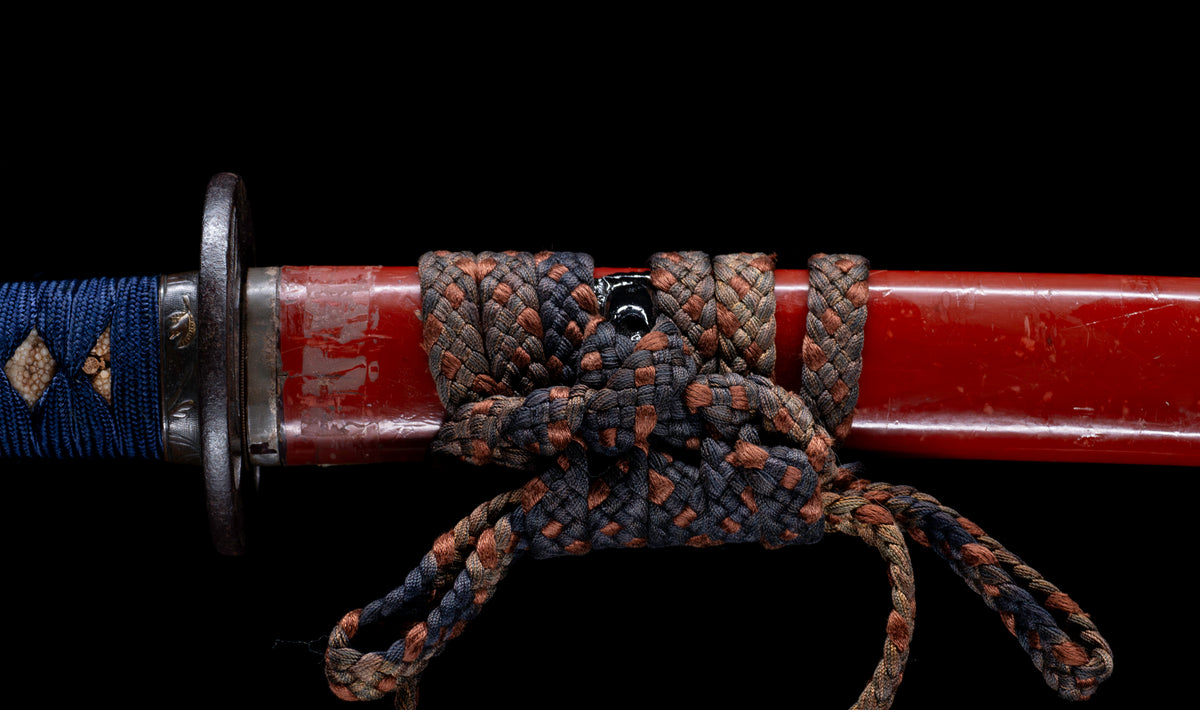
The mounting is the immediate pleasure of this sword. The saya is lacquered in vermilion, shu-urushi, a colour worn by men who were not trying to go unnoticed, set against a tsuka wrapped in deep blue silk over white samegawa. The oyatsubu, the large central node of the rayskin and the most prized part of the hide, sits proud on one face of the handle. The wrap is tsumami-maki, the pinched style, and the sageo is a thick woven cord in brown, black and blue that looks every bit as old as the mounting it belongs to.
The tsuba is iron, maru-gata, worked in ji-sukashi with a bold abstract silhouette that reads as stylised antlers or myoga shoots, with a kaku-mimi koniku rim and copper sekigane still in place at both ends of the nakago-ana. It is unsigned. The fuchi and kashira are a matching set and the finest thing in the mounting: sparrows in flight among bamboo, carved in takabori with gold accents over a nanako ground. The menuki are gilt copper, coiled beasts set under the wrap. The kojiri is brass, deeply cut with karakusa scrolling vine.
Condition of the saya: the vermilion saya is split. There are deep cracks running lengthwise along the wood, several areas of lacquer loss and chipping, and the horn koiguchi is worn and lifting from the core. It is stable enough to hold the blade for display, but it needs the attention of a sayashi before the sword is carried or drawn. The seppa are a mismatched pair, one with a coined edge and one plain, which is entirely normal on a sword that saw real use.
The blade is unsigned, so there is no smith to name. What can be said is which generation of smiths it belongs to, and that is a more interesting question than it first appears.
The swords of the Kanbun era were made by men whose fathers and grandfathers had forged for war and who themselves would never see one. The Tokugawa peace had held for half a century. Armour was ceremonial, the great campaigns were stories told by old men, and the sword had quietly changed from a weapon of the battlefield into something between a sidearm, a badge of rank and a piece of daily dress. Smiths responded by building exactly what their customers now needed: a short, stiff, fast blade with almost no curve, balanced to be drawn in one movement in a confined space.
They also worked quietly. The flamboyant tempers of the previous century gave way to restrained suguha and shallow notare of the kind on this blade, because a sword worn as dress in a city at peace was not competing to be seen. That restraint is the reason so many sound Kanbun-era blades are unsigned and unpapered today: they were made in numbers, by competent men, for customers who wanted a good sword rather than a famous one.
The NBTHK examines unsigned blades every year and issues attributions on workmanship alone, and a great many papered mumei swords began exactly where this one stands. What lies between this blade and that process is a foundation polish.
The mounting tells the same story as the blade, from the other direction.
A vermilion scabbard against deep blue silk is not the equipment of a man expecting to fight. It is the taste of the Edo townsman-samurai, for whom the sword at his hip was the most visible thing he owned and was dressed accordingly. Sparrows among bamboo on the fuchi-kashira belongs to the same world: a seasonal, domestic, faintly literary motif, the kind of subject that appears on lacquer boxes and painted screens, and nothing at all like a warlord's dragon.
The iron tsuba underneath is plainer and older in character than the set it now sits in, which means somebody assembled this mounting from what he had and what he liked. That is how swords were actually put together, and it is why the two mekugi-ana in the tang matter: this blade was taken apart and redressed at least once in its working life, by an owner who wanted it to look a particular way.
What is offered here is a genuine antique Japanese katana of the early Edo period, with the unmistakable proportions of the Kanbun style, registered with the Japanese authorities in 1967, complete in a period mounting, and with a clear path to a certificate for a buyer willing to fund a polish.


Contenuto comprimibile
Payment
You can pay by Bank card or Bank transfer. If you wish to use bank transfer please contact us using the form bellow with the name of the sword you are willing to buy.
Customs and Taxes
・Import duties, taxes and charges are not included in the item price or shipping charges. These charges are the buyer’s responsibility.
・Please check with your country’s customs office to determine what these additional costs will be prior to bidding/buying.
・These charges are normally collected by the delivering freight (shipping) company or when you pick the item up - do not confuse them for additional shipping charges.
Shipping and Return
- Swords are shipped from Tokyo, Japan. We manage all the procedures to export the sword.
- You can't return sword to Japan because procedures are too strict.
- We work with a shipping company that have experience with Nihonto so you don't have to worry.
- Please check the rules of your country before importing the sword. We do not take any responsibility, including (not limited to) refund, due to the above reasons.
- We can NOT cancel an order once, we already applied for the export authorization. As this document is made to customer name.
We have shipped authentic Japanese swords to the USA, UK, Canada, Mexico, Germany, France, Hong Kong, and Australia. If you don’t live in these countries and like to order, please contact us first before purchasing. We normally ship by EMS (Express Mail Service) provided by Japan Post.
If you live in the UK, please contact us BEFORE order.
Export Procedure (We manage it)
・All our swords are registered in the Agency for Cultural Affairs as artwork and The Board of Education(Cultural properties protection Committee); therefore each sword has the registration card, issued by the Board of Education.
・After receiving the full payment of the items,we return the registration card and get the permission from Ministry of Cultural Affairs to export the swords legally from Japan. It will take about 1 to 3 months for that step.
・After the receiving the permission, we will inform you by email and send the items immediately.
Contact form
What Our Collectors Say
Independent reviews from verified buyers on Trustpilot
Wonderful folks to buy from
“Large selection to choose from. The katana were signed with Hozon and the blades in a shirasaya. My two katana and Kozuka came packed in a solid wooden crate. Great friendly communication.”
Got a beautiful sword delivered to NYC
“Condition is just as pictured. Took a little while to get all the way to the states, but I was very happy with this seller and plan to purchase more from them.”
Order with confidence
“In the end I received what I ordered, well-packaged and in the condition specified.”
Un katana antique magnifique
“J'ai posé beaucoup de questions au support qui a su répondre et m'aider dans mon choix. La commande est arrivée avec le certificat dans un emballage robuste et en parfait état, il est vraiment magnifique !”