


Tokyo Nihonto
Antique Japanese Katana Sword with Hoso-Suguha Hamon, Phoenix Fuchi and Coin Menuki — Muromachi Period
Antique Japanese Katana Sword with Hoso-Suguha Hamon, Phoenix Fuchi and Coin Menuki — Muromachi Period
Impossibile caricare la disponibilità di ritiro
- Signature (Mei): Mumei (unsigned)
- Period: Muromachi, koto. Shortened blade with two mekugi-ana and a koto sugata. No certificate confirms this
- Certificate: None.
- Japanese Registration (Tōroku-shō): Kanagawa no. 1375, issued 14 September 1952
- Mounting: Complete katana koshirae, black roiro lacquer saya, iron tsuba, phoenix fuchi, cash-coin menuki
- Blade Length (Nagasa): 60.0 cm
- Curvature (Sori): 1.6 cm
- Mekugi-ana: 2
- Shape (Sugata): Shinogi-zukuri, iori-mune, chū-kissaki, shortened (suriage)
- Jihada: Itame mixed with mokume, partly obscured by an old polish
- Hamon: Hoso-suguha with slight notare, nioi-deki
- Bōshi: Sugu with a ko-maru turn-back
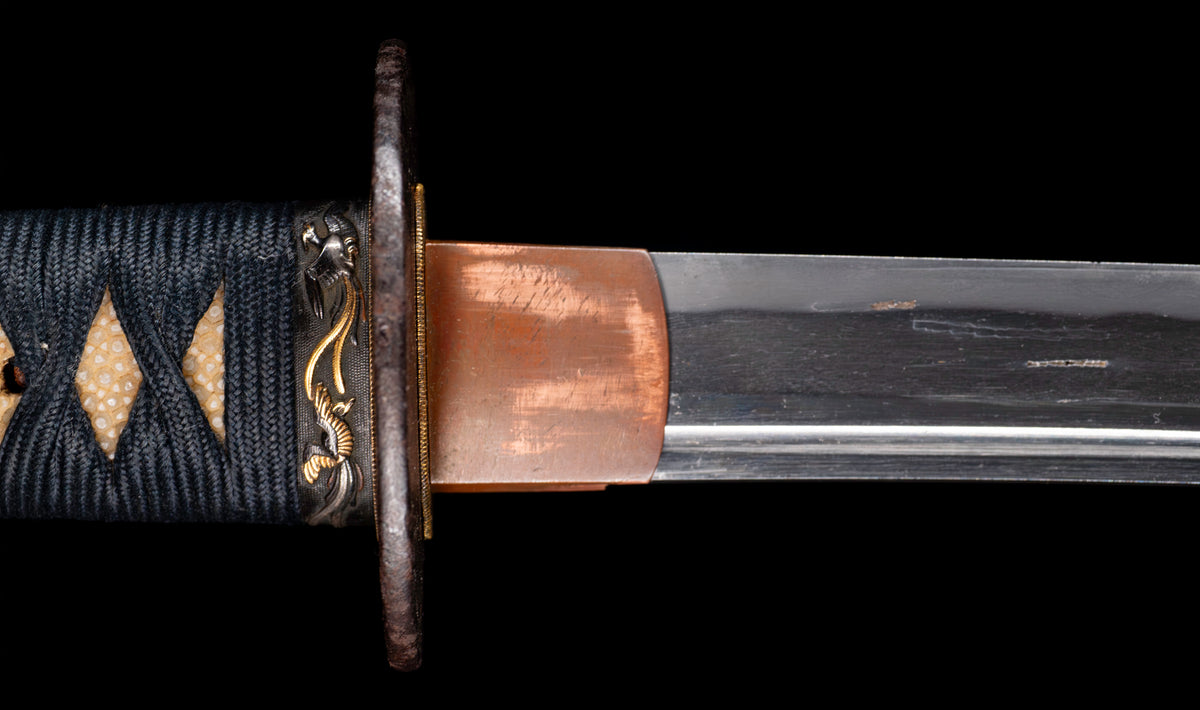
- Habaki: Single-piece copper
An unsigned Muromachi katana of 60.0 cm with 1.6 cm of curvature, registered in Japan since 1952, sold complete in an Edo-period koshirae. It carries no shinsa paper and we make no attribution: this is an honest entry into the world of koto blades, priced accordingly.
The shape is shinogi-zukuri with an iori-mune and a chū-kissaki. The blade has been shortened, and the tang carries two mekugi-ana and a deep, dark patina with patches of old rust. At 60 cm it sits at the compact end of the katana range, the length favoured in the late Muromachi period.
The hamon is a narrow straight temper, hoso-suguha, with a slight undulation in places, continuing into the point and turning back in a ko-maru. The steel is an itame mixed with mokume.
We want to be plain about condition. The blade is in an old, cloudy polish with surface scratches, which hides much of the activity in the steel and hamon. No fatal flaws are visible in our photographs, but a fresh polish would be needed to read the blade properly. It is offered as it is, for the collector who wants a genuine Muromachi sword in hand, or who is prepared to invest in a polish and a shinsa.
Koshirae Details
The koshirae was assembled over time from unrelated Edo-period parts, as working mounts often were.
The tsuba is a round iron plate with a single hitsu-ana, copper sekigane, and small traces of gold inlay that survive from a decoration now mostly worn away.
The fuchi is the finest piece of the mount: shakudō on a nanako ground, carved in relief with a hō-ō phoenix highlighted in gold. The kashira is a plain dark cap. The menuki take the form of old cash coins, a popular good-luck motif, under a dark blue wrap in hineri-maki over white same.
The saya is black roiro lacquer with an iron kojiri. It shows wear, chips and a split along the back seam, and would benefit from restoration. The habaki is single-piece copper.
Reading an Unsigned Muromachi Blade
This katana has no signature and no NBTHK paper, so no smith or school can honestly be named. What the blade itself shows is a shortened koto katana with two mekugi-ana, a compact 60 cm length and a restrained straight temper. The Japanese dealer who handled it catalogued it as Muromachi, and the physical evidence is consistent with that.
Straight tempers in nioi were made across many provinces in the 15th and 16th centuries, which is precisely why an unsigned suguha blade is hard to place without examining it in fresh polish. A new polish followed by NBTHK shinsa is the only route to an attribution, and we make no promise about its outcome.
Swords of the Muromachi Period
The Muromachi period (1336–1573) covers the rise and collapse of the Ashikaga shogunate and the long Sengoku civil war. Demand for swords was enormous, and fighting on foot changed the weapon itself: the long tachi worn edge-down gave way to the shorter uchigatana, worn edge-up through the sash and drawn in a single motion. Blades around 60 cm, like this one, are typical of that change.
What is offered here is an unsigned Muromachi katana of 60.0 cm, registered in Japan since 1952, in an old polish, complete in an assembled Edo-period koshirae with a gold-highlighted phoenix fuchi and cash-coin menuki.


Contenuto comprimibile
Payment
You can pay by Bank card or Bank transfer. If you wish to use bank transfer please contact us using the form bellow with the name of the sword you are willing to buy.
Customs and Taxes
・Import duties, taxes and charges are not included in the item price or shipping charges. These charges are the buyer’s responsibility.
・Please check with your country’s customs office to determine what these additional costs will be prior to bidding/buying.
・These charges are normally collected by the delivering freight (shipping) company or when you pick the item up - do not confuse them for additional shipping charges.
Shipping and Return
- Swords are shipped from Tokyo, Japan. We manage all the procedures to export the sword.
- You can't return sword to Japan because procedures are too strict.
- We work with a shipping company that have experience with Nihonto so you don't have to worry.
- Please check the rules of your country before importing the sword. We do not take any responsibility, including (not limited to) refund, due to the above reasons.
- We can NOT cancel an order once, we already applied for the export authorization. As this document is made to customer name.
We have shipped authentic Japanese swords to the USA, UK, Canada, Mexico, Germany, France, Hong Kong, and Australia. If you don’t live in these countries and like to order, please contact us first before purchasing. We normally ship by EMS (Express Mail Service) provided by Japan Post.
If you live in the UK, please contact us BEFORE order.
Export Procedure (We manage it)
・All our swords are registered in the Agency for Cultural Affairs as artwork and The Board of Education(Cultural properties protection Committee); therefore each sword has the registration card, issued by the Board of Education.
・After receiving the full payment of the items,we return the registration card and get the permission from Ministry of Cultural Affairs to export the swords legally from Japan. It will take about 1 to 3 months for that step.
・After the receiving the permission, we will inform you by email and send the items immediately.
Contact form
What Our Collectors Say
Independent reviews from verified buyers on Trustpilot
Wonderful folks to buy from
“Large selection to choose from. The katana were signed with Hozon and the blades in a shirasaya. My two katana and Kozuka came packed in a solid wooden crate. Great friendly communication.”
Got a beautiful sword delivered to NYC
“Condition is just as pictured. Took a little while to get all the way to the states, but I was very happy with this seller and plan to purchase more from them.”
Order with confidence
“In the end I received what I ordered, well-packaged and in the condition specified.”
Un katana antique magnifique
“J'ai posé beaucoup de questions au support qui a su répondre et m'aider dans mon choix. La commande est arrivée avec le certificat dans un emballage robuste et en parfait état, il est vraiment magnifique !”