


Tokyo Nihonto
Katana giapponese antica con Hamon Toran e Tsuba in ferro a fiore di ciliegio — Osaka Shintō
Katana giapponese antica con Hamon Toran e Tsuba in ferro a fiore di ciliegio — Osaka Shintō
Impossibile caricare la disponibilità di ritiro
- Signature (Mei): Mumei (無銘) - unsigned
- Tradition: Osaka Shintō workmanship
- Period: Edo Period, Kanbun era (mid-17th century)
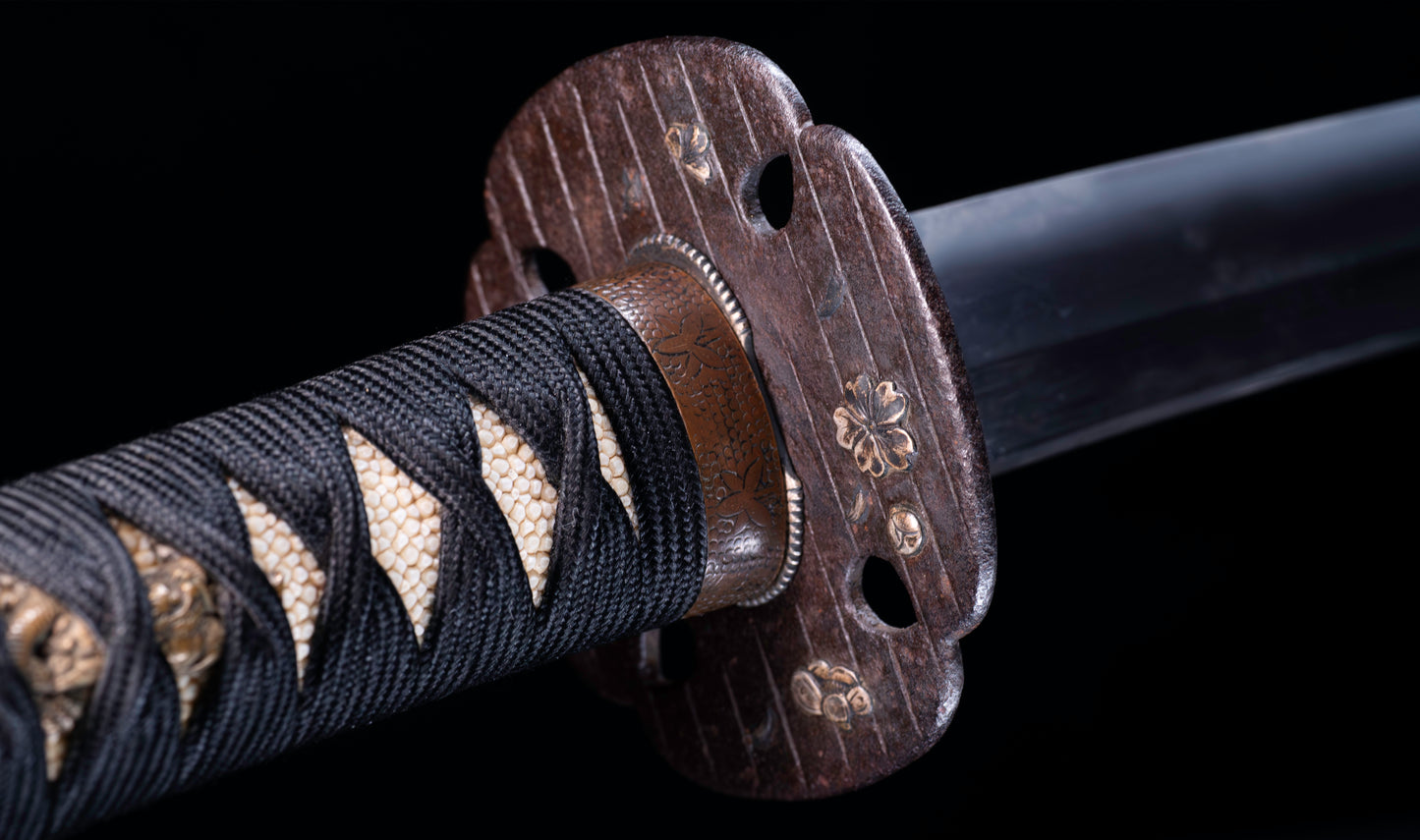
- Mounting: Black-and-russet mottled urushi koshirae with iron mokkō tsuba and silver cherry-blossom decoration
- Blade Length (Nagasa): circa 63,0 cm (2 shaku 0 sun 8 bu)
- Curvature (Sori): circa 1,1 cm - shallow Kanbun-Shintō curve
- Mekugi-ana: 2 (suriage - shortened)
- Shape: Shinogi-zukuri with iori-mune and chū-kissaki
- Jihada: Tight, bright ko-itame - classic Osaka jigane
- Hamon: Notare tending to toran-midare, nioiguchi with ko-nie and ashi
Questa Katana è una lama mumei (unsigned), suriage (accorciata) nel caratteristico stile della tradizione Osaka Shintō. La descriviamo basandoci sull'evidenza dell'acciaio stesso piuttosto che su una firma—perché la firma è andata persa quando una lama più antica e lunga è stata accorciata dalla spina. Quello che rimane è la fattura, ed è ben leggibile.
La prima cosa che un occhio esperto cerca in una lama di Osaka è l'acciaio, e questo non delude: un jihada di ko-itame compatto e ben fattiro, luminoso e quasi senza aperture visibili—l'raffinato ō-saka-tetsu (acciaio di Osaka) che ha costruito la reputazione della scuola. Su quel terreno pulito, l'hamon corre come un generoso notare che si gonfia verso toran-midare—la linea di tempra rotolante e ondulata resa popolare da Tsuda Sukehiro e il suo circolo—impostato in un morbido nioiguchi con ko-nie e ashi che si estendono nel bordo indurito.
La sugata è da manuale Kanbun Shintō: shinogi-zukuri con iori-mune, un chū-kissaki controllato, e la caratteristica sori poco profonda degli anni 1660-70, quando i fabbri di Osaka favorivano un profilo più dritto e pratico. Il boshi segue l'hamon nella punta con un elegante rialzo. In mano, la lama è sana e ben levigata, mostrando il luminoso, gelido bordo indurito che i collezionisti associano a questa scuola.
Il nakago mostra due mekugi-ana, il record fisico del suo accorciamento. Questa è una lama d'epoca onesta, valutata per quello che chiaramente è: acciaio Osaka Shintō di qualità e tempra dal cuore del periodo Shintō.
Dettagli del Koshirae
La spada è montata in un elegante e sobrio koshirae nero con un elemento genuinamente distintivo. La saya è rifinita in una lacca urushi nera e marrone-ruggine screziata—una superficie variegata e simile a corteccia dove il marrone rossastro caldo emerge dal fondo nero, conferendo al fodero una reale profondità e movimento alla luce piuttosto che una finitura piatta. È completata con un sageo blu navy (kon-iro).
La tsuba è una piastra in ferro mokkō-gata (quattro lobi) lavorata con fine intaglio di linee verticali su entrambe le facce e decorata con ciliegi d'argento (sakura) applicati e gemme sparse come alla deriva—un contrasto tranquillo ed elegante tra l'argento brillante e il ferro scuro. La fuchi continua il tema floreale in metallo morbido patinato con fiori incisi e fronde evidenziate in oro, su un fondo finemente testurizzato.
L'habaki è un pulito collare in argento in un unico pezzo tagliato con linee di lima diagonali (neko-gaki). La tsuka è avvolta in ito nero su same bianco (pelle di razza) nel tradizionale motivo a diamante hineri-maki, con menuki figurativi dorati posizionati sotto l'involucro. Considerati insieme, i fornimenti sono coordinati e gustosi—un montaggio da samurai assemblato con cura piuttosto che per l'apparenza.
Osaka Shintō: La Scuola dell'Acciaio Bellissimo
Dopo che Toyotomi Hideyoshi costruì il Castello di Osaka, la città divenne il cuore commerciale del Giappone, e i fabbri di spade vi si riversarono per lavorare per i mercanti, i samurai e i signori feudali che la attraversavano. Da quella concentrazione di talento nacque l'Osaka Shintō—una tradizione definita soprattutto dalla bellezza del suo jigane. L'accesso a materiale di alta qualità e acqua a Osaka consentì ai suoi fabbri di forgiare un acciaio così compatto e luminoso da essere riconoscibile a prima vista, spesso descritto semplicemente come ō-saka-tetsu.
I tre giganti della scuola—i Sanketsu—erano Awataguchi Tadatsuna, Inoue Shinkai e Tsuda Sukehiro, l'ultimo dei quali ha perfezionato lo sfarzoso toranba (hamon "onda-turbine") che ha influenzato l'intera città. Le lame Osaka Shintō abbinano quell'acciaio raffinato a audaci e ritmiche linee di tempra—un'estetica prezzata dai collezionisti proprio perché è così difficile da imitare convincentemente.
Questa katana appartiene a quel mondo. Il suo jigane compatto e luminoso e l'hamon notare-toran influenzato da Sukehiro la collocano fermamente all'interno dell'idioma Osaka Shintō—una autentica lama del Edo medio che porta i segni distintivi che hanno reso queste spade lo standard dell'oro della loro epoca.


Contenuto comprimibile
Payment
You can pay by Bank card or Bank transfer. If you wish to use bank transfer please contact us using the form bellow with the name of the sword you are willing to buy.
Customs and Taxes
・Import duties, taxes and charges are not included in the item price or shipping charges. These charges are the buyer’s responsibility.
・Please check with your country’s customs office to determine what these additional costs will be prior to bidding/buying.
・These charges are normally collected by the delivering freight (shipping) company or when you pick the item up - do not confuse them for additional shipping charges.
Shipping and Return
- Swords are shipped from Tokyo, Japan. We manage all the procedures to export the sword.
- You can't return sword to Japan because procedures are too strict.
- We work with a shipping company that have experience with Nihonto so you don't have to worry.
- Please check the rules of your country before importing the sword. We do not take any responsibility, including (not limited to) refund, due to the above reasons.
- We can NOT cancel an order once, we already applied for the export authorization. As this document is made to customer name.
We have shipped authentic Japanese swords to the USA, UK, Canada, Mexico, Germany, France, Hong Kong, and Australia. If you don’t live in these countries and like to order, please contact us first before purchasing. We normally ship by EMS (Express Mail Service) provided by Japan Post.
If you live in the UK, please contact us BEFORE order.
Export Procedure (We manage it)
・All our swords are registered in the Agency for Cultural Affairs as artwork and The Board of Education(Cultural properties protection Committee); therefore each sword has the registration card, issued by the Board of Education.
・After receiving the full payment of the items,we return the registration card and get the permission from Ministry of Cultural Affairs to export the swords legally from Japan. It will take about 1 to 3 months for that step.
・After the receiving the permission, we will inform you by email and send the items immediately.
Contact form
What Our Collectors Say
Independent reviews from verified buyers on Trustpilot
Wonderful folks to buy from
“Large selection to choose from. The katana were signed with Hozon and the blades in a shirasaya. My two katana and Kozuka came packed in a solid wooden crate. Great friendly communication.”
Got a beautiful sword delivered to NYC
“Condition is just as pictured. Took a little while to get all the way to the states, but I was very happy with this seller and plan to purchase more from them.”
Order with confidence
“In the end I received what I ordered, well-packaged and in the condition specified.”
Un katana antique magnifique
“J'ai posé beaucoup de questions au support qui a su répondre et m'aider dans mon choix. La commande est arrivée avec le certificat dans un emballage robuste et en parfait état, il est vraiment magnifique !”