

Tokyo Nihonto
Katana Japonés Antiguo con Tsuba de Hierro Sukashi Floral, Hoja Mumei del Período Edo
Katana Japonés Antiguo con Tsuba de Hierro Sukashi Floral, Hoja Mumei del Período Edo
No se pudo cargar la disponibilidad de retiro
- Firma (Mei): Mumei (無銘) - sin firmar
- Tipo: Katana
- Período: Período Edo (Shintō)
- Montadura: Koshirae negro con urushi y tsuba de sukashi de hierro con tsuka envuelta en cuero negro
- Longitud de la Hoja (Nagasa): aprox. 69 cm
- Curvatura (Sori): 1,4 cm
- Mekugi-ana: 1
- Forma: Shinogi-zukuri con iori-mune y chū-kissaki
- Jihada: Ko-itame apretado y brillante
- Hamon: Suguha-chō con notare suave, nioiguchi con ko-nie
- Boshi: Ko-maru
Esta Katana es una hoja mumei (sin firmar) del período Edo, presentada por sus propios méritos—una auténtica espada japonesa antigua, registrada en Japón y ofrecida por lo que el acero muestra en sí mismo en lugar de un nombre en la espiga.
La sugata es una limpia shinogi-zukuri con iori-mune, un chū-kissaki equilibrado, y un sori moderado de 1,4 cm—el perfil compuesto y práctico de una katana del período Edo hecha para que un samurái la portara y usara. En la mano la hoja está sana y bien pulida, con buena sustancia de machi a punta.
El jihada es un apretado y bien comprimido ko-itame, brillante y forjado limpiamente, el tipo de grano disciplinado que se lee como calidad discreta más que como alarde. Contra él, el hamon corre como un tranquilo suguha-chō—una línea de templado recta con una suave ondulación notare—establecido en un suave nioiguchi con fino ko-nie. El boshi se vuelve en un ordenado ko-maru. Esta es una estética clásica y contenida: el atractivo reside en la uniformidad del trabajo y el brillo del acero, no en una actividad dramática.
Una hoja Edo mumei como esta es exactamente lo que muchos coleccionistas buscan como su primer nihonto auténtico—una verdadera espada japonesa forjada tradicionalmente en condición honesta, sin la prima de precio que exige una firma. Un comprador que después desee documentos formales puede presentarla para shinsa del NBTHK.
Detalles de la Koshirae
La espada viene en una completa y coordinada koshirae negra. La saya está acabada en barniz negro brillante de urushi—simple y dignificada—y adornada con un sageo negro.
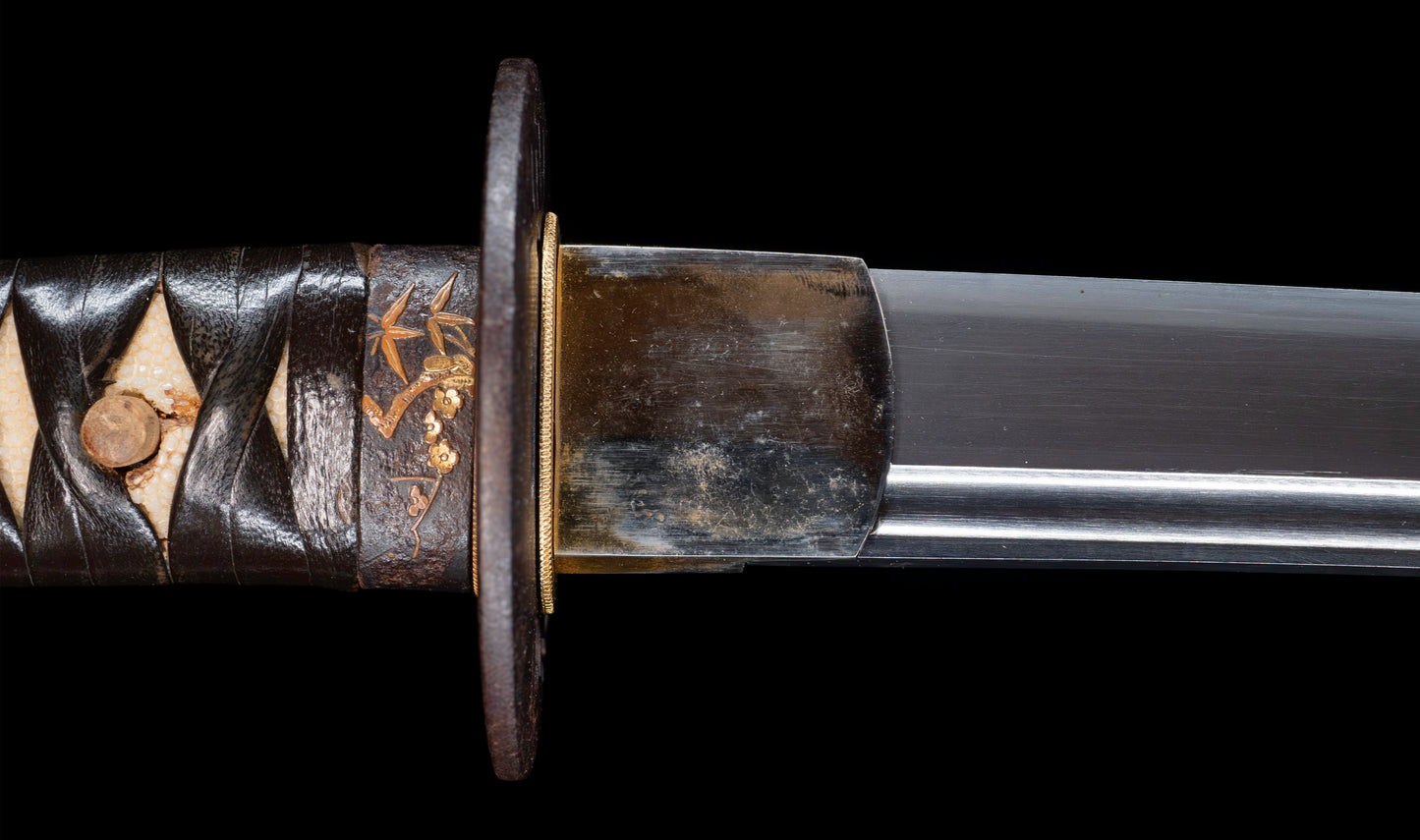
La tsuba es una placa redonda de tetsu (hierro) con pátina oscura, cortada en ji-sukashi (calado): un ramo floral estilizado con pétalos radiantes arriba y una rama de follaje abajo, con dos hitsu-ana para kozuka y kōgai. El fuchi está trabajado en metal suave oscuro con un delicado diseño floral—ciruela y follaje—destacado en dorado, un toque refinado contra la montadura sobria.
El tsuka está envuelto en cuero negro (kawa) sobre blanco same (piel de raya) en el patrón de diamante tradicional hineri-maki, con menuki de dragón finamente detallados y destacados en dorado colocados bajo el envoltorio. El cuero muestra una edad honesta y un poco de desgaste menor—el tipo de carácter que se espera de una espada que ha sido portada y conservada en lugar de guardada bajo llave. El habaki es un collar dorado. En conjunto los herrajes forman una montadura de samurái tranquila y de buen gusto.
Sobre la Katana Edo Mumei
Una hoja mumei (sin firmar) no es una hoja inferior—es simplemente una sin firma en el nakago (espiga). Muchas espadas del período Edo salieron de la fragua sin firmar, y muchas otras perdieron su firma cuando fueron acortadas a lo largo de los siglos. Lo que importa es la artesanía: el acero, la línea de templado, la forma y la salud de la hoja. Esas son cosas que puedes ver y sostener, y son la verdadera base sobre la cual debe juzgarse un nihonto.
Para un coleccionista, una katana Edo mumei ofrece una verdadera espada japonesa hecha tradicionalmente—forjada de tamahagane, endurecida con el método de arcilla y agua que produce el hamon—en un nivel más accesible que una pieza firmada y documentada por un nombre famoso. Este ejemplo es un representante honesto y atractivo de esa categoría: una verdadera hoja Edo en monturas completas, registrada en Japón y lista para estudiar, exhibir o construir una colección alrededor.


Contenido desplegable
Payment
You can pay by Bank card or Bank transfer. If you wish to use bank transfer please contact us using the form bellow with the name of the sword you are willing to buy.
Customs and Taxes
・Import duties, taxes and charges are not included in the item price or shipping charges. These charges are the buyer’s responsibility.
・Please check with your country’s customs office to determine what these additional costs will be prior to bidding/buying.
・These charges are normally collected by the delivering freight (shipping) company or when you pick the item up - do not confuse them for additional shipping charges.
Shipping and Return
- Swords are shipped from Tokyo, Japan. We manage all the procedures to export the sword.
- You can't return sword to Japan because procedures are too strict.
- We work with a shipping company that have experience with Nihonto so you don't have to worry.
- Please check the rules of your country before importing the sword. We do not take any responsibility, including (not limited to) refund, due to the above reasons.
- We can NOT cancel an order once, we already applied for the export authorization. As this document is made to customer name.
We have shipped authentic Japanese swords to the USA, UK, Canada, Mexico, Germany, France, Hong Kong, and Australia. If you don’t live in these countries and like to order, please contact us first before purchasing. We normally ship by EMS (Express Mail Service) provided by Japan Post.
If you live in the UK, please contact us BEFORE order.
Export Procedure (We manage it)
・All our swords are registered in the Agency for Cultural Affairs as artwork and The Board of Education(Cultural properties protection Committee); therefore each sword has the registration card, issued by the Board of Education.
・After receiving the full payment of the items,we return the registration card and get the permission from Ministry of Cultural Affairs to export the swords legally from Japan. It will take about 1 to 3 months for that step.
・After the receiving the permission, we will inform you by email and send the items immediately.
Contact form
What Our Collectors Say
Independent reviews from verified buyers on Trustpilot
Wonderful folks to buy from
“Large selection to choose from. The katana were signed with Hozon and the blades in a shirasaya. My two katana and Kozuka came packed in a solid wooden crate. Great friendly communication.”
Got a beautiful sword delivered to NYC
“Condition is just as pictured. Took a little while to get all the way to the states, but I was very happy with this seller and plan to purchase more from them.”
Order with confidence
“In the end I received what I ordered, well-packaged and in the condition specified.”
Un katana antique magnifique
“J'ai posé beaucoup de questions au support qui a su répondre et m'aider dans mon choix. La commande est arrivée avec le certificat dans un emballage robuste et en parfait état, il est vraiment magnifique !”