


Tokyo Nihonto
Katana Japonesa Antigua con Hamon Toran y Tsuba de Hierro Flor de Cerezo — Osaka Shintō
Katana Japonesa Antigua con Hamon Toran y Tsuba de Hierro Flor de Cerezo — Osaka Shintō
No se pudo cargar la disponibilidad de retiro
- Firma (Mei): Mumei (無銘) - sin firmar
- Tradición: Artesanía Osaka Shintō
- Período: Período Edo, era Kanbun (mediados del siglo XVII)
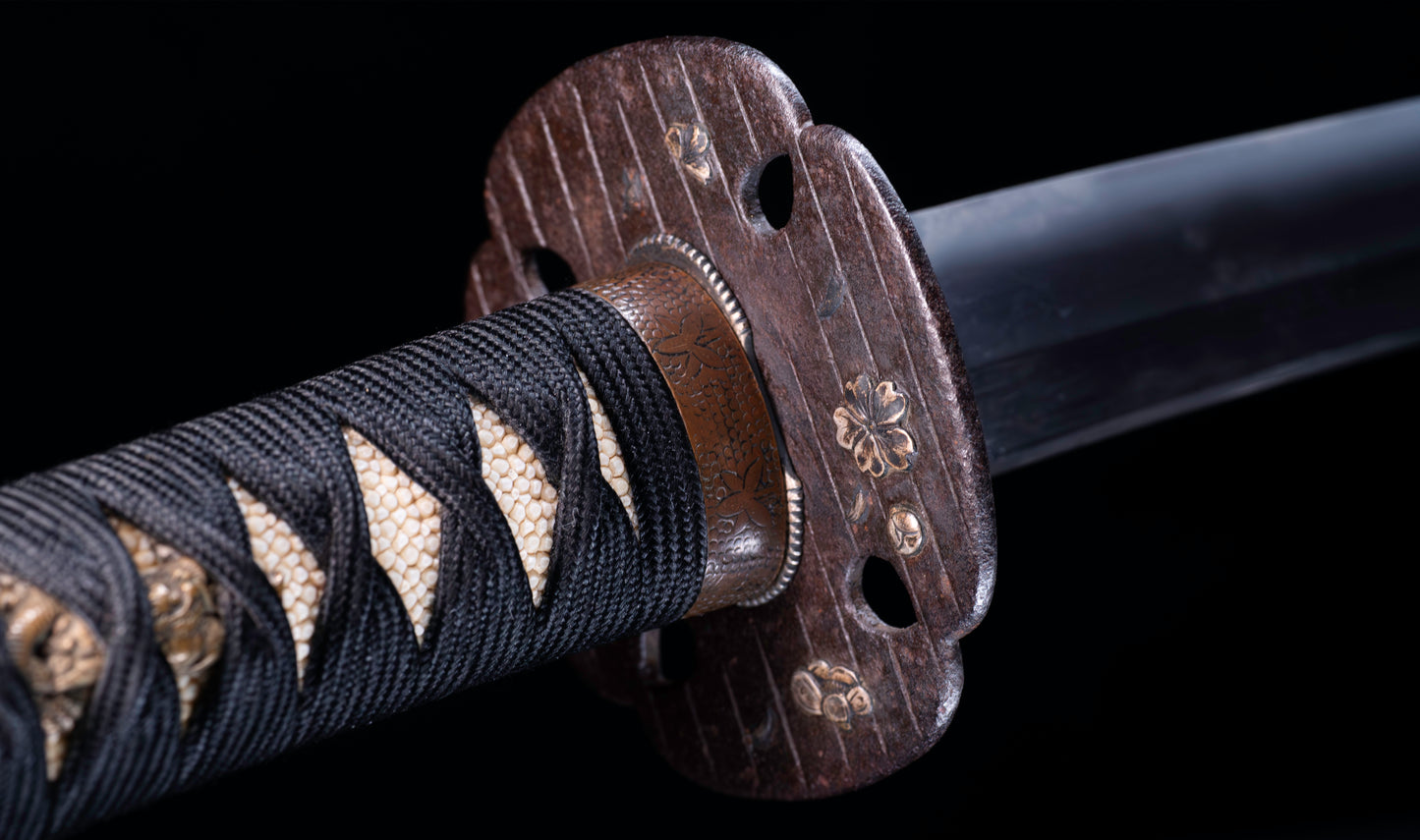
- Montaje: Koshirae urushi negro y herrumbre moteado con tsuba mokkō de hierro y decoración de flor de cerezo en plata
- Longitud de la hoja (Nagasa): aprox. 63,0 cm (2 shaku 0 sun 8 bu)
- Curvatura (Sori): aprox. 1,1 cm - curva Kanbun-Shintō poco profunda
- Mekugi-ana: 2 (suriage - acortada)
- Forma: Shinogi-zukuri con iori-mune y chū-kissaki
- Jihada: Ko-itame apretada y brillante - jigane Osaka clásica
- Hamon: Notare tendiendo a toran-midare, nioiguchi con ko-nie y ashi
Esta Katana es una hoja mumei (sin firmar), suriage (acortada) en el estilo inconfundible de la tradición Osaka Shintō. La describimos basándonos en la evidencia del acero en sí y no en una firma, porque la firma se perdió cuando una hoja más antigua y larga fue cortada desde la espiga. Lo que sobrevive es la artesanía, y se lee con claridad.
Lo primero que un ojo entrenado busca en una hoja Osaka es el acero, y esta lo ofrece: una jihada de ko-itame apretada y bien compactada, brillante y casi sin aberturas visibles—el refinado ō-saka-tetsu (acero Osaka) que construyó la reputación de la escuela. Contra ese terreno limpio, el hamon corre como un generoso notare que se dilata hacia toran-midare—la línea de temple ondulante y rodante popularizada por Tsuda Sukehiro y su círculo—envuelta en un suave nioiguchi con ko-nie y ashi que se extienden hacia el filo endurecido.
La sugata es un ejemplo de libro de Kanbun Shintō: shinogi-zukuri con iori-mune, un chū-kissaki controlado, y la sori poco profunda característica de los años 1660-70, cuando los herreros Osaka favoreían un perfil más recto y práctico. El boshi sigue el hamon hacia la punta con un retorno ordenado. En la mano, la hoja está sana y bien pulida, mostrando el filo endurecido brillante y escarchado que los coleccionistas asocian con esta escuela.
El nakago muestra dos mekugi-ana, el registro físico de su acortamiento. Esta es una hoja antigua honesta, valorada por lo que es claramente: acero y temple Osaka Shintō de calidad desde el corazón del período Shintō.
Detalles del Koshirae
La espada está montada en una hermosa y sobria koshirae negra con un elemento genuinamente distintivo. La saya se termina con un laca urushi moteada negro y herrumbre—una superficie variegada similar a la corteza donde el marrón rojizo cálido irrumpe en el fondo negro, dando a la vaina profundidad y movimiento real bajo la luz en lugar de un acabado plano. Está adornada con una sageo (kon-iro) azul marino.
El tsuba es una placa de hierro mokkō-gata (de cuatro lóbulos) trabajada con fina talla de líneas verticales en ambas caras y decorada con flores de cerezo (sakura) y botones de plata aplicados dispersos como si fluyeran—un contraste tranquilo y elegante de plata brillante contra hierro oscuro. El fuchi continúa el tema floral en metal suave patinable con flores grabadas y follaje resaltado en dorado, sobre un fondo finamente texturizado.
El habaki es un limpio collar de plata de una sola pieza cortado con líneas de lima diagonal (neko-gaki). El tsuka está envuelto en ito negro sobre same (piel de raya) blanca en el patrón de diamante hineri-maki tradicional, con menuki figurativo dorado colocado bajo el envoltorio. En conjunto, los accesorios están coordinados y de buen gusto—un montaje de samurái ensamblado con cuidado más que para ostentación.
Osaka Shintō: La Escuela del Acero Hermoso
Después de que Toyotomi Hideyoshi construyera el Castillo de Osaka, la ciudad se convirtió en el corazón comercial de Japón, y herreros acudieron en masa para trabajar para los comerciantes, samurái y señores feudales que pasaban por allí. De esa concentración de talento surgió Osaka Shintō—una tradición definida sobre todo por la belleza de su jigane. El acceso a material de alta calidad y agua en Osaka permitió que sus herreros forjaran un acero tan apretado y luminoso que es reconocible a simple vista, frecuentemente descrito simplemente como ō-saka-tetsu.
Los tres gigantes de la escuela—el Sanketsu—fueron Awataguchi Tadatsuna, Inoue Shinkai e Inoue Shinkai, Tsuda Sukehiro, el último de los cuales perfeccionó el exuberante toranba (hamon "onda ondulante") que influyó en toda la ciudad. Las hojas Osaka Shintō emparejan ese acero refinado con líneas de temple audaces y rítmicas—una estética valorada por los coleccionistas precisamente porque es tan difícil de imitar convincentemente.
Esta katana pertenece a ese mundo. Su jigane apretada y brillante y su hamon notare-toran influenciado por Sukehiro la sitúan firmemente dentro del idioma Osaka Shintō—una hoja auténtica de mediados del Edo que lleva los sellos distintivos que hicieron de estas espadas el estándar de oro de su era.


Contenido desplegable
Payment
You can pay by Bank card or Bank transfer. If you wish to use bank transfer please contact us using the form bellow with the name of the sword you are willing to buy.
Customs and Taxes
・Import duties, taxes and charges are not included in the item price or shipping charges. These charges are the buyer’s responsibility.
・Please check with your country’s customs office to determine what these additional costs will be prior to bidding/buying.
・These charges are normally collected by the delivering freight (shipping) company or when you pick the item up - do not confuse them for additional shipping charges.
Shipping and Return
- Swords are shipped from Tokyo, Japan. We manage all the procedures to export the sword.
- You can't return sword to Japan because procedures are too strict.
- We work with a shipping company that have experience with Nihonto so you don't have to worry.
- Please check the rules of your country before importing the sword. We do not take any responsibility, including (not limited to) refund, due to the above reasons.
- We can NOT cancel an order once, we already applied for the export authorization. As this document is made to customer name.
We have shipped authentic Japanese swords to the USA, UK, Canada, Mexico, Germany, France, Hong Kong, and Australia. If you don’t live in these countries and like to order, please contact us first before purchasing. We normally ship by EMS (Express Mail Service) provided by Japan Post.
If you live in the UK, please contact us BEFORE order.
Export Procedure (We manage it)
・All our swords are registered in the Agency for Cultural Affairs as artwork and The Board of Education(Cultural properties protection Committee); therefore each sword has the registration card, issued by the Board of Education.
・After receiving the full payment of the items,we return the registration card and get the permission from Ministry of Cultural Affairs to export the swords legally from Japan. It will take about 1 to 3 months for that step.
・After the receiving the permission, we will inform you by email and send the items immediately.
Contact form
What Our Collectors Say
Independent reviews from verified buyers on Trustpilot
Wonderful folks to buy from
“Large selection to choose from. The katana were signed with Hozon and the blades in a shirasaya. My two katana and Kozuka came packed in a solid wooden crate. Great friendly communication.”
Got a beautiful sword delivered to NYC
“Condition is just as pictured. Took a little while to get all the way to the states, but I was very happy with this seller and plan to purchase more from them.”
Order with confidence
“In the end I received what I ordered, well-packaged and in the condition specified.”
Un katana antique magnifique
“J'ai posé beaucoup de questions au support qui a su répondre et m'aider dans mon choix. La commande est arrivée avec le certificat dans un emballage robuste et en parfait état, il est vraiment magnifique !”