


Tokyo Nihonto
Katana japonesa antigua con guarda de hierro con incrustaciones de oro, atribuida a Chikuzen Nobukuni — NBTHK Hozon
Katana japonesa antigua con guarda de hierro con incrustaciones de oro, atribuida a Chikuzen Nobukuni — NBTHK Hozon
No se pudo cargar la disponibilidad de retiro
- Firma (Mei): Mumei (無銘) - sin firmar
- Atribución: Escuela Chikuzen Nobukuni (筑前信国), según kantei NBTHK
- Certificado: NBTHK Hozon Kanteishō No. 3037362 (Reiwa 7 / 2025)
- Tipo: Katana
- Período: Período Edo (Shintō)
- Montaje: Koshirae de urushi negro con tsuba de hierro incrustado en oro y herrajes con escudos familiares (mon)
- Longitud de la hoja (Nagasa): 69,4 cm (2 shaku 2 sun 8 bu kyō)
- Curvatura (Sori): 1,2 cm
- Mekugi-ana: 3 (2 reparados) - suriage
- Forma: Shinogi-zukuri con iori-mune y chū-kissaki
- Jihada: Ko-itame brillante y forjado apretadamente
- Hamon: Suguha-chō con notare suave, nioiguchi con ko-nie y ashi
- Boshi: Ko-maru
Esta Katana es obra de la escuela Chikuzen Nobukuni, atribuida por el NBTHK en una tasación Hozon actual (Reiwa 7 / 2025). La hoja es mumei y suriage - fue acortada en algún momento de su vida útil, y sus tres mekugi-ana (dos ahora reparados) registran esa historia. La firma original se perdió en el acortamiento, por lo que la atribución se basa en la lectura experta del NBTHK de la factura en lugar de en una firma superviviente. Esta es la base normal y respetada en la que se clasifican las hojas Edo acortadas.
La sugata es una shinogi-zukuri limpia con iori-mune, un chū-kissaki equilibrado, y un sori de 1,2 cm poco profundo y compuesto sobre una hoja de 69,4 cm - el perfil tranquilo e intencionado de una katana de la era Shintō. La hoja está sana y pulida brillantemente.
La jihada es un ko-itame forjado apretadamente, brillante y bien compactado - el acero disciplinado y refinado por el cual la línea Nobukuni es conocida. El hamon discurre como suguha-chō con un movimiento notare suave, trabajado en nioiguchi suave con fino ko-nie y ashi entrando en el temple; el boshi se devuelve en un elegante ko-maru. El resultado es una hoja tranquilamente clásica en la que el brillo del acero y la uniformidad del trabajo llevan el interés.
Detalles del Koshirae
La hoja está alojada en un koshirae negro coordinado. La saya tiene un acabado de barniz urushi negro brillante y va acompañada de un sageo azul oscuro y blanco. La tsuba es una placa de hierro redonda con un distinctive borde de cuerda trenzada (nawame) y zōgan (incrustación) en oro que describe motivos de plantas y hierba en la superficie, con una de las aberturas cortada en forma de flor - una pieza refinada y erudita de trabajo en hierro.
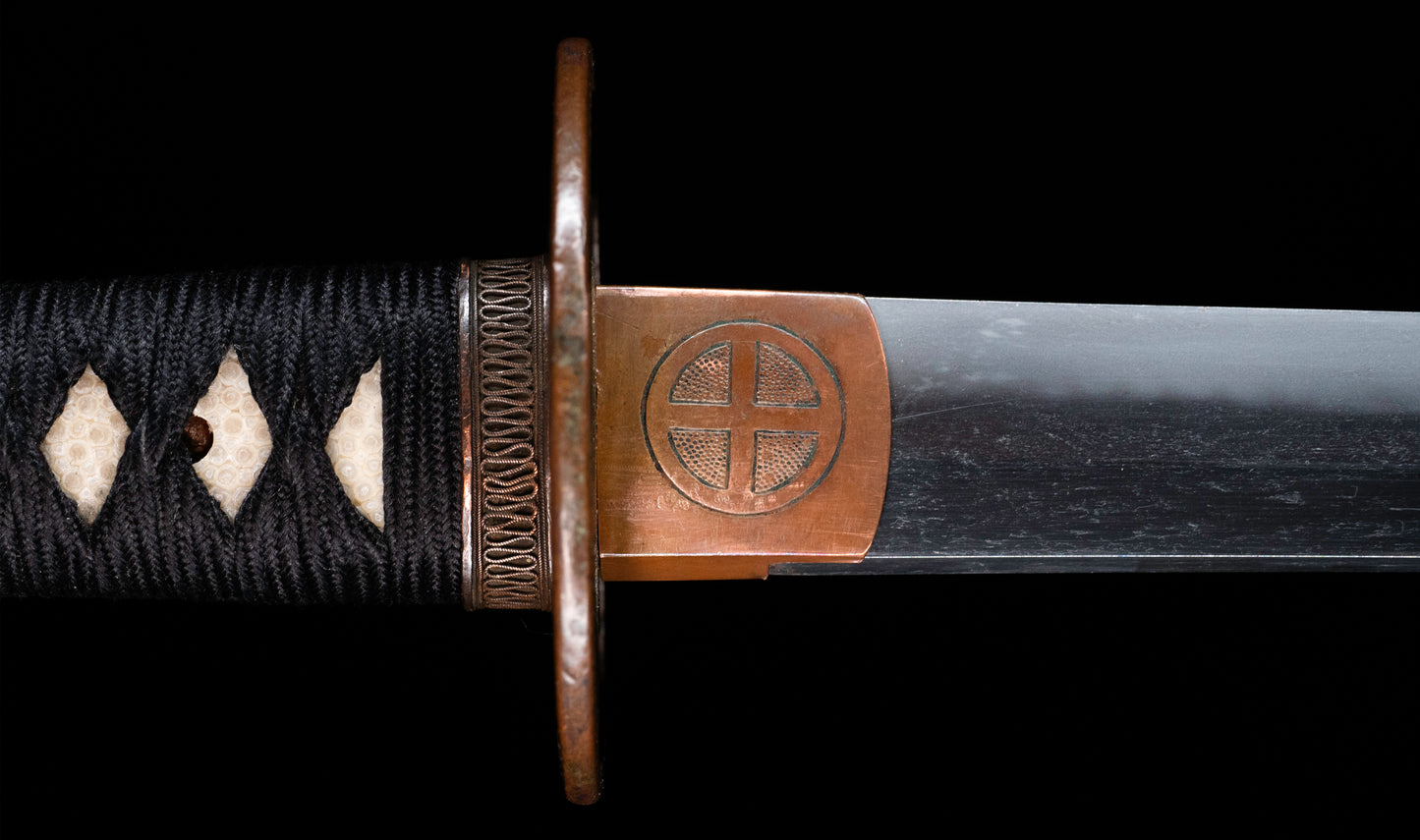
Los herrajes del grip son notables por sus kamon (escudos familiares). El fuchi y kashira llevan escudos en relieve - una cruz dentro de un anillo (la forma maru-ni-jūmonji, usada entre otros por los Shimazu de Satsuma) y un medallón floral - y los menuki dorados bajo el envoltorio son en sí mismos medallones de escudos de tres hojas. Escudos de este tipo indican que el montaje fue hecho para una familia de samuráis; los describimos como se observan y no hacemos ninguna afirmación documentada de propiedad por ningún clan específico.
La tsuka está envuelta en seda negra ito sobre same (piel de raya) blanco en el patrón de diamante tradicional hineri-maki, con un habaki dorado en la vaina de la hoja. El conjunto se presenta como un montaje de samurái distinguido y con escudos en buen estado.
La Escuela Chikuzen Nobukuni
El nombre Nobukuni es uno de los más antiguos y respetados en la historia de la espada japonesa. La línea comenzó en Kioto (provincia de Yamashiro) en el período Nanbokuchō, su fundador contado tradicionalmente como alumno del gran maestro Sōshū Sadamune; las hojas Nobukuni más antiguas muestran un carácter Sōshū-den fuerte.
En 1602 (Keichō 7), el herrador Nobukuni Yoshisada se trasladó a provincia de Chikuzen (actual Fukuoka, en Kyūshū) por invitación del daimyō Kuroda Nagamasa, señor del nuevo dominio de Fukuoka. A partir de ese momento la escuela sirvió al clan Kuroda como herradores retenidos (kakae-kaji), generación tras generación, a través del período Edo y hasta el Meiji temprano. Sus herradores - Yoshisada, Yoshimasa, Yoshitsugu, Yoshikane, Shigekane y sus sucesores - eran conocidos colectivamente como los "Tsukushi Nobukuni," uno de los grupos de fabricación de espadas más prósperos de todo Kyūshū. El miembro más célebre de la escuela, Shigekane, fue convocado a Edo para forjar para el octavo Shōgun Tokugawa Yoshimune y se le otorgó el honor de tallar el escudo de malva (aoi) en sus tangs.
La factura de la escuela mezcla la herencia clásica Yamashiro/Sōshū con los estilos robustos de Kyūshū de la edad Shintō: un ko-itame jigane brillante y bien forjado (a menudo con nagare fluido y fine ji-nie), y hamon que van desde suguha tranquilo a lively chōji- y gunome-midare. Una hoja atribuida a esta escuela es, en efecto, una pieza de esa larga y bien documentada tradición del dominio Kuroda.
Sobre Esta Atribución
Debido a que la hoja es mumei y suriage, su nombre proviene de kantei - el juicio entrenado de los tasadores del NBTHK - en lugar de una firma. El papel NBTHK Hozon fresco (2025) confirma tanto la autenticidad de la hoja como un nihonto auténtico antiguo como la atribución de escuela a Chikuzen Nobukuni. Para un coleccionista esto ofrece una katana Edo atribuida a escuela documentada en atractivos montajes con escudos, basado en el papel actual de la principal institución de tasación de Japón.


Contenido desplegable
Payment
You can pay by Bank card or Bank transfer. If you wish to use bank transfer please contact us using the form bellow with the name of the sword you are willing to buy.
Customs and Taxes
・Import duties, taxes and charges are not included in the item price or shipping charges. These charges are the buyer’s responsibility.
・Please check with your country’s customs office to determine what these additional costs will be prior to bidding/buying.
・These charges are normally collected by the delivering freight (shipping) company or when you pick the item up - do not confuse them for additional shipping charges.
Shipping and Return
- Swords are shipped from Tokyo, Japan. We manage all the procedures to export the sword.
- You can't return sword to Japan because procedures are too strict.
- We work with a shipping company that have experience with Nihonto so you don't have to worry.
- Please check the rules of your country before importing the sword. We do not take any responsibility, including (not limited to) refund, due to the above reasons.
- We can NOT cancel an order once, we already applied for the export authorization. As this document is made to customer name.
We have shipped authentic Japanese swords to the USA, UK, Canada, Mexico, Germany, France, Hong Kong, and Australia. If you don’t live in these countries and like to order, please contact us first before purchasing. We normally ship by EMS (Express Mail Service) provided by Japan Post.
If you live in the UK, please contact us BEFORE order.
Export Procedure (We manage it)
・All our swords are registered in the Agency for Cultural Affairs as artwork and The Board of Education(Cultural properties protection Committee); therefore each sword has the registration card, issued by the Board of Education.
・After receiving the full payment of the items,we return the registration card and get the permission from Ministry of Cultural Affairs to export the swords legally from Japan. It will take about 1 to 3 months for that step.
・After the receiving the permission, we will inform you by email and send the items immediately.
Contact form
What Our Collectors Say
Independent reviews from verified buyers on Trustpilot
Wonderful folks to buy from
“Large selection to choose from. The katana were signed with Hozon and the blades in a shirasaya. My two katana and Kozuka came packed in a solid wooden crate. Great friendly communication.”
Got a beautiful sword delivered to NYC
“Condition is just as pictured. Took a little while to get all the way to the states, but I was very happy with this seller and plan to purchase more from them.”
Order with confidence
“In the end I received what I ordered, well-packaged and in the condition specified.”
Un katana antique magnifique
“J'ai posé beaucoup de questions au support qui a su répondre et m'aider dans mon choix. La commande est arrivée avec le certificat dans un emballage robuste et en parfait état, il est vraiment magnifique !”