


Tokyo Nihonto
Katana japonaise antique signée Osafune Sukesada, fin de la période Muromachi - NBTHK Hozon
Katana japonaise antique signée Osafune Sukesada, fin de la période Muromachi - NBTHK Hozon
Impossible de charger la disponibilité du service de retrait
- Signature (Mei) : 備州長船祐定 Bishū Osafune Sukesada
- Maître forgeron : Sukesada (Osafune School)
- École / Tradition : Bizen Osafune School (Bizen-den tradition)
- Période / Province : Fin de la période Muromachi (fin des années 1400 - début des années 1500) / Province de Bizen
- Certificat : NBTHK Hozon (保存刀剣) - Lame digne de préservation
- Monture : koshirae de la période avec incrustations de mon familial (blason)
- Longueur de la lame (Nagasa) : 65,15 cm (2 shaku 1 sun 5 bu)
- Courbure (Sori) : 2,4 cm (8 bu) - courbe prononcée de la période Muromachi
- Mekugi-ana : 2
- Forme : Shinogi-zukuri avec courbure profonde de l'époque Sengoku
- Jihada : Classique Bizen Mokume-itame avec potentiel Utsuri
- Hamon : Notare avec éléments Gunome - style classique du Bizen de la mi-Muromachi avec Nie prominent
Ce katana historique est une œuvre certifiée NBTHK Hozon du légendaire Bishū Osafune Sukesada, l'une des lignées de forgerons les plus prolifiques et respectées de l'histoire de l'épée japonaise. Mesurant 65,15 cm avec un sori substantiel de 2,4 cm, cette lame exemplifie l'épée de champ de bataille typique de la fin de la période Muromachi, forgée pendant la tumultueuse période Sengoku quand les performances de coupe pratiques étaient primordiales. La courbure prononcée a été spécifiquement conçue pour le combat de cavalerie montée et les styles de combat dynamiques qui ont défini cette époque de guerres constantes.
La lame porte les caractéristiques incontournables du travail de Bizen Osafune, présentant l'approche signature de l'école en matière de forgeage de l'acier et de traitement thermique. Le hamon affiche un élégant motif notare (vague ondulante) avec des pics distinctifs en gunome (en forme de clou de girofle) - un style de trempe raffiné qui représente la maturité artistique du travail de Sukesada du mi-Muromachi. Le nie brillant et actif (structures martensite cristallines) dansant le long du habuchi (ligne de démarcation) démontre le contrôle au niveau du maître des techniques traditionnelles de trempe à l'eau de Bizen. Ce style de hamon équilibre la fonctionnalité du champ de bataille avec la sophistication esthétique, montrant que même pendant la production en temps de guerre, les forgerons Sukesada compétents ont maintenu leurs normes artistiques. La soie conserve les yasurime appropriés à la période (marques de lime) et le mei clairement gravé, authentifiés par l'organisation principale de préservation des épées du Japon.
Le boshi (motif de trempe sur la kissaki/pointe) montre un bon retournement avec une activité contrôlée, tandis que le hamon global affiche l'ondulation rythmique douce caractéristique du travail accompli de Sukesada de la mi-période. Les particules de nie visibles créent une apparence brillante et vivante le long de tout le tranchant - une caractéristique de la trempe différentielle traditionnelle japonaise correctement exécutée.
Cette épée représente un authentique morceau de l'histoire des samouraïs - une arme forgée pendant l'une des périodes les plus violentes et transformatrices du Japon, quand des maîtres forgerons comme Sukesada ont fourni d'innombrables lames aux clans en guerre qui ont façonné la destinée du Japon.
Détails du Koshirae
L'épée conserve son koshirae de la période (montures), montrant l'âge authentique et l'usage historique. La tsuba est un remarquable chef-d'œuvre en shakudō présentant une décoration intricate en karakusa (motifs d'arabesque en feuillage) avec des mises en évidence dorées sur un fond nanako-ji (pointillé). Le design ajouré sophistiqué et l'enrichissement en métaux précieux indiquent que celui-ci a été commandé pour un samouraï de statut considérable - pas l'arme d'un simple soldat.
Plus significativement, la saya (fourreau) présente un mon familial (blason) inrusté en ce qui semble être de la nacre ou un matériau similaire. Ce design triangulaire indique la propriété spécifique d'un clan ou d'une famille, transformant ceci d'une antiquité anonyme en une épée avec une généalogie samouraï traçable. La finition en laque urushi noire, tout en montrant l'usure et la patine appropriées à l'âge, conserve l'esthétique digne convenant à la station de son propriétaire original.
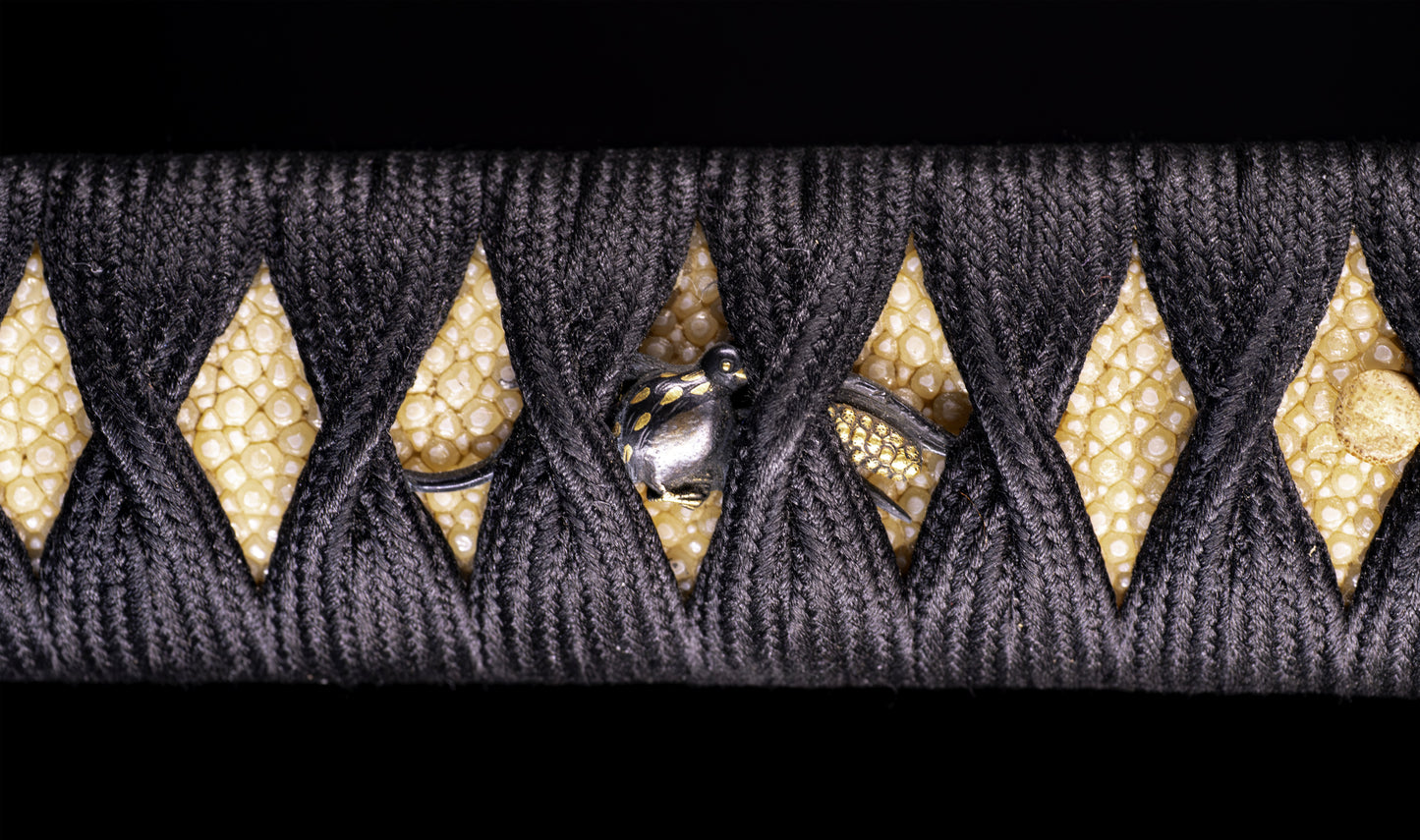
La tsuka (poignée) maintient son enroulement traditionnel en cuir noir dans le motif en losange classique hishimaki, avec les ornements menuki originaux toujours en place. La présentation générale témoigne de siècles de gérance minutieuse par des collectionneurs qui ont reconnu l'importance historique et artistique de cette épée.
Contexte du Maître Forgeron
Osafune Sukesada (長船祐定) représente l'une des lignées de forgerons les plus durables de l'histoire de l'épée japonaise, avec plusieurs générations portant ce nom de la période mi-Muromachi jusqu'à la fin des années 1500. Travaillant dans la Province de Bizen (Okayama Prefecture actuelle) - le cœur de la production d'épées japonaises - la lignée Sukesada a produit des milliers de lames pendant la demande sans précédent de la période Sengoku pour des armes de qualité.
Les forgerons Sukesada étaient connus pour maintenir la tradition Bizen classique même quand la guerre exigeait une production accrue. Leurs lames équilibraient la praticité du champ de bataille avec les sensibilités esthétiques raffinées qui avaient fait de Bizen la région de production d'épées de premier rang pendant des siècles. Bien que certains travaux Sukesada montrent une construction hâtive due à la demande en temps de guerre, beaucoup - comme cet exemple certifié Hozon - démontrent la technique magistrale qui a valu à ce nom une reconnaissance internationale.
Les lames Sukesada ont été portées par des samouraïs à travers le Japon pendant les batailles cruciales d'unification, ce qui en fait des liens tangibles aux événements dramatiques qui ont forgé le Japon moderne sous Oda Nobunaga, Toyotomi Hideyoshi et finalement Tokugawa Ieyasu.
Historique de l'École : Tradition Bizen Osafune
L'Osafune School dans la Province de Bizen s'est dressée comme le centre incontesté de la production d'épées japonaises pendant plus de 500 ans. De la période Kamakura à l'époque Muromachi, le village d'Osafune était le siège de centaines de forgerons qui ont fourni à la classe des samouraïs les meilleures lames du Japon. Des noms comme Nagamitsu, Kanemitsu, Kiyomitsu et Sukesada sont devenus synonymes d'excellence de coupe et d'artistry raffiné.
Le Bizen-den (tradition Bizen) le style de forgeage soulignait une approche distinctive du pliage de l'acier, produisant le motif de grain caractéristique mokume-itame et présentant souvent l'utsuri - un effet de réflexion mystérieux dans le ji qui reste l'une des réalisations les plus captivantes de la métallurgie japonaise. La méthode de trempe de l'école a créé des motifs de hamon dynamiques qui variaient de l'élégante ondulation notare à des gunome-midare plus actifs, toujours présentant le nie cristallin brillant qui est devenu synonyme d'excellence Bizen. Cette combinaison d'esthétique raffinée avec une géométrie de tranchant supérieure a fait des lames Bizen la norme d'or pour les épées japonaises.
À la période Sengoku, quand cette lame a été forgée, les forgerons Osafune travaillaient à pleine capacité pour répondre à la demande en temps de guerre. Malgré la production de milliers d'épées annuellement, les maîtres forgerons comme Sukesada ont maintenu les normes de qualité qui continuent à mériter la reconnaissance NBTHK cinq siècles plus tard. La tradition Osafune représente l'apogée de l'art du maître forgeron japonais - une synthèse parfaite de la science métallurgique, de la philosophie esthétique et de la conception d'armes pratiques.
Ce katana se dresse comme un authentique témoignage de cette légendaire tradition, certifié par des experts modernes et portant les caractéristiques incontournables qui ont fait des lames Bizen les armes les plus recherchées du Japon féodal.


Contenu réductible
Payment
You can pay by Bank card or Bank transfer. If you wish to use bank transfer please contact us using the form bellow with the name of the sword you are willing to buy.
Customs and Taxes
・Import duties, taxes and charges are not included in the item price or shipping charges. These charges are the buyer’s responsibility.
・Please check with your country’s customs office to determine what these additional costs will be prior to bidding/buying.
・These charges are normally collected by the delivering freight (shipping) company or when you pick the item up - do not confuse them for additional shipping charges.
Shipping and Return
- Swords are shipped from Tokyo, Japan. We manage all the procedures to export the sword.
- You can't return sword to Japan because procedures are too strict.
- We work with a shipping company that have experience with Nihonto so you don't have to worry.
- Please check the rules of your country before importing the sword. We do not take any responsibility, including (not limited to) refund, due to the above reasons.
- We can NOT cancel an order once, we already applied for the export authorization. As this document is made to customer name.
We have shipped authentic Japanese swords to the USA, UK, Canada, Mexico, Germany, France, Hong Kong, and Australia. If you don’t live in these countries and like to order, please contact us first before purchasing. We normally ship by EMS (Express Mail Service) provided by Japan Post.
If you live in the UK, please contact us BEFORE order.
Export Procedure (We manage it)
・All our swords are registered in the Agency for Cultural Affairs as artwork and The Board of Education(Cultural properties protection Committee); therefore each sword has the registration card, issued by the Board of Education.
・After receiving the full payment of the items,we return the registration card and get the permission from Ministry of Cultural Affairs to export the swords legally from Japan. It will take about 1 to 3 months for that step.
・After the receiving the permission, we will inform you by email and send the items immediately.
Contact form
What Our Collectors Say
Independent reviews from verified buyers on Trustpilot
Wonderful folks to buy from
“Large selection to choose from. The katana were signed with Hozon and the blades in a shirasaya. My two katana and Kozuka came packed in a solid wooden crate. Great friendly communication.”
Got a beautiful sword delivered to NYC
“Condition is just as pictured. Took a little while to get all the way to the states, but I was very happy with this seller and plan to purchase more from them.”
Order with confidence
“In the end I received what I ordered, well-packaged and in the condition specified.”
Un katana antique magnifique
“J'ai posé beaucoup de questions au support qui a su répondre et m'aider dans mon choix. La commande est arrivée avec le certificat dans un emballage robuste et en parfait état, il est vraiment magnifique !”