

Tokyo Nihonto
Katana japonais antique avec Koshirae laqué noir et Tsuba en fer à motif de plume signée Chikushi Tadamasa - Hozon
Katana japonais antique avec Koshirae laqué noir et Tsuba en fer à motif de plume signée Chikushi Tadamasa - Hozon
Impossible de charger la disponibilité du service de retrait
- Signature (Mei) : 筑紫忠正作 Chikushi Tadamasa saku
- Maître forgeron : Chikushi Tadamasa
- Classification : Gendaitō (現代刀) - nihonto traditionnel moderne, ère Shōwa
- Certificat : NBTHK Hozon Tōken (保存刀剣) n° 361035 - délivré février 2002 (Heisei 14)
- Montage : Koshirae complet en urushi noir avec tsuba en fer à motif de plume
- Longueur de lame (Nagasa) : 62,7 cm (2 shaku 0 sun 6 bu 5 rin)
- Courbure (Sori) : 1,3 cm - torii-zori élégant et mesuré
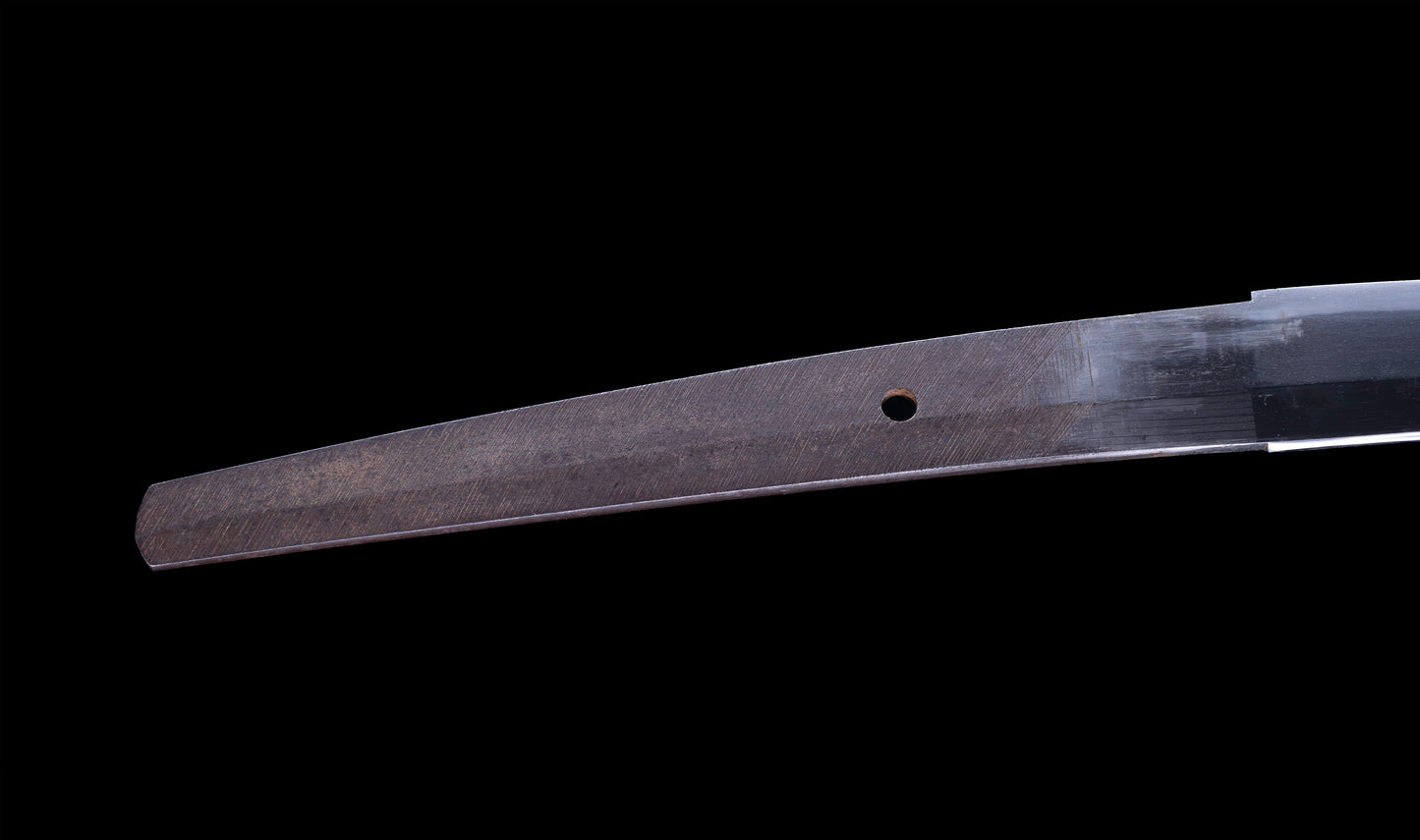
- Mekugi-ana : 1 (ubu - original, nakago inaltéré)
- Forme : Shinogi-zukuri avec iori-mune et chū-kissaki
- Jihada : Ko-itame serré et bien forgé
- Hamon : Notare avec gunome, nioiguchi brillant, ko-nie et ashi prononcé
Ce Katana est un gendaitō signé et certifié NBTHK Hozon portant le mei 筑紫忠正作 (Chikushi Tadamasa saku) et daté par le NBTHK à l'ère Shōwa. Mesurant 62,7 cm avec un sori contrôlé de 1,3 cm, c'est une épée japonaise entièrement traditionnelle forgée à partir de tamahagane selon les méthodes classiques—ni une lame d'arsenal de guerre ni une réplique. Pour qu'une œuvre du XXe siècle soit acceptée par l'examen NBTHK shinsa et reçoive les papiers Hozon, les évaluateurs doivent confirmer à la fois que la signature est authentique et que la lame a été forgée par des méthodes traditionnelles véritables. Cette distinction est précisément ce qui sépare un vrai nihonto des showatō trempés à l'huile qui inondent le marché moderne.
La lame est saine et bien formée, présentée en shinogi-zukuri avec iori-mune et un chū-kissaki équilibré. Le jihada est un ko-itame dense et fortement forgé, propre et bien maîtrisé sur le ji—le type de grain discipliné qu'un maître Shōwa correctement formé obtenait par des pliages patients. Sur ce fond, le hamon s'étend en notare fluide avec des ondulations de gunome, marqué par un nioiguchi brillant avec une couverture de fine ko-nie.
Ce qui donne à cette lame son caractère lors d'une inspection minutieuse, c'est l'activité à l'intérieur du fil durci : le ashi prononcé descend vers le fil de coupe en lignes diagonales claires, brisant le hamon en compartiments vivants et rythmés. C'est un travail destiné à être étudié en main et sous une lumière appropriée. Le boshi revient en un ko-maru bien rangé, avec le hamon porté proprement jusqu'à la pointe.
Le nakago est ubu (original et non raccourci), conservant son unique mekugi-ana et le sashimei clairement gravé du maître forgeron. Un fourreau intact sur une lame signée est l'état de conservation idéal—rien n'a été altéré, la signature se tient exactement comme le maître l'a laissée, et le NBTHK l'a confirmé.
Détails du Koshirae
L'épée est montée dans un koshirae noir complet conçu pour l'élégance discrète plutôt que l'exposition. La saya est finie avec un vernis urushi noir profond et brillant—lisse et sans ornement, laissant la forme du montage parler d'elle-même—et est agrémentée d'un sageo noir et blanc tacheté.
Le tsuba est le détail remarquable : une garde tetsu (fer) robuste en forme mokkō-gata (quatre lobes), sa plaque montrant une texture d'acier forgé honnête. Sur les deux faces, elle est décorée de plumes disséminées en zōgan (incrustation) de métal tendre, chacune détaillée avec un fin kebori gravure en cheveux pour rendre la plume et les barbes. La plume—et le flet de flèche qu'elle évoque—est un motif classique des samouraïs, lu comme un emblème de résolution et de visée. Deux hitsu-ana flanquent le nakago-ana central pour kozuka et kōgai.
La tsuka est enveloppée de ito noir sur same (peau de raie) blanc selon le motif diamant traditionnel hineri-maki, les nodules blancs de la samegawa se montrant clairement à travers le treillis. Sous l'enveloppe se trouvent de fins menuki coulés en métal patiné foncé, travaillés en relief figuratif détaillé. La présentation générale est retenue et confiante—une esthétique de samouraï fonctionnel plutôt que décoratif.
Contexte du Maître Forgeron
Cette lame est signée 筑紫忠正作 (Chikushi Tadamasa saku)—« forgée par Chikushi Tadamasa ». Le NBTHK a examiné l'œuvre, confirmé la signature, et daté la lame à la période Shōwa, l'ère de la fabrication traditionnelle d'épées moderne qui a commencé une fois la forge sous licence reprise au Japon de l'après-guerre.
Le nom artistique Chikushi (également lu Tsukushi) est le nom classique des terres du nord de Kyushu—les anciennes provinces de Chikuzen et Chikugo, dans la présente Fukuoka—une région ayant une longue tradition de fabrication d'épées. La lame elle-même reflète une formation solide et orthodoxe : un jihada ko-itame propre et un hamon notare-gunome maîtrisé avec nioiguchi brillant et ashi actif, exécuté avec la discipline attendue d'un maître Shōwa correctement autorisé travaillant en tamahagane.
Plutôt que d'attacher une provenance romantisée à cette pièce, nous laissons les preuves parler : une lame signée, un fourreau ubu, un travail traditionnel authentique, et les papiers NBTHK Hozon confirmant tout cela. C'est une fondation plus honnête pour un collectionneur qu'une histoire inventée.
Gendaitō : Épées Modernes dans la Tradition Traditionnelle
Un gendaitō (現代刀, « épée moderne ») est une lame japonaise forgée à partir de 1876 selon des méthodes traditionnelles—acier tamahagane, plié et forgé à la main, durci différentiellement avec un revêtement d'argile et trempage à l'eau. La catégorie est fréquemment mal comprise : un gendaitō est un vrai nihonto en tous les sens techniques, distinct des showatō produits en masse par machine et trempés à l'huile lors des armements de guerre, et à des mondes de distance des répliques coulées ou en acier inoxydable vendues comme décoration.
La ligne de démarcation est précisément ce que la certification NBTHK établit. Lorsque le NBTHK décerne le statut Hozon Tōken (« digne de conservation ») à une lame moderne, il certifie que l'épée a été forgée à la main selon les méthodes traditionnelles et que sa signature est authentique. Pour un acheteur, ce papier élimine le plus grand risque du marché des épées modernes : payer le prix du nihonto pour quelque chose qui n'a jamais été forgé de manière traditionnelle.
Ce katana se situe fermement du bon côté de cette ligne—une œuvre Shōwa signée et certifiée Hozon dans un honnête koshirae noir, préservant toute la discipline de l'art du maître forgeron japonais dans l'ère moderne.


Contenu réductible
Payment
You can pay by Bank card or Bank transfer. If you wish to use bank transfer please contact us using the form bellow with the name of the sword you are willing to buy.
Customs and Taxes
・Import duties, taxes and charges are not included in the item price or shipping charges. These charges are the buyer’s responsibility.
・Please check with your country’s customs office to determine what these additional costs will be prior to bidding/buying.
・These charges are normally collected by the delivering freight (shipping) company or when you pick the item up - do not confuse them for additional shipping charges.
Shipping and Return
- Swords are shipped from Tokyo, Japan. We manage all the procedures to export the sword.
- You can't return sword to Japan because procedures are too strict.
- We work with a shipping company that have experience with Nihonto so you don't have to worry.
- Please check the rules of your country before importing the sword. We do not take any responsibility, including (not limited to) refund, due to the above reasons.
- We can NOT cancel an order once, we already applied for the export authorization. As this document is made to customer name.
We have shipped authentic Japanese swords to the USA, UK, Canada, Mexico, Germany, France, Hong Kong, and Australia. If you don’t live in these countries and like to order, please contact us first before purchasing. We normally ship by EMS (Express Mail Service) provided by Japan Post.
If you live in the UK, please contact us BEFORE order.
Export Procedure (We manage it)
・All our swords are registered in the Agency for Cultural Affairs as artwork and The Board of Education(Cultural properties protection Committee); therefore each sword has the registration card, issued by the Board of Education.
・After receiving the full payment of the items,we return the registration card and get the permission from Ministry of Cultural Affairs to export the swords legally from Japan. It will take about 1 to 3 months for that step.
・After the receiving the permission, we will inform you by email and send the items immediately.
Contact form
What Our Collectors Say
Independent reviews from verified buyers on Trustpilot
Wonderful folks to buy from
“Large selection to choose from. The katana were signed with Hozon and the blades in a shirasaya. My two katana and Kozuka came packed in a solid wooden crate. Great friendly communication.”
Got a beautiful sword delivered to NYC
“Condition is just as pictured. Took a little while to get all the way to the states, but I was very happy with this seller and plan to purchase more from them.”
Order with confidence
“In the end I received what I ordered, well-packaged and in the condition specified.”
Un katana antique magnifique
“J'ai posé beaucoup de questions au support qui a su répondre et m'aider dans mon choix. La commande est arrivée avec le certificat dans un emballage robuste et en parfait état, il est vraiment magnifique !”