


Tokyo Nihonto
Katana Japonaise Antique avec Hamon Toran et Tsuba en Fer Sakura — Osaka Shintō
Katana Japonaise Antique avec Hamon Toran et Tsuba en Fer Sakura — Osaka Shintō
Impossible de charger la disponibilité du service de retrait
- Signature (Mei): Mumei (無銘) - non signé
- Tradition: Travail Osaka Shintō
- Période: Période Edo, ère Kanbun (milieu du XVIIe siècle)
- Montage: Koshirae urushi moucheté noir et rouille avec tsuba mokkō en fer et décoration de fleur de cerisier en argent
- Longueur de lame (Nagasa): env. 63,0 cm (2 shaku 0 sun 8 bu)
- Courbure (Sori): env. 1,1 cm - courbe Kanbun-Shintō peu profonde
- Mekugi-ana: 2 (suriage - raccourcie)
- Forme: Shinogi-zukuri avec iori-mune et chū-kissaki
- Jihada: Ko-itame serré et brillant - jigane Osaka classique
- Hamon: Notare tendant à toran-midare, nioiguchi avec ko-nie et ashi
Cette Katana est une lame mumei (non signée), suriage (raccourcie) dans le style inimitable de la tradition Osaka Shintō. Nous la décrivons sur la base de l'acier lui-même plutôt que d'une signature—car la signature a été perdue quand une lame plus ancienne et plus longue a été raccourcie au niveau de la soie. Ce qui subsiste est le travail, et il se lit clairement.
La première chose qu'un œil exercé recherche dans une lame Osaka est l'acier, et celle-ci le livre : un jihada de ko-itame serré et bien compacté, brillant et presque sans ouvertures visibles—l'ō-saka-tetsu (acier Osaka) raffiné qui fit la réputation de l'école. Sur ce fond pur, le hamon court comme un généreux notare gonflant vers toran-midare—la ligne de trempe ondulante et onduleuse popularisée par Tsuda Sukehiro et son cercle—placée dans un nioiguchi doux avec ko-nie et ashi s'étendant jusqu'à l'arête durcie.
Le sugata est un manuel Kanbun Shintō : shinoji-zukuri avec iori-mune, un chū-kissaki contrôlé, et le sori peu profond caractéristique des années 1660-70, quand les forgerons Osaka favorisaient un profil plus droit et pratique. Le boshi suit le hamon jusqu'à la pointe avec un retournement soigné. En main, la lame est en bon état et bien polie, montrant l'arête durcie brillante et givrée que les collectionneurs associent à cette école.
Le nakago montre deux mekugi-ana, le document physique de son raccourcissement. C'est une lame antique honnête, appréciée pour ce qu'elle est clairement : une lame et un trempe Osaka Shintō de qualité du cœur de la période Shintō.
Détails du Koshirae
L'épée est montée dans un beau koshirae noir sobre avec un élément véritablement distinctif. Le saya est fini en laque urushi moucheté noir et rouille—une surface variée ressemblant à l'écorce où le brun rougeâtre chaud transparaît sur le fond noir, donnant au fourreau une vraie profondeur et du mouvement sous la lumière plutôt qu'une finition plate. Il est orné d'un sageo bleu marine (kon-iro).
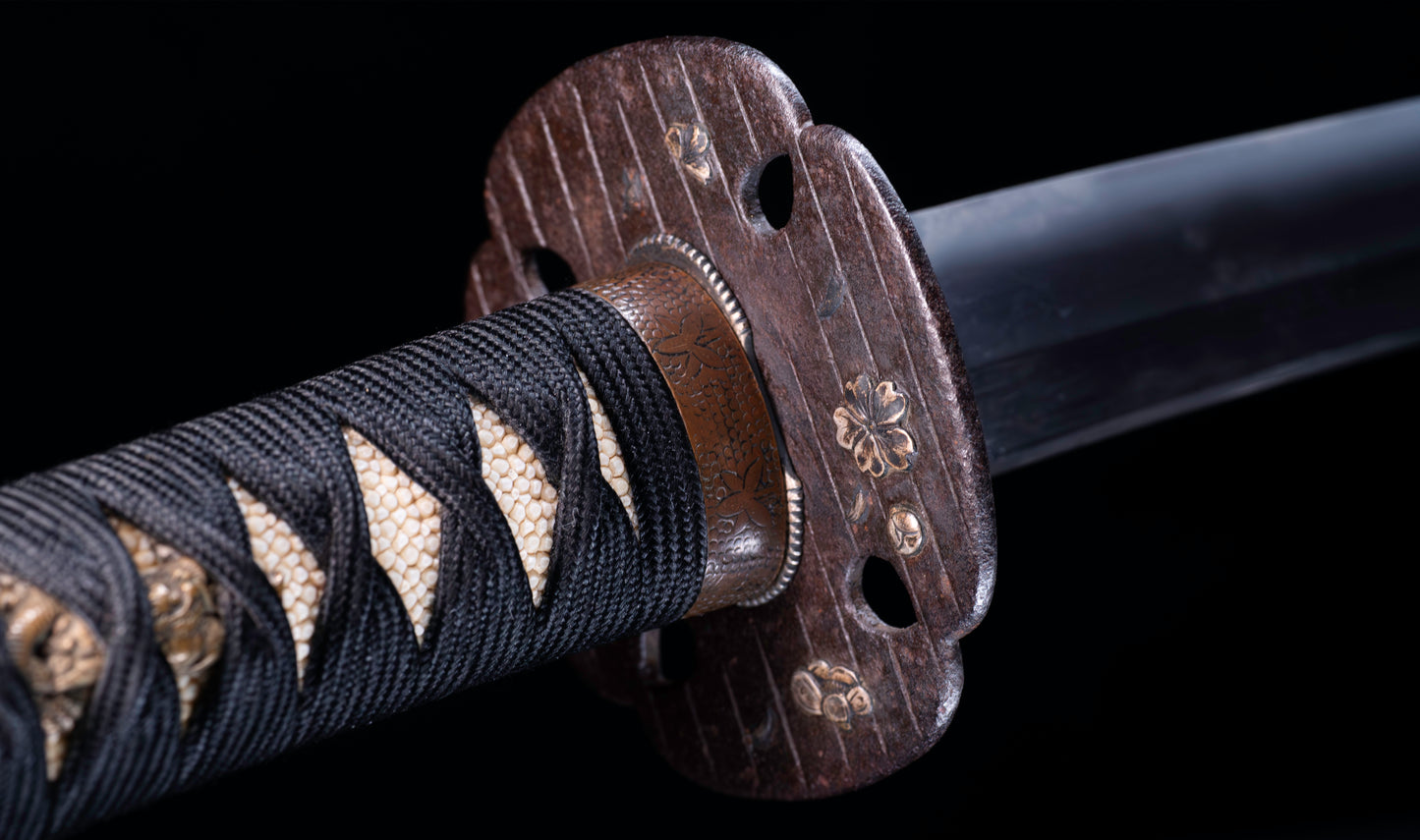
La tsuba est une plaque en fer mokkō-gata (quatre lobes) travaillée avec un fin ciselage de lignes verticales sur les deux faces et décorée de fleurs de cerisier en argent appliquées (sakura) et de bourgeons dispersés comme à la dérive—un contraste discret et élégant de l'argent brillant contre le fer sombre. La fuchi poursuit le thème floral en métal doux patiné avec fleurs et feuillages gravés rehaussés de dorure, sur un fond finement texturé.
Le habaki est un collier argent simple d'une seule pièce coupé avec des lignes de lime diagonales (neko-gaki). La tsuka est enveloppée de ito noir sur blanc same (peau de raie) dans le motif de diamant hineri-maki traditionnel, avec des menuki figuratifs dorés placés sous l'enveloppe. Pris ensemble, les garnitures sont coordonnées et de bon goût—un montage de samouraï assemblé avec soin plutôt que pour l'apparence.
Osaka Shintō : L'École du Bel Acier
Après que Toyotomi Hideyoshi ait construit le château d'Osaka, la ville s'est transformée en cœur commercial du Japon, et les forgerons d'épées s'y sont précipités pour travailler pour les marchands, les samouraïs et les seigneurs féodaux qui y passaient. De cette concentration de talent est née Osaka Shintō—une tradition définie avant tout par la beauté de son jigane. L'accès au matériel de haute qualité et à l'eau à Osaka a permis à ses forgerons de forger un acier si serré et lumineux qu'il est reconnaissable à première vue, souvent décrit simplement comme ō-saka-tetsu.
Les trois géants de l'école—la Sanketsu—étaient Awataguchi Tadatsuna, Inoue Shinkai et Tsuda Sukehiro, ce dernier ayant perfectionné le toranba ("vague-ondulante") hamon flamboyant qui a influencé toute la ville. Les lames Osaka Shintō associent cet acier raffiné à des lignes de trempe audacieuses et rythmées—une esthétique prisée par les collectionneurs précisément parce qu'elle est si difficile à imiter de manière convaincante.
Cette katana appartient à ce monde. Son jigane serré et brillant et son hamon notare-toran influencé par Sukehiro la placent fermement dans l'idiome Osaka Shintō—une authentique lame du milieu de l'Edo portant les caractéristiques qui ont fait de ces épées l'étalon-or de leur époque.


Contenu réductible
Payment
You can pay by Bank card or Bank transfer. If you wish to use bank transfer please contact us using the form bellow with the name of the sword you are willing to buy.
Customs and Taxes
・Import duties, taxes and charges are not included in the item price or shipping charges. These charges are the buyer’s responsibility.
・Please check with your country’s customs office to determine what these additional costs will be prior to bidding/buying.
・These charges are normally collected by the delivering freight (shipping) company or when you pick the item up - do not confuse them for additional shipping charges.
Shipping and Return
- Swords are shipped from Tokyo, Japan. We manage all the procedures to export the sword.
- You can't return sword to Japan because procedures are too strict.
- We work with a shipping company that have experience with Nihonto so you don't have to worry.
- Please check the rules of your country before importing the sword. We do not take any responsibility, including (not limited to) refund, due to the above reasons.
- We can NOT cancel an order once, we already applied for the export authorization. As this document is made to customer name.
We have shipped authentic Japanese swords to the USA, UK, Canada, Mexico, Germany, France, Hong Kong, and Australia. If you don’t live in these countries and like to order, please contact us first before purchasing. We normally ship by EMS (Express Mail Service) provided by Japan Post.
If you live in the UK, please contact us BEFORE order.
Export Procedure (We manage it)
・All our swords are registered in the Agency for Cultural Affairs as artwork and The Board of Education(Cultural properties protection Committee); therefore each sword has the registration card, issued by the Board of Education.
・After receiving the full payment of the items,we return the registration card and get the permission from Ministry of Cultural Affairs to export the swords legally from Japan. It will take about 1 to 3 months for that step.
・After the receiving the permission, we will inform you by email and send the items immediately.
Contact form
What Our Collectors Say
Independent reviews from verified buyers on Trustpilot
Wonderful folks to buy from
“Large selection to choose from. The katana were signed with Hozon and the blades in a shirasaya. My two katana and Kozuka came packed in a solid wooden crate. Great friendly communication.”
Got a beautiful sword delivered to NYC
“Condition is just as pictured. Took a little while to get all the way to the states, but I was very happy with this seller and plan to purchase more from them.”
Order with confidence
“In the end I received what I ordered, well-packaged and in the condition specified.”
Un katana antique magnifique
“J'ai posé beaucoup de questions au support qui a su répondre et m'aider dans mon choix. La commande est arrivée avec le certificat dans un emballage robuste et en parfait état, il est vraiment magnifique !”