


Tokyo Nihonto
Antique Japanese Katana Sword with Regular Gunome Hamon, Higo Iron Fittings and Black Leather Tsukamaki
Antique Japanese Katana Sword with Regular Gunome Hamon, Higo Iron Fittings and Black Leather Tsukamaki
Insured worldwide shipping from Tokyo
Impossible de charger la disponibilité du service de retrait
- Signature (Mei): Mumei, unsigned
- Nakago: Unshortened, tapering naturally to a ha-agari kuri-jiri, thick reddish-brown patina, a single mekugi-ana
- Swordsmith: Unknown. The blade carries no shinsa paper
- School / Tradition: Not attributed
- Period: Late Edo, the shinshinto era of the late eighteenth and nineteenth centuries
- Registration: Japanese torokusho Kanagawa no. 51646, issued 19 January 1972
- Certificate: None supplied with the sword
- Mounting: Complete katana koshirae in Higo taste, iron fuchi-kashira and kojiri with silver inlay, black leather tsukamaki
- Blade Length (Nagasa): 74.4 cm
- Curvature (Sori): 1.4 cm
- Mekugi-ana: 1
- Shape (Sugata): Shinogi-zukuri, iori-mune, chu-kissaki, shallow torii-zori
- Jihada: Tight itame mixed with mokume, compact and well knit
- Hamon: Gunome-midare, strikingly regular and repeating, moderate width, nioi-deki with a tight controlled nioiguchi
- Boshi: Midare-komi, the gunome carrying into the point and turning in a ko-maru, healthy
- Habaki: Single-piece copper, filed in neko-gaki cat-scratch style
- Polish: Good. No hagire, fukure, ware or significant kizu
At 74.4 cm this is a long katana, six or seven centimetres longer than the Edo-period norm, and it still has its original tang: unshortened, tapering naturally to a ha-agari kuri-jiri, pierced by a single mekugi-ana. It is registered in Japan under torokusho Kanagawa no. 51646 of 19 January 1972 and dated to the late Edo period.
A blade this long, made this late, is not an accident of taste. It is a statement, and to read it you have to know what had happened to Japanese swords by the time it was forged.
For most of the Edo period swords had been getting shorter, straighter and more decorative, because nobody was fighting with them. Then, in the last decades of the eighteenth century, a smith named Suishinshi Masahide published an argument that the craft had gone soft: that smiths had learned to make blades that looked magnificent and would fail under a real blow, and that the only cure was to go back to the forging methods of the fourteenth century. He trained a generation on that principle. The swords they produced are called shinshinto, new-new swords, and they are long, broad, heavy in the hand and built to be used.
They were also built just in time. The men buying them in the 1850s and 1860s were living through the collapse of the Tokugawa order, in a decade when political argument in Kyoto was genuinely settled with steel. A seventy-four centimetre blade worn in that climate was a working expectation, not an ornament.
The temper is the other half of the story. It is a gunome-midare of almost mechanical regularity, the same rounded head repeating at an even interval down the whole length of the blade, moderate in width, in nioi-deki with a tight, controlled nioiguchi. That disciplined repeating gunome is the Mino manner, and reviving the old provincial traditions is exactly what shinshinto smiths set out to do. Underneath it the forging is a tight itame mixed with mokume, compact and well knit. The hamon carries into the point as midare-komi and turns back in a ko-maru, with the hardened edge in the kissaki still healthy. The blade is unsigned and has no paper, so no smith or school is attributed to it.
The condition is better than on most antique blades. The polish is good, the steel does not look tired, no core steel is showing, and there is no hagire, fukure, ware or meaningful kizu. This sword does not need work before it can be appreciated, and it could go to shinsa exactly as it stands.
This is the most coherent mounting of the group, and the taste running through it is unmistakably Higo: iron rather than soft metal, restraint rather than display, and a set of fittings that were clearly chosen to live together.
The fuchi, kashira and kojiri are all iron, inlaid in silver and gold nunome-zogan with stylised cursive characters, and they match as a suite. The kashira is the rounded hornless type. The kojiri carries scrolling tendrils in silver overlay in the same hand as the rest.
The tsuba is iron with a dark mature patina, carved in takabori and highlighted in gold nunome-zogan with a sansui landscape: mountains, pines, a bridge, a dwelling, birds in the sky. The kozuka-hitsu-ana is plugged with dark metal, the kogai-hitsu-ana is open, and copper sekigane sit at both ends of the nakago-ana. Unsigned.
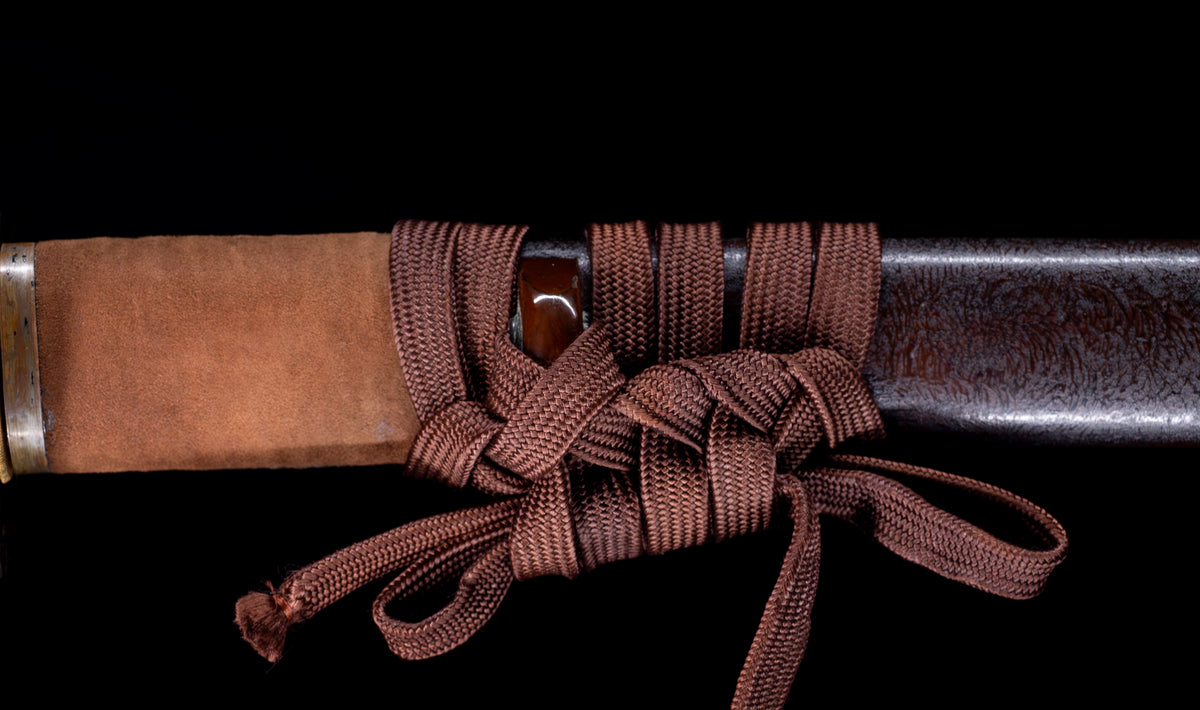
The tsuka is wrapped in black leather rather than silk, over samegawa stained a deep tea brown, in hineri-maki. Leather was the practical man's choice: it grips when wet and it does not fray. It is intact and tight, but genuinely old, dry in places and finely cracked at the surface, . The menuki under the wrap are dark alloy with traces of gilding, and what shows through the openings is a coiled scaled body.
The saya is lacquered in a dark brown-black ishime texture, in good condition, and its upper section carries a brown suede sleeve, the protective cover a sword wears in daily use. The habaki is solid copper with deep diagonal neko-gaki filing and a natural dark patina. The seppa are a copper-alloy pair with coin-edge filing and have taken on verdigris.
The iron fittings, the tsuba, the leather wrap and the habaki are all genuine period work. The suede sleeve and the brown sageo are later additions meant to protect and complete the mounting.
The blade is unsigned, so there is no smith to name. What it does carry is a date and a set of intentions, and both are legible.
A shinshinto smith was, by definition, someone working against the fashion of his own century. The argument Masahide made and his students inherited was that the Japanese sword had reached its peak four hundred years earlier and had been declining ever since, and that the job of a modern smith was not to invent but to recover. So they studied Kamakura and Nanbokucho blades, copied Mino and Bizen tempers, rebuilt their forging around what they believed the old masters had done, and made swords that were longer and heavier than anything their customers' fathers had carried.
The result divides collectors to this day. The blades are superbly healthy, because they are only one or two centuries old and have rarely been polished thin. They are powerful in the hand. What some connoisseurs hold against them is precisely their competence: a revival is a revival, and the hataraki in a shinshinto temper can be more controlled and less surprising than in the blades it is imitating. This sword shows both sides of that argument. Its gunome is beautifully even, and its evenness is the point.
For a buyer, the practical consequence is the good one. This is an antique Japanese sword in sound polish with a healthy boshi, plenty of steel left in it, and no restoration required, which is not true of most unpapered blades. It can go to the NBTHK as it stands.
The Higo style of sword furniture comes out of Kumamoto in Kyushu, and it is the most quietly disciplined of the major traditions. Where Kyoto makers reached for shakudo, gold and nanako grounds, Higo workers used iron, inlaid it sparingly with silver or gold wire, favoured rounded hornless kashira, and preferred leather to silk on the handle. The result reads as equipment rather than jewellery.
That aesthetic was cultivated under the Hosokawa lords, whose household had a deep tea-ceremony culture, and the values are the ones tea taught: restraint, natural material, nothing added that does not earn its place. A Higo mounting was meant to be handled.
It is also the right dress for this blade. A long shinshinto sword in black leather and plain iron is what a serious man carried in the final years of the shogunate, when swords had stopped being costume again. Everything on this mounting is chosen for grip, for durability and for silence, and the suede sleeve over the scabbard exists for one reason: to protect a sword that was being carried, not displayed.
What is offered here is a long antique Japanese katana of the late Edo period in good polish, with an untouched tang and a bold, highly regular gunome temper, registered in Japan since 1972, dressed in a coherent set of period iron fittings in the Higo manner. It carries no attribution, and it is ready for shinsa exactly as it stands.


Contenu réductible
Payment
You can pay by Bank card or Bank transfer. If you wish to use bank transfer please contact us using the form bellow with the name of the sword you are willing to buy.
Customs and Taxes
・Import duties, taxes and charges are not included in the item price or shipping charges. These charges are the buyer’s responsibility.
・Please check with your country’s customs office to determine what these additional costs will be prior to bidding/buying.
・These charges are normally collected by the delivering freight (shipping) company or when you pick the item up - do not confuse them for additional shipping charges.
Shipping and Return
- Swords are shipped from Tokyo, Japan. We manage all the procedures to export the sword.
- You can't return sword to Japan because procedures are too strict.
- We work with a shipping company that have experience with Nihonto so you don't have to worry.
- Please check the rules of your country before importing the sword. We do not take any responsibility, including (not limited to) refund, due to the above reasons.
- We can NOT cancel an order once, we already applied for the export authorization. As this document is made to customer name.
We have shipped authentic Japanese swords to the USA, UK, Canada, Mexico, Germany, France, Hong Kong, and Australia. If you don’t live in these countries and like to order, please contact us first before purchasing. We normally ship by EMS (Express Mail Service) provided by Japan Post.
If you live in the UK, please contact us BEFORE order.
Export Procedure (We manage it)
・All our swords are registered in the Agency for Cultural Affairs as artwork and The Board of Education(Cultural properties protection Committee); therefore each sword has the registration card, issued by the Board of Education.
・After receiving the full payment of the items,we return the registration card and get the permission from Ministry of Cultural Affairs to export the swords legally from Japan. It will take about 1 to 3 months for that step.
・After the receiving the permission, we will inform you by email and send the items immediately.
Contact form
What Our Collectors Say
Independent reviews from verified buyers on Trustpilot
Wonderful folks to buy from
“Large selection to choose from. The katana were signed with Hozon and the blades in a shirasaya. My two katana and Kozuka came packed in a solid wooden crate. Great friendly communication.”
Got a beautiful sword delivered to NYC
“Condition is just as pictured. Took a little while to get all the way to the states, but I was very happy with this seller and plan to purchase more from them.”
Order with confidence
“In the end I received what I ordered, well-packaged and in the condition specified.”
Un katana antique magnifique
“J'ai posé beaucoup de questions au support qui a su répondre et m'aider dans mon choix. La commande est arrivée avec le certificat dans un emballage robuste et en parfait état, il est vraiment magnifique !”